
Life purpose becomes increasingly relevant as business leaders progress beyond early growth stages. While initial focus is often on revenue, expansion, and operational success, many leaders eventually begin to question long-term direction and personal alignment.
Many SME owners first work with a business consultant in Ireland to stabilise and grow their business. However, over time, the focus often shifts from external success to internal clarity.
Life purpose is not theoretical. It directly influences decision-making, motivation, and long-term leadership direction.
This guide explores how life purpose connects with leadership and when it becomes necessary to address it.
What Is Life Purpose?
In a business context, life purpose refers to the broader direction that guides decisions beyond immediate commercial outcomes.
It influences:
- long-term priorities
- leadership decisions
- motivation and energy
- definition of success
- alignment between personal and business goals
Life purpose is not about theory. It is about clarity.
Where structured reflection is required, leaders often explore the Personal Advisory for Business Leaders, which supports alignment between personal direction and business decisions.
Purpose and Motivation
One of the strongest benefits of purpose is the motivation it creates.
Leaders who feel connected to a meaningful vision are often more willing to invest sustained effort into their work. Challenges and setbacks become easier to manage when individuals believe their efforts contribute to something valuable.
Without this sense of meaning, even successful careers may eventually feel unsatisfying. Leaders may begin to question whether their work aligns with their personal values.
Purpose and Leadership
Purpose also influences leadership behaviour.
Leaders who are clear about their purpose tend to communicate more consistently. Their decisions reflect clear priorities, and their teams often find it easier to understand the direction of the organisation.
In contrast, leaders who feel uncertain about their purpose may send mixed signals. Strategic decisions may change frequently, creating confusion within the organisation.
For this reason, many founders explore purpose alongside Personal Development for Business Leaders work that strengthens self-awareness and leadership clarity.

How Do You Discover Your Purpose at Work?
Discovering purpose rarely happens through a single moment of insight. Instead, it usually develops gradually as individuals reflect on their experiences, values, and aspirations.
For many entrepreneurs, purpose becomes clearer after several years of business experience. Early career stages may focus primarily on survival and growth. Once stability is achieved, deeper questions about meaning and direction often emerge.
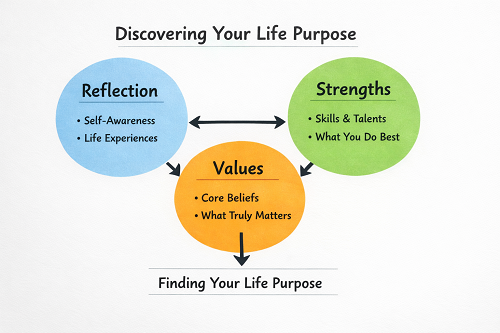
Discovering purpose involves examining several aspects of life and work.
Research discussed by Harvard Business Review shows that leaders who connect their work to personal purpose often demonstrate stronger motivation, resilience, and long-term leadership effectiveness.
Reflecting on Personal Values
Values represent the principles that guide how individuals want to live and work.
Some leaders value independence and innovation. Others prioritise collaboration, social contribution, or long-term stability.
Understanding personal values helps individuals evaluate whether their current career aligns with what matters most to them.
Questions that may support this reflection include:
• What aspects of my work give me the greatest satisfaction?
• Which activities feel most meaningful?
• What kind of impact do I want to have through my work?
• What values guide my important decisions?
These questions help individuals identify patterns that reveal deeper motivations.
Recognising Natural Strengths
Purpose often intersects with natural strengths.
Many people experience a sense of fulfilment when their work allows them to use abilities that come naturally to them. These abilities may involve strategic thinking, creativity, communication, or leadership.
For a deeper exploration of how thinking patterns influence leadership behaviour, see Mindset for SME Leaders.
For entrepreneurs, recognising strengths also supports better delegation. Leaders can focus on activities that align with their abilities while empowering others to contribute in complementary areas.
This process often becomes easier through discussions with experienced mentors or advisors who provide objective perspective.
When Leaders Benefit from Purpose Clarity
Purpose work becomes particularly valuable when leadership complexity increases or direction feels unclear.
Common situations include:
• business success no longer feels fulfilling
• major career or leadership transition
• preparing for exit, succession, or scaling back
• decision fatigue at senior level
• conflict between personal values and business direction
Life Coach Dublin: When Is It Appropriate?
Many professionals reach a stage in their career where external success no longer answers deeper questions about direction and fulfilment. At this point, individuals often begin exploring whether their work truly aligns with their values and long-term goals.
A life coach can help facilitate these conversations.
Life coaching focuses on helping individuals clarify priorities, examine personal motivations, and explore potential future paths. While business advisors typically focus on organisational strategy, life coaches often concentrate on personal meaning and lifestyle alignment.
For entrepreneurs and senior leaders in Ireland, this type of support may become useful during periods of transition.
When Leaders Seek Life Coaching
Leaders may consider working with a life coach in several situations.
These often include:
• uncertainty about long-term career direction
• feeling disconnected from the meaning of their work
• difficulty balancing professional and personal priorities
• major life or business transitions
• desire for greater personal fulfilment
Life coaching does not replace strategic advice or operational consulting. Instead, it provides space for reflection and personal clarity.
Personal Reflection and Strategic Direction
Personal orientation often influences professional decisions.
For example, a founder who realises that autonomy and creativity are central personal values may prioritise innovative projects rather than purely financial expansion.
Similarly, an executive who values mentorship may shift toward roles that involve developing teams and future leaders.

What to Do If You Feel Misaligned with Your Career?
Career misalignment occurs when individuals feel that their daily work no longer reflects their personal values or aspirations.
This experience is more common than many people realise. Professionals often build successful careers by responding to opportunities, yet later discover that their work no longer matches what they truly want.
Recognising misalignment is the first step toward addressing it.
Recognising the Signs of Misalignment
Misalignment does not always appear dramatically. Instead, it often develops gradually.
Common signs may include:
• feeling disconnected from the purpose of daily work
• reduced motivation despite professional success
• frequent questioning of career direction
• desire to pursue different types of projects or responsibilities
These feelings do not necessarily mean that a career change is required. Sometimes they simply indicate that aspects of work need to evolve.
Reflecting Before Making Major Changes
When individuals feel misaligned with their career, it can be tempting to make rapid changes. However, thoughtful reflection usually produces better outcomes.
Key reflection questions may include:
• Which aspects of my work feel meaningful?
• Which activities feel draining or repetitive?
• What values do I want my career to represent?
• How might my current role evolve to better reflect those values?
These questions help individuals distinguish between temporary frustration and deeper misalignment.

Aligning Business with Personal Values
For many entrepreneurs and leaders, business begins as a practical pursuit. It may start with an opportunity in the market, a technical skill, or a desire for independence. Over time, however, leaders often begin to ask whether their business also reflects their personal values.
Values represent the principles that guide how individuals want to operate in the world. They influence decisions about partnerships, culture, growth strategies, and the long-term direction of the organisation.
When business decisions align with personal values, leaders often experience greater clarity and motivation. The work feels purposeful rather than purely transactional.
Why Independent Perspective Matters for Leadership Clarity
Purpose is difficult to define in isolation.
Leaders operate under pressure, expectations, and constant decision-making. This often limits objective reflection.
External perspective introduces strategic path.
Experienced advisors help leaders:
• challenge assumptions about success
• separate identity from business performance
• evaluate long-term direction objectively
• navigate transitions with structure
This perspective strengthens both personal clarity and strategic decision-making.
In practice, many leaders explore these questions through structured private advisory support, where confidential discussions help clarify both strategic and personal direction.
Turning Personal Values into Leadership Decisions
When personal values and professional decisions move in the same direction, leaders often experience greater clarity and consistency. Decisions become easier because they are guided by principles rather than short-term pressure.
Values alignment also strengthens trust inside the organisation. Employees tend to respond positively when leaders demonstrate consistency between what they say and how they act.
Values alignment also improves long-term strategy. When leaders understand what matters most to them, they are less likely to pursue opportunities that conflict with their principles.
This clarity allows businesses to grow in ways that remain consistent with the founder’s vision and the organisation’s culture.
Identifying Your Core Values
Many professionals have never deliberately defined their values. Instead, these principles develop gradually through life experiences and career choices.
Taking time to identify core values can provide powerful clarity.
Leaders may begin by asking questions such as:
• What principles guide my most important decisions?
• What kind of impact do I want my work to create?
• Which behaviours do I expect from myself and my team?
• What does success mean beyond financial results?
Reflecting on these questions helps individuals understand what truly matters to them.
Once values become clear, leaders can evaluate whether their business decisions support or contradict those principles.
Some founders explore these questions with the support of a strategic business advisory who understands both strategic leadership and the personal challenges of entrepreneurship.
Building Values into Business Strategy
Values become meaningful when they influence real decisions.
Aligning strategy with values does not mean ignoring commercial realities. Instead, it means ensuring that growth occurs in a way that reflects the principles the organisation stands for.
In some cases, founders combine values reflection with business consulting services support to translate personal vision into practical strategy.

When Success Feels Empty
Achieving business success is often considered the ultimate professional goal. Revenue growth, industry recognition, and financial stability are widely used measures of accomplishment.
However, many leaders discover that success alone does not always produce a sense of fulfilment.
After years of intense effort building a company or career, some individuals begin to ask deeper questions about the meaning of their work.
The Hidden Side of Achievement
Professional success often requires focus, discipline, and sacrifice. Entrepreneurs may dedicate long hours to building their organisations while postponing reflection about long-term purpose.
Once the business becomes stable or successful, space finally appears for these questions.
Leaders may begin to wonder:
• What impact do I want my work to create?
• Is this the type of organisation I truly want to lead?
• What role do I want to play in the next phase of my career?
These questions do not diminish success. Instead, they signal that individuals are ready to explore the deeper meaning of their work.
Redefining Success
When leaders experience a sense of emptiness despite external achievement, it often indicates that their definition of success needs to evolve.
Early career success may be defined by financial growth or professional recognition. Later stages of leadership often involve broader goals such as contribution, legacy, and mentorship.
Redefining success allows individuals to reconnect with the deeper motivations behind their work.
Creating Meaningful Work
Purposeful work often emerges when individuals align their professional activities with their values and strengths.
Leaders may find meaning in several areas:
• building organisations that support employees and communities
• developing innovative products or services
• mentoring emerging entrepreneurs
• contributing knowledge and experience to the next generation
By reconnecting with the deeper impact of their work, leaders often rediscover motivation and clarity.
Identity Beyond Business
For many entrepreneurs and senior professionals, business becomes closely tied to personal identity. Years of effort, responsibility, and emotional investment can make it difficult to separate the individual from the organisation they lead.
While this connection can create strong commitment, it may also introduce challenges. Leaders sometimes begin to define their entire sense of worth through business outcomes.
When this happens, periods of uncertainty or transition may feel particularly difficult.
Recognising identity beyond business helps leaders maintain perspective and resilience.
Why Identity Can Become Attached to Business
Entrepreneurs often build their organisations from the ground up. The business may represent creativity, independence, and personal achievement.
Because of this connection, leaders may begin to see the company as an extension of themselves.
This dynamic can be powerful during the early stages of growth. It encourages determination and persistence. However, it may also make it harder to step back from operational responsibilities later.
As organisations expand, founders must gradually shift from direct control to strategic oversight.
This transition becomes easier when individuals recognise that their identity extends beyond the company itself.
Expanding Personal Identity
Developing a broader sense of identity allows leaders to approach their work with greater balance.
Instead of viewing the business as the sole source of meaning, individuals recognise multiple dimensions of their life, including family, community, creativity, and mentorship.
This broader perspective often strengthens leadership performance because it reduces the emotional pressure associated with every decision.
Leaders who maintain a balanced identity are better able to evaluate situations calmly and adapt when circumstances change.

Rebuilding Direction After Crisis
Every leadership journey includes difficult moments. Economic downturns, organisational challenges, or personal setbacks can disrupt the direction leaders once felt confident about.
During these periods, individuals may feel uncertain about the future of their career or business.
Although these experiences can be challenging, they also provide opportunities for reflection and renewal.
Learning from Difficult Periods
Crisis often forces leaders to re-examine assumptions.
Strategies that once appeared successful may no longer apply. Markets may shift, teams may change, or personal priorities may evolve.
Rather than interpreting these situations purely as failure, many leaders choose to examine what can be learned from them.
Questions that support this reflection include:
• What lessons have emerged from this experience?
• Which assumptions need to change?
• What new opportunities might exist?
These questions help transform difficult periods into learning experiences.
Rebuilding with Clarity
Once reflection has taken place, leaders can begin rebuilding direction with greater clarity.
This process may involve redefining strategic priorities, strengthening leadership teams, or revisiting personal goals.
In some situations, individuals benefit from confidential discussions with a trusted advisor who can offer objective perspective.

Designing a Purpose-Led Career
A purpose-led career aligns professional activities with personal values and long-term aspirations.
Rather than focusing solely on short-term achievements, individuals design their career path around the type of contribution they wish to make.
This approach often leads to more consistent motivation and long-term satisfaction.
Career purpose and meaning at work are also explored by institutions such as Stanford Graduate School of Business, which publishes research on leadership fulfilment and career alignment.
Research across leadership development and organisational psychology consistently shows that purpose-driven leaders demonstrate stronger resilience, clearer decision-making, and more sustainable performance over time.
Purpose and Long-Term Fulfilment
A purpose-led career rarely emerges overnight. Instead, it develops gradually as individuals gain experience and reflect on the impact they want their work to create.
Early career stages often focus on learning skills and building stability. As confidence grows, many professionals begin asking deeper questions about contribution and meaning.
Purpose-led careers tend to focus on impact rather than position. Individuals consider how their work supports employees, communities, or industries rather than focusing solely on personal achievement.
For entrepreneurs, this may involve mentoring younger founders, developing ethical business practices, or building organisations that create opportunity for others.
Many leaders also benefit from structured business mentoring support, where experienced advisors provide perspective on long-term career and leadership direction.
Combining Strengths and Meaning
Purpose-led careers typically emerge when individuals combine their natural strengths with meaningful objectives.
When strengths and meaning intersect, work often becomes more engaging and fulfilling.
This alignment can also create positive impact for employees, customers, and communities.
Planning the Next Stage
Designing a purpose-led career does not necessarily require dramatic change. In many cases, individuals adjust their focus gradually.
This evolution allows leaders to remain connected to their organisations while pursuing activities that reflect their deeper motivations.
Many professionals explore these transitions through Business Mentoring for SME Owners, where experienced advisors share insights from their own leadership journeys.

Work-Life Integration for Founders
Entrepreneurship often demands intense commitment. Founders frequently invest long hours and emotional energy into building their organisations.
Leaders seeking deeper clarity often combine this work with structured Business Coaching for SME Owners, particularly when aligning personal purpose with leadership behaviour and performance.
While this dedication can drive success, it may also create imbalance if not managed carefully.
Work-life integration focuses on creating sustainable ways to combine professional ambition with personal wellbeing.
Moving Beyond Work-Life Balance
Traditional discussions about work-life balance often imply that work and personal life must remain separate.
In reality, many entrepreneurs experience these areas as deeply connected.
For many entrepreneurs, discussions about purpose also connect with broader business decisions. In such cases, leaders may combine life coaching conversations with guidance from a trusted business consultant who understands the strategic realities of running a growing organisation.
Leaders may achieve this by:
• prioritising high-impact activities
• delegating operational tasks effectively
• scheduling time for personal relationships and reflection
• maintaining clear boundaries during periods of intense work
These practices help leaders sustain energy and clarity over long periods.
Sustainable Leadership
Sustainable leadership recognises that long-term success depends on both professional capability and personal wellbeing.
When leaders maintain balance, they are more likely to remain creative, resilient, and focused.
Conversely, persistent exhaustion can weaken decision-making and reduce organisational stability.

Why Purpose Matters for SME Leaders
Purpose strengthens leadership clarity and long-term direction.
Leaders with clarity:
- make more consistent decisions
- align business with long-term direction
- maintain motivation over time
Research from Harvard Business Review highlights the role of purpose in leadership effectiveness.
When Should You Focus on Life Purpose?
You should consider focusing on life purpose when:
- long-term direction feels unclear
- success feels misaligned
- decisions carry personal weight
- you are preparing for transition
Purpose work supports clarity before major decisions are made.
Situations Where Leaders Explore Life Purpose
Life purpose work becomes particularly relevant in structured leadership contexts, including:
- When strategic direction is unclear despite business success
- When leadership decisions feel reactive rather than intentional
- During transitions such as succession, exit, or scaling
- When personal values begin to conflict with business direction
- When long-term motivation becomes inconsistent
In these situations, leaders often combine purpose work with:
- structured insight from the Business Advisory for SME Owners
- leadership development through the Business Coaching for SME Owners
- experience-based perspective from the Business Mentoring for SME Owners
FAQ
Life purpose in business refers to aligning professional decisions with personal values and long-term meaning.
Yes. Purpose often evolves as responsibilities, priorities, and life stages change.
Not always. However, structured guidance can accelerate clarity and reduce blind spots.
Both matter. Purpose guides direction, while profit sustains the business.
Common signals include low motivation, constant doubt, and lack of fulfilment despite success.
Work on Your Life Purpose
If your business is growing but your direction feels unclear, the challenge is not performance alone. It is alignment.
Life purpose shapes how you:
- define success
- make long-term decisions
- align business with personal values
- lead through transition
Without clarity of purpose, even successful businesses can feel directionless.
Explore our private advisory services to define your next stage with structure, clarity, and confidence.
This is not reflection.
This is direction.