
Business mentoring for SME owners in Ireland is often misunderstood. It is frequently confused with coaching, yet the function is fundamentally different. It is frequently grouped with coaching, yet it serves a different function. Where coaching strengthens decision-making, mentoring provides experience. It brings commercially grounded perspective to leaders making decisions under pressure.
Most SME owners do not fail due to lack of effort. They fail due to poor sequencing of decisions under pressure.
Many founders begin by speaking with a business consultant in Ireland to clarify priorities before engaging in mentoring.
When used correctly, business mentoring accelerates maturity, reduces avoidable mistakes and strengthens strategic confidence. When misunderstood, it becomes informal advice without structure.
Mentoring is most powerful when aligned with growth stage, founder mindset and organisational complexity.
This page defines how business mentoring actually works in practice.
Most businesses don’t need more information. They need better judgement. And that doesn’t come from more content. It comes from structured thinking, experience, and challenge.
They need experienced judgement applied at the right time.
What Is Business Mentoring for SME Owners??
Business mentoring is a structured developmental relationship in which an experienced business leader provides perspective, insight and commercially grounded guidance to another leader, founder or executive.
At its best, mentoring accelerates maturity. It shortens learning curves and reduces avoidable risk. It also provides clarity during moments of uncertainty.
Unlike coaching, which primarily strengthens thinking through structured questioning, mentoring incorporates direct experience. The mentor contributes insight drawn from real commercial exposure. That experience may span multiple industries, growth stages, board environments or ownership structures.
A well-structured business mentoring engagement typically supports:
• Strategic sequencing during growth
• Commercial risk awareness
• Leadership confidence
• Founder perspective under pressure
• Long-term direction clarity
• Governance readiness
Mentoring becomes particularly valuable when a business enters unfamiliar terrain. That terrain may include rapid scaling, capital raising, board formation, acquisition integration or founder transition.
When leaders face decisions they have never encountered before, experience matters.
This is particularly relevant for SME mentoring in Ireland where growth complexity increases quickly.
The Importance of Structure in Business Mentoring
Without boundaries, objectives and clarity of purpose, mentoring can drift into unfocused conversation.
In practice, mentoring relationships often operate on a scheduled basis. Monthly or quarterly sessions are common. These sessions focus on reviewing strategic priorities, examining upcoming decisions and reflecting on leadership behaviour.
Unlike structured Business Consulting for Growing SMEs, which focuses on implementation. Mentoring does not deliver implementation. Unlike coaching, mentoring does not restrict itself to questioning. It blends experience, perspective and measured guidance.
Over time, mentoring builds strategic steadiness. Decisions become less reactive. Risk becomes more measured. Leadership confidence becomes grounded rather than performative.
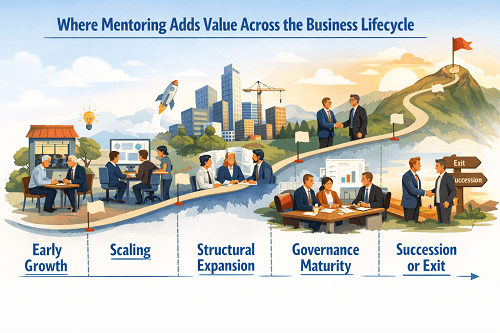
The Core Function of a Business Mentor
The core function of a business mentor is perspective.
Perspective reduces reactive decision-making and improves judgement under pressure.
An experienced mentor has seen patterns before. They recognise growth illusions, cash flow traps, hiring missteps and board misalignment. This pattern recognition allows them to offer clarity before mistakes compound.
The mentor does not take control. They do not override authority. Instead, they create a reflective environment where the leader can evaluate options more calmly.
At this stage, many founders choose to work with an experienced business advisor in Ireland to bring structure to decision-making before errors compound.
Core functions of effective business mentoring include:
1. Experience-Based Pattern Recognition
Mentors often identify repeating business cycles such as:
• Overexpansion during revenue spikes
• Underinvestment in governance
• Founder over-centralisation
• Cultural drift during hiring waves
• Emotional decision-making during downturns
Because they have observed these cycles before, mentors can highlight early warning signs.
This shortens the learning curve significantly.
2. Strategic Sequencing
Many businesses fail not because strategy is flawed, but because timing is misaligned.
A mentor helps leaders explore critical questions such as:
• Whether the decision is right or simply a good idea introduced at the wrong time
• If current systems can properly support the next strategic move
• Whether leadership capacity is strong enough to sustain expansion
Sequencing often determines sustainability.
3. Emotional Stabilisation Under Pressure
Pressure distorts judgement. Mentoring stabilises it. Financial exposure, reputational risk and employee responsibility create pressure that is rarely visible externally.
A mentor provides a stable reference point.
This does not mean offering reassurance without substance. It means helping the leader distinguish between:
• Rational concern
• Emotional reaction
• Ego-driven impulse
• Market-driven necessity
By separating these elements, decision clarity improves.
4. Founder Reflection and Identity Awareness
For founders, mentoring frequently extends beyond operational decisions. It touches identity.
At this stage of leadership transition, deeper uncertainties begin to surface. Particularly around identity, authority and shifting responsibility.
Leaders begin reassessing who they are beyond day-to-day operational control and what it truly means to evolve from operator to strategist. As the business expands, authority itself must also be redefined.
Who am I without operational control?
While mentoring does not replace coaching, it often intersects with founder Mindset for SME Leaders during transitional phases.
5. Governance Readiness
As businesses grow, informal decision-making becomes insufficient. Mentors can prepare leaders for governance maturity by encouraging:
• Structured reporting
• Clear decision rights
• Defined escalation channels
• Board readiness
This area may eventually intersect with Strategic Management & Governance for SMEs support.

Business Mentor vs Business Coach: What’s the Difference?
Both business mentoring and the Business Coaching for SME Owners are often used interchangeably. They should not be.
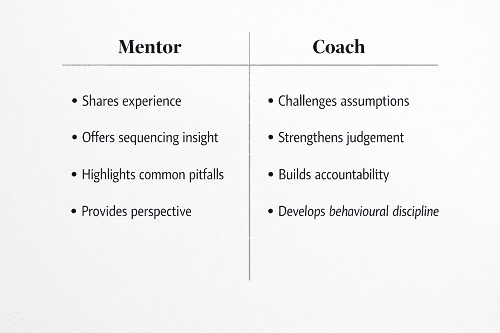
A business mentor contributes experience.
A business coach strengthens thinking.
The Structural Difference
A mentor draws on lived commercial exposure. They may say:
“When I faced a similar situation, this is what happened.”
“This is the mistake I made.”
“This is what I would sequence differently now.”
The mentor’s value lies in pattern recognition shaped by history.
A coach, by contrast, is less likely to offer direct answers. Instead, they may ask:
“What assumptions are you making?”
“What risk have you not yet considered?”
“What are you avoiding?”
The coach sharpens independent judgement.
The mentor accelerates learning through shared experience.
Both are valuable. The key is knowing which you need.
While mentoring focuses on sharing experience, organisations often combine mentoring with structured business consulting services when operational systems or strategy require deeper analysis.
When Mentoring Is More Appropriate
Business mentoring is particularly useful when:
• You are entering a stage you have never navigated before
• You want to avoid predictable scaling errors
• You need perspective rather than interrogation
• You are building governance maturity
• You want access to seasoned commercial judgement
When Coaching Is More Appropriate
Coaching becomes more suitable when:
• Decision hesitation persists
• Delegation resistance is behavioural rather than structural
• Leadership maturity is lagging behind growth
• Strategic clarity fluctuates despite experience
Can Mentoring and Coaching Work Together?
Yes. In many scaling organisations, mentoring and coaching operate in parallel.
A mentor may offer experience-based perspective, while a coach strengthens behavioural discipline. Together, they address both the structural and psychological dimensions of leadership.
However, clarity of roles is essential. Without clarity, mentoring can drift into informal advice, and coaching can be mistaken for consulting.
The leader must understand the purpose of each engagement.
Best Business Mentors: What Defines Quality?
Experience alone does not define a strong mentor.
Not every successful entrepreneur or executive is an effective mentor. The ability to transfer insight clearly, responsibly and constructively is a separate skill.
A high-quality business mentor typically demonstrates five critical characteristics.
1. Relevant Commercial Exposure
Relevance matters more than prestige.
A mentor does not need to have built a global conglomerate. They do need experience that aligns with your growth stage, industry complexity or governance maturity.
Relevant exposure may include:
• Scaling from start-up to structured SME
• Introducing formal governance frameworks
• Navigating investor relationships
• Managing downturn recovery
• Executing succession transitions
When experience matches context, guidance becomes sharper.
2. Emotional Intelligence
Mentoring requires listening before advising.
A poor mentor dominates conversation. A strong mentor asks clarifying questions before offering perspective.
Emotional intelligence enables the mentor to:
• Detect hesitation
• Identify ego-driven decisions
• Recognise fatigue or stress
• Adjust guidance tone accordingly
Without emotional awareness, mentoring becomes instruction rather than development.
3. Strategic Restraint
The best mentors know when not to intervene.
They avoid over-directing and resist imposing their own historical preferences. They recognise that every business environment is different.
Strategic restraint ensures that mentoring supports autonomy rather than dependency.
If a mentee begins to rely entirely on mentor approval, the relationship has become imbalanced.
4. Governance Awareness
As organisations grow, mentoring must expand beyond operational tactics.
Quality mentors understand:
• Decision rights
• Reporting structures
• Risk oversight
• Board expectations
Without governance awareness, mentoring may focus only on growth while ignoring structural stability.
5. Integrity and Boundaries
Mentoring often involves confidential discussions. Trust is foundational.
A professional mentor maintains:
• Clear confidentiality
• Defined scope of engagement
• Transparency around conflicts of interest
• Consistent professional boundaries
Ethical standards in leadership development are reinforced by institutions such as the Chartered Management Institute in the UK.
Professional structure strengthens credibility.
Warning Signs of a Weak Mentoring Relationship
To avoid misalignment, watch for warning signs:
• Advice without context
• Dominating conversation
• Lack of structure
• No measurable progress
• Dependency forming
Effective mentoring strengthens independence. It does not create reliance.

Business Mentor Dublin: What Should Founders Look For?
When searching for a business mentor in Dublin or elsewhere in Ireland, context matters but capability matters more.
Local awareness can be valuable. Regulatory expectations, funding ecosystems and governance norms differ across regions. A mentor familiar with the Irish SME landscape may better understand the pressures facing growing businesses in that environment.
However, proximity alone does not guarantee relevance.
Founders should evaluate a mentor based on structured criteria rather than convenience.
Geographic closeness may build rapport more quickly. Strategic depth sustains value long term.
Many founders begin their search for a business mentor in Ireland with a focus on Dublin, though capability matters more than location.
Context vs Competence
Industry familiarity is helpful, particularly where sector compliance is complex. Yet mentoring is not industry consulting.
A mentor does not need to have built your exact business model. They do need to understand growth dynamics, financial exposure and leadership evolution.
In many cases, mentoring conversations complement guidance from a trusted business advisor in Ireland who can help founders evaluate strategic decisions objectively.
A capable mentor will recognise when informal guidance is no longer sufficient and more formal governance architecture is required.

Small Business Mentor: When Do SMEs Need One?
A small business mentor becomes increasingly valuable as SMEs move into more complex growth stages. These are periods when complexity increases faster than internal capability.
Common trigger points include:
• First significant hiring wave
• Rapid revenue growth
• Introduction of senior management layers
• Investor involvement
• Formal board formation
• Founder role transition
In early-stage businesses, founders often rely on instinct and speed. That instinct can drive success initially. However, as scale increases, instinct alone becomes insufficient.
A small business consultant introduces perspective without increasing headcount.
Mentoring at SME level often focuses on three core areas:
1. Structural Clarity
As businesses grow beyond 10–15 employees, role overlap increases. Decision rights blur. Founders may struggle to relinquish control.
A mentor can help clarify:
• Who owns which decisions
• Where escalation occurs
• How authority is distributed
• How accountability is tracked
Without clarity, growth becomes chaotic.
2. Financial Discipline
SMEs often experience revenue spikes without corresponding cash stability. Mentoring can help founders examine:
• Margin sustainability
• Cost creep
• Hiring pacing
• Capital allocation
Many scaling errors occur not from poor strategy, but from poor sequencing.
3. Leadership Maturity
Founders must evolve from operator to strategist. This transition requires behavioural adjustment.
Mentoring supports:
• Delegation confidence
• Emotional steadiness
• Boundary setting
• Long-term perspective
In some cases, mentoring may also intersect with structured Mindset development, particularly where identity resistance emerges.
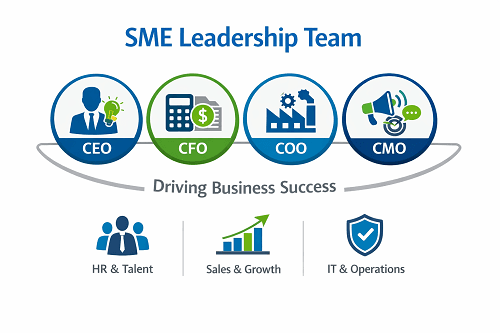
Situations Where SME Owners Need Business Mentoring
Business mentoring becomes particularly valuable during periods where experience gaps begin to affect decision quality.
Common situations include:
• Entering unfamiliar growth stages such as scaling beyond €1M–€5M revenue
• Preparing for first-time board or investor engagement
• Transitioning from founder-led control to structured leadership teams
• Navigating rapid hiring without established management layers
• Experiencing inconsistent decision-making under pressure
• Expanding into new markets without prior operational experience
Addressing these moments early allows leaders to avoid predictable mistakes and build more stable growth foundations.
Small Business Mentoring Programme: How Does It Work?
A structured mentoring programme differs significantly from informal advisory conversations.
An effective mentoring programme typically includes:
• Defined engagement objectives
• Clear time horizon
• Scheduled review cadence
• Growth milestone checkpoints
• Confidentiality agreement
• Defined boundaries of scope
Sessions may occur monthly or quarterly depending on complexity. Each session should focus on specific strategic priorities rather than general discussion.
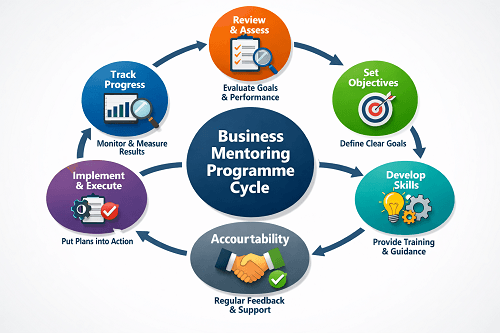
A disciplined mentoring framework may follow this cycle:
- Review recent decisions
- Examine upcoming strategic moves
- Assess risk exposure
- Challenge sequencing
- Confirm accountability actions
Unlike consulting, mentoring does not implement systems. Unlike coaching, mentoring includes direct experiential input.
The mentor may share comparable scenarios from their own background, but always with context.
Some founders also work alongside experienced business mentoring services providers who help translate lessons into practical leadership decisions.
Programme Duration
Short-term mentoring (3–6 months) may support a specific transition.
Longer-term mentoring (12–24 months) often supports sustained scaling or governance maturation.
Duration should match complexity, not convenience.
Boundaries and Expectations
Clarity is essential.
A mentoring programme should define:
• What is within scope
• What requires external consulting
• What remains the founder’s responsibility
Without boundaries, mentoring can drift into dependency.
Strong mentoring strengthens independence.
Find a Business Mentor: Where Should You Start?
Finding the right business mentor should begin with internal clarity, not external search.
Many founders begin by asking, “Who is available?”
A better question is, “What do I actually need?”
Before approaching a potential mentor, pause and reflect carefully. The value you gain will often depend on the clarity you bring into the conversation.
Consider the stage your business is currently in and the level of complexity you are navigating. Think about which decisions feel uncertain or carry the greatest risk. Be honest about patterns of repeated mistakes and whether they are strategic or behavioural in nature.
Reflect on whether you need help with sequencing and direction, or whether you would benefit more from constructive challenge. Finally, ask yourself if you are truly ready to hear perspectives that may feel uncomfortable but necessary.
Clarity at this stage makes mentoring far more purposeful and effective. Clarity of need improves the quality of selection.
Mentoring works best when objectives are defined. If goals remain vague, conversations drift. When goals are explicit, mentoring becomes focused.
Common entry points include:
• Growth plateau
• Leadership tension
• Capital raising preparation
• Governance formalisation
• Founder fatigue
In each case, mentoring provides perspective rather than implementation.
It is also important to distinguish mentoring from consulting. If a technical gap exists, for example in compliance or financial modelling, consulting may be more appropriate.
Mentoring strengthens judgement. Consulting delivers solutions.
Understanding that difference prevents misalignment from the outset.
Business Mentors Ireland: What Options Exist?
Within Ireland, mentoring opportunities typically fall into three categories:
- Independent experienced entrepreneurs
- Structured mentoring programmes
- Advisory-led mentoring relationships
Each carries advantages and limitations.
Independent Entrepreneurs
Many founders seek mentors who have built successful companies. These individuals often bring valuable lived experience. However, availability, structure and consistency can vary.
Without formal engagement boundaries, mentoring may lack discipline.
Structured Mentoring Programmes
Certain business networks and development organisations offer structured mentoring programmes. These may include defined objectives, limited duration and periodic review.
Such programmes can provide access to experienced professionals in a controlled environment. However, they may not always align perfectly with specific industry nuance or growth complexity.
Advisory-Led Mentoring
As businesses mature, mentoring often transitions into advisory engagement. In this context, the mentor brings not only experience but governance awareness and oversight capability.
This shift typically occurs when:
• Investor relationships emerge
• Board structures form
• Reporting standards increase
• Risk exposure grows
At this stage, mentoring intersects with formal Business Advisory for SME Owners support.
The difference is subtle but important. Informal guidance evolves into structured oversight.

Online Business Mentor: Does Remote Mentoring Work?
Remote mentoring has become increasingly common. When structured correctly, it can be highly effective.
Physical proximity is less important than engagement quality.
Remote mentoring offers:
• Access to broader experience pools
• Scheduling flexibility
• Reduced travel time
• Efficient session preparation
Depth of engagement depends on preparation and structure, not location.
A well-managed remote mentoring relationship should include:
• Pre-session agenda circulation
• Clear objectives for each meeting
• Follow-up accountability notes
• Defined communication boundaries
Without structure, virtual mentoring risks becoming informal conversation. With discipline, it becomes efficient and focused.
Confidentiality remains essential. Secure communication channels and professional discretion must be maintained.
In many cases, hybrid mentoring works best. Periodic in-person sessions combined with regular virtual check-ins provide balance.
Some entrepreneurs also seek perspective from a business consultant for SMEs who can help translate mentoring insights into operational improvements.
When Does Mentoring Become Strategic Advisory?
As organisational complexity increases, mentoring often evolves into advisory.
In situations where discussions involve sensitive leadership issues, confidential private advisory support may also be appropriate.
Early-stage mentoring focuses on guidance and perspective. Advisory introduces governance oversight and structured strategic accountability.
This transition typically emerges when:
• Board formation begins
• External investors demand reporting clarity
• Risk oversight becomes formalised
• Succession planning intensifies
• Compliance obligations expand
At this stage, experience alone is insufficient. Governance discipline becomes critical.
Advisory relationships often include:
• Formal reporting review
• Structured performance evaluation
• Risk oversight discussion
• Long-term strategic alignment
Mentoring may continue, but it now sits within broader strategic architecture.
Leadership development bodies such as the Chartered Management Institute outline structured frameworks for professional development and governance maturity.
This transition does not replace mentoring. It strengthens it.
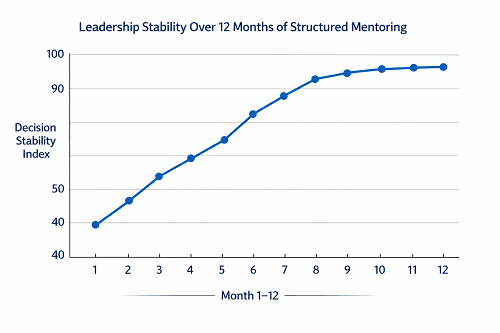
Measuring the Impact of Business Mentoring
Mentoring impact is not always immediate. It rarely produces dramatic short-term revenue spikes.
Instead, it creates stability.
Observable indicators of effective mentoring include:
• Reduced decision volatility
• Improved sequencing discipline
• Stronger delegation confidence
• Fewer repeated strategic mistakes
• Increased leadership steadiness
• Clearer governance awareness
Over time, mentoring reduces reactive decision-making. That steadiness improves organisational resilience.
Research published by Harvard Business Review highlights the measurable impact of structured mentorship on leadership effectiveness and business performance.
Mentoring does not eliminate risk. It reduces unnecessary risk.
Why Experienced Mentors Matter for SME Growth
Experience is what makes mentoring valuable.
Not theory. Not frameworks.
Pattern recognition.
Experienced mentors bring:
• exposure to real business cycles
• understanding of commercial risk
• governance awareness
• independent perspective
This shortens decision cycles and reduces avoidable mistakes.
When Should You Invest in Business Mentoring?
Business mentoring is most valuable when:
• You are entering unfamiliar growth territory
• You lack experienced perspective internally
• Decision pressure feels high
• You want guidance without formal consultancy
Mentoring accelerates learning curves.
FAQ
Provides experience-based perspective to improve decisions.
Mentoring shares experience. Coaching challenges thinking.
When entering unfamiliar or complex growth stages
Costs vary depending on experience and engagement structure, but should be viewed as an investment in avoiding costly mistakes.
Yes, when structured correctly and aligned with the right mentor, it significantly reduces risk and accelerates leadership maturity.
Work With an Experienced Business Advisor
If your business is growing but decisions feel uncertain, the constraint is not strategy alone. It is experience applied at the right time.
Business mentoring strengthens how you:
- sequence decisions
- evaluate commercial risk
- apply experience to complex situations
- lead with greater strategic confidence
Without experienced perspective, avoidable mistakes compound as complexity increases.
Explore our private advisory services and access commercially grounded experience to support better decision-making.
This is not advice.
This is applied experience.