Business consulting for SMEs plays a critical role during periods of growth, restructuring, or operational strain. As businesses expand, complexity increases. Informal systems begin to fail, decision-making slows, and performance becomes inconsistent.
Many organisations begin this process by speaking with a business consultant in Ireland who understands the challenges facing growing SMEs and leadership teams.
When implemented correctly, business consulting improves efficiency, clarifies processes, strengthens governance and enhances measurable performance.
This guide explores what business consulting truly involves, what consultancy services include, how to evaluate consultants and how consulting differs from mentoring, advisory and coaching.
What Is Business Consulting?

Business consulting is a structured service where an external expert diagnoses organisational challenges, designs solutions and supports implementation to improve performance, efficiency and governance.
At its core, consulting is intervention-based.
Rather than strengthening how a leader thinks, consulting strengthens the systems within which decisions are made.
Typically, consulting engagements address:
• Operational inefficiencies
• Strategic misalignment
• Governance gaps
• Financial performance issues
• Structural growth challenges
• Compliance or regulatory weaknesses
Importantly, business consulting is not theoretical analysis. It is structured, outcome-oriented work designed to produce measurable change.
Where mentoring provides perspective and coaching develops judgement, consulting delivers frameworks, systems and operational clarity.
This area intersects directly with Business Mentoring for SME Owners and Business Coaching for SME Owners.
The Difference Between Advice and Consulting
Advice is informal. Consulting is structured.
Advice may involve sharing recommendations without follow-through. Consulting, by contrast, includes:
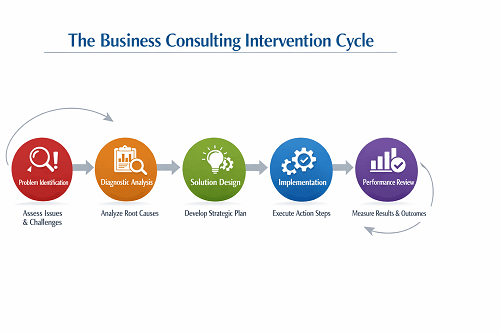
• Diagnosis
• Analysis
• Solution design
• Implementation roadmap
• Performance measurement
Furthermore, consulting engagements often include data analysis, stakeholder interviews and formal reporting.
When Is Business Consulting Necessary?
Consulting becomes necessary when:
• Internal capability is insufficient
• Growth has created operational strain
• Governance is underdeveloped
• Performance metrics are unclear
• External investors require formal reporting
• Regulatory obligations increase
In such cases, internal reflection alone is insufficient. External diagnostic capability is required.
Research published by the UK Government’s Department for Business and Trade highlights how structured consultancy interventions improve SME productivity and operational efficiency.
External expertise can accelerate problem resolution significantly.
Situations Where Businesses Seek Business Consulting
Business consulting is most effective when organisations face structural challenges that cannot be resolved through internal effort alone.
Common scenarios include:
• Scaling beyond founder-led decision-making where systems are no longer keeping pace with growth
• Persistent operational inefficiencies despite increasing revenue
• Lack of clear reporting structures or performance visibility
• Preparing for investor involvement, funding rounds or external scrutiny
• Governance gaps emerging as the organisation expands
Why Experienced Consultants Matter for SME Growth
Experience plays a critical role in effective consulting. Frameworks matter. Experience diagnoses accurately.
Experienced consultants bring:
• Pattern recognition across different growth stages
• Understanding of common SME scaling challenges
• Ability to prioritise high-impact interventions
• Practical knowledge of governance and operational systems
• Awareness of risks that may not yet be visible internally
This depth of experience ensures that consulting does not remain theoretical. Instead, it translates into practical, measurable improvements aligned with business reality.
Business Consultancy Services: What Do They Include?
Many organisations explore structured business consulting services to improve strategy, operational systems, and leadership alignment.
Consultancy in business services vary depending on organisational complexity. Nevertheless, most engagements fall into several broad categories.
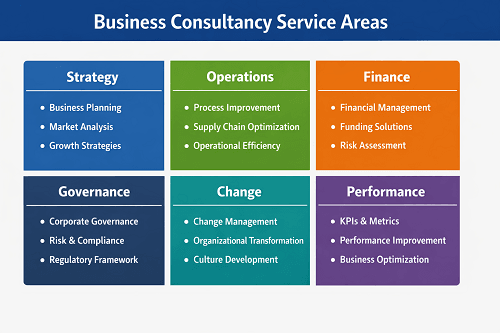
These include:
• Strategic consulting
• Operational consulting
• Financial consulting
• Governance consulting
• Change management
• Performance optimisation
Each category addresses a different dimension of business architecture.
1. Strategic Consulting
Strategic consulting focuses on long-term direction.
Consultants may assist with:
• Market positioning analysis
• Competitive landscape review
• Growth planning frameworks
• Expansion feasibility studies
• Mergers and acquisitions evaluation
Unlike mentoring, which offers perspective, strategic consulting often involves detailed modelling and scenario planning.
The output is usually documented strategy accompanied by implementation sequencing.
2. Operational Consulting
Operational consulting examines how work is executed.
This may involve:
• Process mapping
• Workflow optimisation
• Reporting redesign
• Role clarification
• KPI system construction
Operational inefficiency often hides beneath revenue growth. Therefore, consulting interventions can prevent structural fragility before it becomes visible.
3. Financial Consulting
Financial consulting addresses performance visibility.
Typical focus areas include:
• Cash flow forecasting
• Margin analysis
• Cost restructuring
• Capital allocation modelling
• Financial reporting frameworks
Financial clarity supports strategic discipline. Without it, growth becomes speculative.
This area frequently intersects with Small Business Consulting for SMEs.
4. Governance Consulting
Governance consulting strengthens oversight structures.
This may include:
• Board role definition
• Risk management frameworks
• Reporting cadence design
• Decision-rights clarification
• Compliance alignment
For more governance consulting insights, businesses often explore the Strategic Management & Governance for SMEs.
As organisations mature, governance gaps become increasingly risky. Therefore, governance consulting often precedes investor engagement or succession planning.
5. Change Management
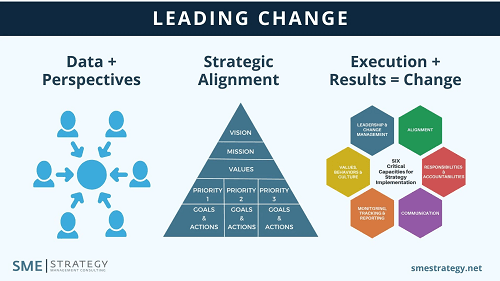
Structural improvement alone does not guarantee adoption. Change management consulting ensures that new systems are embedded effectively.
Focus areas may include:
• Stakeholder communication
• Leadership alignment
• Cultural adaptation
• Resistance mitigation
Without behavioural adoption, technical solutions fail.
6. Performance Optimisation
Performance consulting strengthens measurable output.
This may involve:
• KPI architecture
• Performance dashboards
• Incentive alignment
• Accountability tracking
Consultants ensure that metrics drive behaviour rather than simply reporting activity.
Professional standards for management consultancy are reinforced by bodies such as the Chartered Management Institute, which emphasises ethical practice and structured improvement frameworks.
The Importance of Scope Discipline
Although consultancy services are broad, clarity of scope remains essential.
Leaders must avoid expanding engagement without defined outcomes.
Before appointing a consultant, confirm:
• What success looks like
• How progress will be measured
• What responsibilities remain internal
• What timeline applies
Structure protects value.
Situations Where SMEs Need Business Consulting
Business consulting becomes particularly valuable in real-world scenarios such as:
• scaling beyond founder-led decision making
• preparing for investor or board oversight
• experiencing rapid growth without operational structure
• unclear accountability across leadership teams
• declining margins despite increasing revenue
Business Consultant for Small Businesses: When Is One Needed?
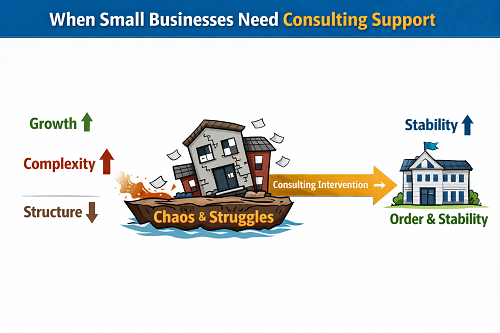
Small businesses often delay engaging a consultant until pressure becomes unavoidable. However, the most effective consulting interventions occur before crisis, not during it.
Founders often complement consulting work with experienced business mentoring services to gain perspective from advisors who have navigated similar challenges.
In many SMEs, growth initially relies on founder instinct, speed and informal decision-making. While this can work in early stages, complexity eventually outpaces intuition. At that point, structured external intervention becomes necessary.
A business consultant for small businesses is typically needed when one or more of the following conditions emerge:
• Revenue is growing, yet profitability remains inconsistent
• Operational inefficiencies are increasing
• Roles and responsibilities are unclear
• Founders are overwhelmed by decision volume
• Reporting lacks reliability or structure
• Strategic direction feels reactive rather than deliberate
Although these symptoms may appear minor at first, they tend to compound over time.
The Early Warning Signs
Many founders hesitate to seek consultancy support because they assume consulting is reserved for large corporates. In reality, SMEs often benefit more from structured intervention because their systems are still forming.
Warning signs may include:
• Decisions repeatedly revisited
• Hiring without defined accountability
• Margins shrinking without clear explanation
• Board or investor questions increasing
• Internal conflict emerging among managers
At this stage, internal reflection alone may not be sufficient. An external consultant introduces objectivity, structure and diagnostic clarity.
Founder Bottleneck and Decision Fatigue
As small businesses scale, founders frequently become bottlenecks. All decisions flow upward. Authority remains centralised. Team confidence erodes.
Although mentoring may provide perspective and coaching may address behavioural patterns, consulting can redesign structural authority.
This might include:
• Decision-right allocation frameworks
• Reporting hierarchy redesign
• Escalation pathway clarification
• Workflow documentation
In this way, consulting complements other development support rather than replacing it.
Timing the Intervention
Delaying intervention often increases cost, resistance and organisational disruption.
By contrast, early engagement allows for gradual adjustment rather than abrupt restructuring.
Small Business Consulting Services Explained
Small business consulting services are designed to improve performance, efficiency and governance without overwhelming the organisation.
Unlike enterprise consulting, which may involve extensive departmental restructuring, SME consulting typically focuses on targeted structural improvements.
Nevertheless, the impact can be substantial.
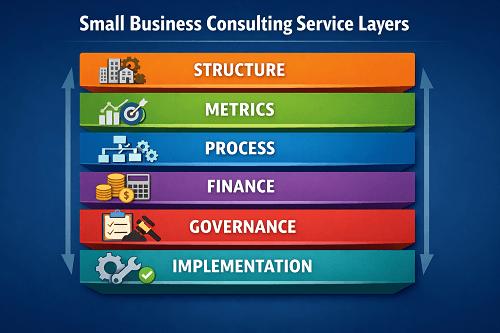
1. Organisational Structure Clarification
Many SMEs operate with informal hierarchies. Titles may exist, but authority boundaries remain unclear.
Consulting in this area may involve:
• Role definition
• Accountability mapping
• Decision-right clarification
• Reporting alignment
Clear structure reduces duplication and improves speed of execution.
2. KPI and Performance Framework Design
Small businesses often track revenue but lack performance architecture.
Consultants may design:
• Departmental KPIs
• Weekly reporting dashboards
• Margin tracking systems
• Forecasting frameworks
Such systems transform intuition into measurable discipline.
Without structured metrics, growth becomes reactive.
3. Process Standardisation
As teams expand, informal communication becomes inefficient.
Consulting may introduce:
• Documented workflows
• Standard operating procedures
• Approval frameworks
• Escalation protocols
Process clarity strengthens consistency.
Over time, this reduces friction and internal conflict.
4. Financial Visibility Enhancement
Cash flow remains one of the most common vulnerabilities in SMEs.
Financial consulting may include:
• Cash forecasting models
• Cost allocation review
• Pricing strategy evaluation
• Expense discipline systems
Improved financial clarity supports strategic pacing rather than reactive contraction.
5. Governance Introduction
As businesses mature, governance becomes unavoidable.
Consulting may assist with:
• Board preparation
• Risk oversight frameworks
• Reporting cadence development
• Compliance structure alignment
6. Change Implementation Support
System design alone is insufficient. Behavioural adoption determines success.
Therefore, SME consulting often includes:
• Leadership alignment workshops
• Communication strategy
• Resistance mitigation
• Implementation monitoring
Without adoption discipline, even well-designed systems fail.
Business Consulting Firms vs Independent Consultants
When engaging business consulting support, leaders often face a structural choice. Should they appoint a large consulting firm, or should they work with an independent consultant?
Both options can deliver value. However, the right choice depends on complexity, scope and internal capacity.
Understanding the difference prevents misalignment and unnecessary cost.
In Ireland, companies often work with a trusted business advisor who can provide independent strategic guidance alongside consulting support.
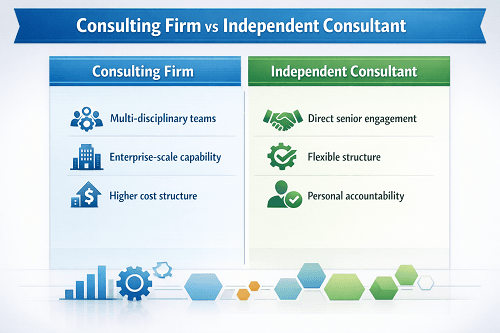
Business Consulting Firms
Larger consulting firms typically offer:
• Multi-disciplinary teams
• Extensive diagnostic resources
• Brand credibility
• Scalable project management
• Access to industry-specific expertise
These firms are often well suited to:
• Enterprise-level restructuring
• Cross-border expansion
• Regulatory transformation
• Large-scale operational redesign
• Mergers and acquisitions
Because firms operate with layered teams, they can deploy specialists across finance, operations, governance and change management simultaneously.
Independent Consultants
In contrast, independent consultants typically offer:
• Direct senior-level involvement
• Flexible engagement structure
• Faster decision-making
• Lower overhead costs
• Greater personal accountability
Independent consultants often work particularly well with SMEs and mid-sized organisations where:
• Scope is targeted rather than enterprise-wide
• Leadership access is direct
• Agility is required
• Budget sensitivity exists
Because independents are personally accountable for delivery, continuity of insight is often stronger.
Nevertheless, capacity may be limited compared with larger firms. Complex multi-department transformations may require additional specialist input.
Choosing Between the Two
The decision should reflect organisational need rather than perception of prestige.
Before selecting a provider, clarify whether this is a large-scale transformation or a targeted intervention.
Consider whether the business requires multiple technical disciplines and whether continuity of insight is more valuable than breadth of resource.
Finally, determine what budget is realistic.
Continuity vs Capacity
Firms offer capacity. Independents offer continuity.
Capacity supports scale. Continuity strengthens insight.
The correct choice depends on where complexity lies.
In some cases, leaders combine both. An independent consultant may lead structural diagnosis while specialist firms provide technical support.
Efficient Business Consulting: What Does Efficiency Mean?
Efficiency in business consulting is frequently misunderstood.
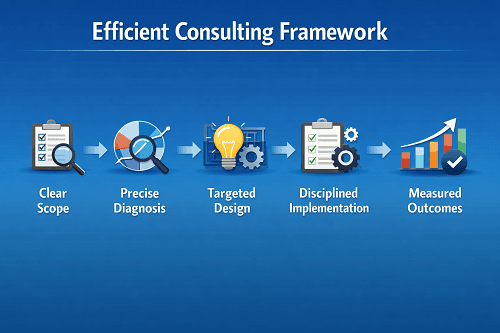
Some assume efficiency means speed alone. Others interpret it as cost reduction. In reality, efficient consulting balances precision, clarity and disciplined implementation.
An efficient consulting engagement should deliver measurable improvement without unnecessary complexity.
Some founders also strengthen leadership capability through structured development programmes such as genius unlocked.
Defining Efficiency in Consulting
Efficiency involves:
• Clear scope definition
• Focused diagnostic analysis
• Targeted solution design
• Controlled implementation
• Measurable outcome tracking
Without scope discipline, consulting can expand into abstraction. Without measurement, improvement becomes subjective.
Therefore, efficiency begins with clarity.
Scope Discipline
Efficient consulting avoids “scope creep”.
Scope creep occurs when:
• Objectives shift mid-engagement
• Additional problems are layered without redefinition
• Internal stakeholders request unrelated interventions
To prevent this, engagements should define:
• Core problem statement
• Measurable outcome
• Time horizon
• Internal responsibilities
Clarity at the outset protects both consultant and organisation.
Diagnostic Precision
Efficiency also depends on accurate diagnosis.
Rather than redesigning entire systems, an efficient consultant identifies leverage points.
Implementation Discipline
Consulting recommendations hold no value unless implemented.
Therefore, efficient consulting includes:
• Clear action sequencing
• Responsibility allocation
• Timeline milestones
• Progress review cadence
Moreover, leadership alignment must be secured before implementation begins. Without alignment, resistance undermines efficiency.
This area relates with Executive Coaching for Senior Leaders where leadership behaviour intersects with structural change.
Measuring Efficiency
Consulting efficiency can be measured through:
• Reduced operational friction
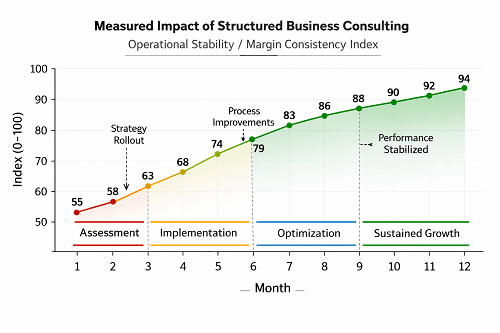
• Increased margin stability
• Shorter decision cycles
• Improved reporting accuracy
• Clearer accountability structures
Professional consultancy standards emphasise outcome-driven delivery.
Efficiency is not about speed at any cost. It is about achieving defined improvement without unnecessary disruption.
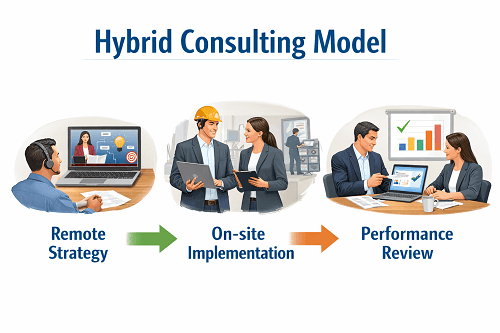
Online Business Consultant: When Does Remote Consulting Work?
Remote consulting has become increasingly common. However, effectiveness depends less on location and more on structure.
An online business consultant can deliver significant value when the engagement is clearly defined and supported by strong internal collaboration.
Remote consulting works particularly well when:
• The problem is analytical rather than physical
• Data can be shared securely
• Leadership alignment exists
• Implementation ownership remains internal
• The business operates across multiple locations
Digital collaboration tools now allow consultants to review documentation, analyse financial models and conduct stakeholder interviews without physical presence.
That said, remote consulting is not universally appropriate.
When Remote Consulting Is Most Effective
Online consulting is especially effective for:
• Strategy reviews
• Financial modelling
• KPI system design
• Governance framework development
• Reporting structure redesign
In these areas, structured documentation and virtual workshops are sufficient to produce measurable improvement.
Furthermore, remote engagement can increase focus. Meetings are often more disciplined. Preparation improves. Time is used deliberately.
When In-Person Consulting Adds Value
Conversely, in-person consulting may be preferable where:
• Deep cultural transformation is required
• Operational observation is necessary
• Leadership conflict needs mediation
• Board dynamics require real-time assessment
In such cases, physical presence enhances nuance.
Hybrid consulting models frequently provide the best balance. Strategic design may occur remotely, while implementation workshops occur in person.
Strategic Management Consultant: What Do They Actually Do?
Strategic management consultants operate at the highest structural level of organisational design.
Their work typically focuses on long-term direction, governance maturity and alignment between strategy and execution.
Unlike operational consultants, who optimise processes, strategic management consultants examine the architecture of leadership and oversight.
Core responsibilities may include:
• Strategy formulation
• Governance structure design
• Board alignment
• Risk oversight frameworks
• Long-term growth modelling
• Succession planning architecture
Because of this scope, strategic consultants often work closely with boards and senior executives rather than operational teams.
In situations involving sensitive leadership decisions, confidential private advisory discussions may also help leaders explore strategic options.
Strategy to Execution Alignment
One of the most common consulting failures occurs when strategy does not translate into execution.
A strategic management consultant addresses this gap by:
• Clarifying decision rights
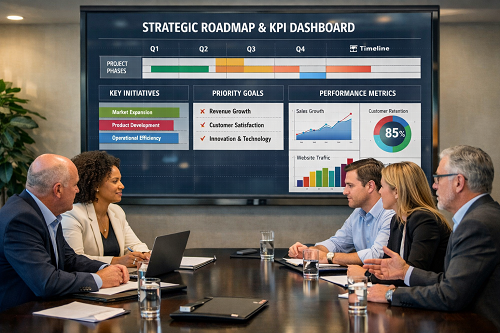
• Aligning KPIs with strategic priorities
• Designing reporting structures
• Establishing review cadence
Without structural alignment, strategy becomes aspirational rather than operational.
Governance Maturity
As businesses grow, informal leadership becomes insufficient.
Strategic consultants introduce:
• Defined board roles
• Risk registers
• Formal reporting frameworks
• Escalation pathways
These systems reduce ambiguity and strengthen accountability.
Where long-term direction becomes the focus, organisations often explore the Business Advisory for SME Owners.
Consulting Companies vs Consulting Firm: What’s the Difference?
Although the terms are often used interchangeably, subtle distinctions can exist between consulting companies and consulting firms.
In practice, both refer to structured professional service providers. However, usage may reflect scale or organisational model.
A consulting company may refer to a broader business entity offering multiple services, possibly including advisory, coaching or operational support.
A consulting firm often implies a specialist practice focused primarily on consulting services with defined methodologies and structured delivery models.
Nevertheless, the distinction is rarely operationally significant.
What matters more than terminology is capability.
When evaluating any consulting provider, consider:
• Depth of expertise
• Methodological clarity
• Track record of measurable results
• Transparency in engagement structure
• Cultural fit with leadership
Brand terminology should not overshadow competence.
Selection Criteria
Before appointing a consulting company or firm, leaders should evaluate:
• Experience within relevant growth stages
• Governance awareness
• Ability to translate strategy into execution
• Measurement discipline
• Professional standards adherence
The title on the website is secondary. Structural capability is primary.
Why Experienced Consultants Matter for SME Growth
Working with experienced consultants ensures that recommendations are grounded in real commercial environments rather than theory.
Experienced consultants understand:
• financial pressure in SME environments
• governance expectations as organisations scale
• how operational inefficiencies impact profitability
• the importance of sequencing decisions correctly
This level of experience improves implementation success and reduces costly mistakes.
How to Measure the Impact of Business Consulting
Consulting should produce observable results.
If improvement cannot be measured, value cannot be confirmed.
Impact measurement typically includes both quantitative and qualitative indicators.
Quantitative Indicators
• Margin improvement
• Revenue stability
• Cost reduction
• Shorter decision cycles
• Improved forecasting accuracy
• Reduced operational error rates
These indicators provide objective validation.
Qualitative Indicators
• Increased leadership confidence
• Improved governance clarity
• Reduced internal conflict
• Greater role clarity
• Improved board alignment
While qualitative factors are harder to measure numerically, they significantly influence sustainability.
Timeline Expectations
Consulting impact rarely appears overnight.
Short-term results may include clarity and structural adjustment. Medium-term outcomes include improved performance metrics. Long-term results involve cultural stabilisation and governance maturity.
Therefore, leaders should align measurement horizon with scope.
Practical Measurement Framework
A structured consulting engagement should define:
• Baseline performance
• Target outcomes
• Milestone checkpoints
• Review cadence
Without baseline comparison, improvement cannot be demonstrated.
Professional consultancy standards emphasise measurable outcome design, reinforcing accountability throughout the engagement.
An experienced SME consultant can quickly identify issues and implement improvements, in many cases.
When Should You Invest in Business Consulting?
Business consulting is most valuable when:
• Internal capability gaps exist
• Strategic direction is unclear
• Systems are failing under growth
• Governance risk is increasing
• Execution discipline is weak
It is an investment in structured improvement.
FAQ
A business consultant diagnoses organisational challenges, designs structured solutions and supports implementation to improve performance.
Consulting focuses on systems and structure, while coaching focuses on improving leadership judgement.
When internal capability is insufficient or operational complexity exceeds existing structure.
Costs vary depending on scope, complexity and duration, but SME engagements are typically tailored.
Yes, particularly when growth creates structural strain or performance inconsistency.
It can range from a few months for targeted projects to longer-term engagements for structural transformation.
Work With an Experienced Business Advisor
If your business is growing but operations feel strained, the constraint is not effort alone. It is structure.
Business consulting strengthens how your organisation:
- improves operational clarity
- builds systems that support growth
- aligns execution with strategy
- delivers measurable performance outcomes
Without structured systems, growth creates complexity rather than stability.
Explore our private advisory services and implement the structures required for consistent, scalable performance.
This is not advice.
This is execution.