
Business advisory for SMEs provides structured strategic oversight as organisations grow in complexity. As businesses scale, decisions carry greater consequences, risks increase, and informal leadership approaches begin to break down.
Many founders first seek guidance from a business consultant in Ireland who understands the governance challenges and strategic pressures facing growing SMEs.
Unlike consulting, which focuses on solving specific problems, or coaching, which strengthens leadership behaviour, business advisory focuses on long-term direction, governance, and decision quality.
When applied correctly, advisory strengthens leadership thinking, improves strategic clarity and reduces risk.
What Does a Business Advisor Do?

Business advisory is a structured service where an experienced advisor provides strategic oversight, challenges decisions and strengthens governance to improve long-term business performance.
At its core, advisory work strengthens oversight.
A business advisor typically:
• Reviews strategic direction
• Challenges leadership assumptions
• Examines risk exposure
• Assesses governance structure
• Monitors long-term sustainability
• Encourages accountability discipline
Rather than solving operational problems directly, advisors evaluate whether leadership decisions are aligned with long-term objectives.
Strategic Oversight, Not Daily Management
A business advisor does not manage staff. Nor do they take executive control. Their value lies in perspective and disciplined scrutiny.
For example, a founder may propose rapid expansion into a new market. An advisor will examine:
• Capital exposure
• Operational readiness
• Leadership capacity
• Risk mitigation planning
Instead of focusing only on opportunity, advisory support ensures risk is evaluated proportionally.
This protects long-term stability.
When Is Business Advisory Needed?
Advisory support becomes necessary when:
• Revenue growth accelerates
• Governance expectations increase
• Investor relationships emerge
• Succession planning begins
• Board structures are introduced
• Regulatory oversight strengthens
During early growth, informal leadership may be sufficient. However, as complexity increases, informal decision-making becomes risky.
Advisory introduces structure before instability appears.
How Business Advisory Works in Practice
Advisory is structured and ongoing.
A typical engagement includes:
- regular strategic sessions
- review of key decisions
- risk evaluation
- governance discussions
- accountability follow-up
Unlike consulting, advisory does not implement systems.
Unlike mentoring, it is not based purely on experience sharing.
It focuses on structured strategic thinking.
Where structural implementation is required, organisations often explore the Business Consulting for Growing SMEs.
Advisory vs Mentoring
These two are often confused.
Business Advisory
- focuses on strategy and governance
- provides structured oversight
- challenges decisions
Business Mentoring
- shares experience
- provides guidance
- supports learning
For experience-based support, leaders often review the Business Mentoring for SME Owners.
Both are valuable but serve different roles.
Advisory vs Coaching
Business Advisory
- improves decision quality at a strategic level
- focuses on long-term direction
Business Coaching
- improves leadership behaviour
- focuses on how decisions are made
For leadership development, organisations often explore the Business Coaching for SME Owners.
The Strategic Value of Independent Oversight
As organisations grow, leadership focus often becomes operational and short-term. Advisory introduces external perspective, ensuring decisions remain aligned with long-term strategy and governance discipline.
Independent advisory introduces distance.
That distance allows for clearer judgement. An advisor is not embedded in daily operations. This separation creates perspective. It enables them to notice what internal leaders may unintentionally overlook.
Because advisors operate outside the organisational hierarchy, they can challenge assumptions without political friction.
This independence protects decision quality.
Moreover, advisory oversight strengthens credibility. Investors, partners and regulators often view structured external oversight as a signal of governance maturity. Even when advisory is informal, the discipline it introduces influences behaviour across the leadership team.

Why Founders Benefit from Independent Strategic Perspective
As businesses grow, decision-making often becomes concentrated within a small leadership group. While this can increase speed, it can also reduce objectivity.
Independent advisory introduces disciplined external perspective.
Experienced advisors provide:
• Objective challenge without internal bias
• Broader exposure to governance and scaling patterns
• Structured evaluation of strategic decisions
• Early identification of risk and misalignment
• Long-term perspective beyond immediate operational pressure
This independence strengthens leadership judgement while reducing the likelihood of reactive or emotionally driven decisions.
When Businesses Benefit from Strategic Advisory
Business advisory becomes increasingly valuable as organisational complexity grows and decision-making carries greater long-term consequences.
Typical scenarios include:
• Scaling beyond founder-led control into structured leadership teams
• Preparing for investor involvement or board-level governance
• Navigating succession planning or leadership transition
• Managing increased financial, operational or reputational risk
• Experiencing strategic drift despite continued growth
What Is a Business Strategy Advisor?
A business strategy advisor focuses specifically on long-term direction and competitive positioning.
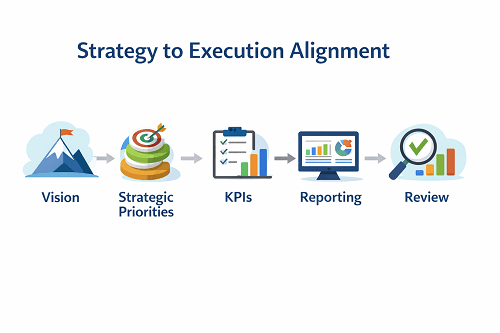
While a general business advisor may review broad governance issues, a strategy advisor concentrates on alignment between vision and execution.
Their role includes:
• Reviewing strategic plans
• Testing market assumptions
• Evaluating competitive positioning
• Aligning KPIs with long-term goals
• Assessing scalability
• Stress-testing growth projections
Strategy advisory is structured analysis.
Strategy vs Execution Gap
One of the most common problems in growing organisations is misalignment between strategy and delivery.
Leadership may agree on direction. However, operational teams may interpret priorities differently.
A strategy advisor addresses this gap by:
• Clarifying measurable objectives
• Aligning reporting structures
• Defining accountability
• Reviewing progress at structured intervals
Without this alignment, strategy remains theoretical.
Competitive Positioning Review
Markets evolve quickly. What worked two years ago may not work today.
Strategy advisory examines:
• Market shifts
• Customer behaviour changes
• Margin sustainability
• Emerging competitors
• Regulatory influences
Advisory enforces proactive recalibration.
Long-Term Sustainability
A strategy advisor also evaluates sustainability.
Growth alone is not success. Sustainable growth requires:
• Financial resilience
• Leadership succession planning
• Governance clarity
• Risk oversight frameworks
When Should a Founder Seek Strategic Advisory Support?
Founders often delay seeking advisory support. In the early stages, speed feels more important than structure. Decisions are made quickly. Authority is centralised. Oversight is informal.
However, growth changes that equation.
Strategic advisory becomes necessary when complexity increases faster than clarity.
Key Signs You Need a Business Advisor
• Revenue is rising, but strategic focus feels blurred
• Leadership decisions are increasingly reactive
• Investor involvement is emerging
• Senior managers disagree on priorities
• Risk exposure is expanding
• The founder feels isolated in major decisions
At this point, instinct alone is no longer sufficient.
Many founders also combine advisory support with experienced business mentoring services to gain perspective from advisors who have navigated similar growth challenges.
The Shift from Control to Oversight
As businesses grow, founders must evolve. Early survival requires control. Long-term stability requires oversight.
This shift can feel uncomfortable.
Strategic advisory helps founders move from operational control to structured supervision. Instead of deciding everything directly, the founder begins to:
• Review performance through structured reporting
• Evaluate strategic trade-offs more formally
• Delegate authority with clarity
• Separate short-term pressure from long-term direction
Without advisory support, this transition can stall. Growth may continue, but governance lags behind.
Preparing for Board-Level Scrutiny
Strategic advisory becomes particularly important when:
• External investors join
• Board structures form
• Reporting standards tighten
• Regulatory oversight increases
In these environments, informal leadership is no longer sufficient. Founders must articulate strategy clearly, justify risk decisions and demonstrate governance maturity.
An advisor provides preparation and discipline before external scrutiny intensifies.
This reduces reputational and financial risk.

What Is Governance Advisory for SMEs?
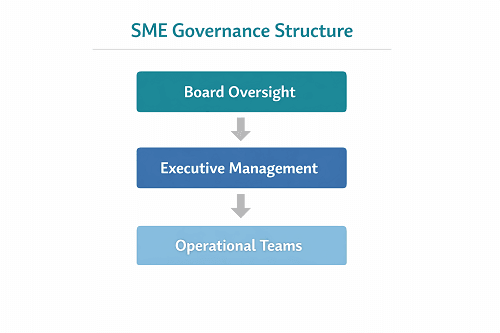
Governance advisory focuses on strengthening oversight systems within growing organisations.
For SMEs, governance often begins informally. Decisions are made quickly. Reporting is minimal. Authority is centralised.
Governance advisory introduces structure before instability appears.
Why Governance Matters for SMEs
Many small and mid-sized businesses assume governance is only relevant for large corporates. In reality, governance becomes critical once:
• Staff numbers exceed 20–30
• Revenue volatility increases
• Investors become involved
• Regulatory requirements expand
• Succession planning begins
Without governance discipline, growth becomes fragile.
Governance advisory helps SMEs introduce:
• Clear decision rights
• Structured reporting
• Risk oversight frameworks
• Defined board roles
• Escalation pathways
These elements reduce ambiguity.
For deeper governance structure, organisations often review the Strategic Management & Governance for SMEs.
Governance vs Management
It is important to distinguish governance from management.
Management focuses on execution.
Governance focuses on oversight.
Management asks:
“Are we delivering?”
Governance asks:
“Are we delivering in a controlled and sustainable way?”
Advisory support strengthens the second question.
Practical Governance Improvements
A governance advisory engagement may include:
• Designing board charters
• Defining director responsibilities
• Establishing risk registers
• Formalising reporting cycles
• Clarifying delegation frameworks
These changes often feel formal at first. However, they protect the organisation as it grows.
Risk Oversight and Stability
As organisations expand, risk multiplies.
Risk may involve:
• Financial exposure
• Operational fragility
• Compliance obligations
• Reputation management
• Leadership succession
Governance advisory ensures risk is monitored rather than discovered after impact.
Professional governance standards are reinforced by organisations such as the Institute of Directors in the UK, which promotes structured board oversight and accountability frameworks.
Structured governance strengthens credibility with investors, partners and regulators.
Governance as a Growth Enabler, Not a Constraint
Many founders initially resist governance. It can feel bureaucratic. It can seem slow. However, well-designed governance does not restrict growth. It protects it.
Clear decision rights accelerate execution. A well-structured reporting framework shortens and sharpens strategic debates.
Proactive risk monitoring creates a safer path for expansion.
Governance advisory helps SMEs avoid two extremes:
• Excessive control that stifles initiative
• Insufficient oversight that increases fragility
The objective is balance.
Confidential Advisor: What Does That Mean?
The term confidential advisor is often used loosely. However, in structured business advisory, confidentiality is not simply about discretion. It is about protected strategic space.
Senior leaders frequently operate without neutral sounding boards. Conversations with investors carry political weight. Discussions with executives influence perception. Even informal exchanges can shape internal dynamics.
In situations involving sensitive leadership or succession issues, confidential private advisory engagement may provide a secure environment for strategic reflection.
A confidential advisor provides a protected environment where sensitive matters can be examined without consequence.
This includes discussions about:
• Leadership tension
• Succession uncertainty
• Personal fatigue
• Investor disagreements
• Governance weaknesses
• Strategic hesitation
Without confidentiality, honest reflection becomes difficult.
Confidentiality Beyond Privacy
Confidential advisory is not merely about keeping information secret. It is about creating psychological safety.
When leaders know conversations will remain private, they are more willing to explore:
• Risk exposure honestly
• Internal doubts
• Difficult personnel decisions
• Personal limitations
• Long-term identity shifts
Personal advisory focuses more deeply on identity, pressure and long-term personal risk. Confidential business advisory, by contrast, keeps the lens on organisational stability while recognising human factors.
When Confidential Advisory Becomes Critical
Confidential advisory becomes particularly important during:
• Exit planning
• Board restructuring
• Investor tension
• Founder transition
• Regulatory investigation
• Leadership conflict
In these moments, clarity must precede communication.
A confidential advisor helps leaders think before they speak.
In many cases, organisations work alongside a trusted business advisor in Ireland who provides independent perspective on strategy, governance, and leadership decisions.
Balancing Business and Personal Risk
In some cases, strategic decisions carry personal consequences. Founders may face reputational exposure or financial risk tied directly to company performance.
A confidential advisor can help examine:
• Personal financial exposure
• Emotional bias in risk-taking
• Long-term career direction
• Identity beyond the business
Clarifying these concerns strengthens commercial negotiation later. Confidential advisory protects both strategy and identity.

Project-Based vs Ongoing Relationship
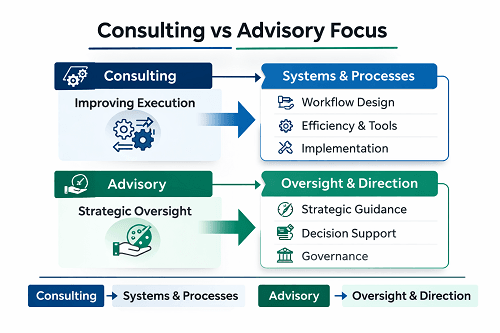
Consulting engagements are usually time-bound. A specific issue is diagnosed, solutions are designed and implementation support is delivered.
Advisory relationships are often longer term. Rather than solving one problem, advisors review the direction of the organisation over time.
Consulting asks:
“How do we fix this?”
Advisory asks:
“Is the organisation heading in the right direction?”
Both questions matter. They simply operate at different levels.
Structural vs Oversight Focus
Consulting strengthens structure. Advisory strengthens judgement within structure.
For example:
A consultant may design a new KPI reporting framework.
An advisor may review whether those KPIs align with long-term strategic objectives.
Consulting builds systems.
Advisory evaluates whether those systems support sustainable growth.
Speed vs Stability
Consulting interventions can be intense and fast-paced. They often aim to correct inefficiency quickly.
Advisory work tends to be steadier. It prioritises stability and long-term alignment rather than rapid change.
Neither approach is superior. The context determines which is appropriate.
When Both Operate Together
In mature organisations, advisory and consulting often operate in parallel.
For instance:
• A consultant may restructure operations.
• An advisor may monitor the long-term governance impact of that restructuring.
Similarly, business development expansion may require consulting input for market entry strategy, while advisory oversight ensures risk remains proportionate.
The distinction is subtle but important.
Consulting changes systems.
Advisory supervises direction.
Advisory vs Non-Executive Director
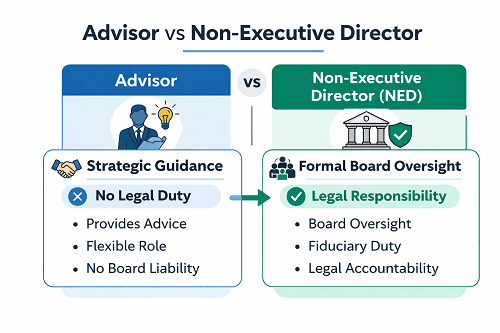
Business advisory and non-executive director (NED) roles are often confused. While both operate at board level, they are not identical.
A non-executive director holds formal board responsibility. An advisor does not.
That distinction is structural and legal.
Formal Authority vs Informal Influence
A non-executive director:
• Holds fiduciary duty
• Shares legal accountability
• Participates in formal board votes
• Carries statutory responsibilities
• Appears in governance documentation
By contrast, a business advisor:
• Provides guidance without formal authority
• Does not vote on board matters
• Does not hold fiduciary responsibility
• Influences decisions through expertise
• Operates through contractual engagement
NEDs carry legal responsibility. Advisors provide professional influence.
When a Business Needs a Non-Executive Director
An organisation may require a NED when:
• Investor governance expectations increase
• Regulatory requirements demand board formalisation
• Risk exposure reaches a higher threshold
• Succession planning becomes urgent
• Ownership structure becomes complex
At this stage, governance maturity must be formal.
A NED strengthens board legitimacy and oversight credibility.
When Advisory Is More Appropriate
However, not every growing organisation requires a formal NED immediately.
Advisory may be more suitable when:
• Governance structure is still developing
• Formal board status is premature
• The founder seeks external perspective without legal restructuring
• Strategic oversight is needed before formalisation
Advisory allows flexibility. It introduces discipline without immediate statutory obligations.
In many cases, advisory relationships precede NED appointments.
Transitional Governance
Some businesses begin with advisory oversight, then transition to formal board structure as maturity increases.
For example:
An SME introduces an external advisor during scaling. After two years, governance stabilises. Investor involvement increases. The advisor may then be invited to join the board formally.
This progression reflects structural evolution.
The key difference remains clear:
A NED governs formally.
An advisor influences strategically.
Long-Term Strategic Advisory Relationships
While some advisory engagements are short-term, the greatest value often emerges from continuity.
Strategic clarity improves when oversight is consistent.
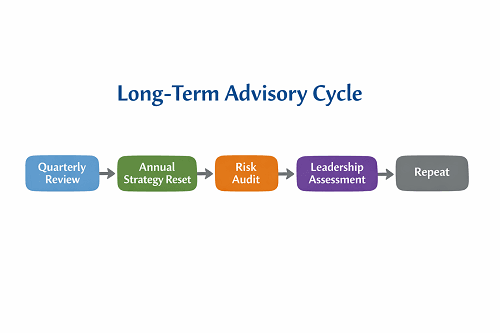
Long-term advisory relationships typically operate on:
• Quarterly board review cycles
• Annual strategy recalibration
• Risk oversight checkpoints
• Leadership succession monitoring
• Governance maturity assessment
This steady rhythm strengthens stability.
Why Continuity Matters
Strategy rarely fails overnight. Instead, drift occurs gradually.
Without consistent oversight:
• Priorities blur
• Reporting weakens
• Risk accumulates
• Decision discipline erodes
Long-term advisory relationships counteract drift.
An advisor who understands historical context can detect subtle misalignment before it becomes visible.
Research from Harvard Business Review highlights the value of external strategic oversight in improving decision quality.
Strategic Memory
Continuity creates what might be called strategic memory.
An advisor who understands prior decisions might raise questions such as:
- Does this align with the agreed three-year strategic direction?
- What factors have brought this matter back for consideration?
- Which underlying assumptions have shifted since the last decision?
These questions protect coherence.
Balancing Challenge and Stability
Over time, advisory relationships deepen trust. However, challenge must remain active.
A healthy long-term advisory relationship maintains:
• Constructive tension
• Honest feedback
• Measurable accountability
• Clear role boundaries
Without challenge, advisory becomes ceremonial.
Without trust, advisory becomes defensive.
The balance defines effectiveness.
Intersection with Business Development
As organisations pursue expansion, advisory oversight becomes even more important.
Rapid business development initiatives can create:
• Capital strain
• Operational fragility
• Cultural tension
• Governance risk
Long-term advisory relationships ensure that growth remains proportionate.
Maintaining Objectivity Over Time
While continuity creates strategic memory, it also requires discipline. Long-term advisory relationships must avoid complacency.
Advisors should periodically reassess:
• Whether strategic priorities remain relevant
• Whether governance structures require adjustment
• Whether leadership composition aligns with future direction
• Whether performance metrics still reflect market realities
In some cases, introducing periodic external review within an existing advisory relationship strengthens objectivity.
Continuity provides stability. However, stability must not become stagnation.
An effective long-term advisory relationship evolves as the organisation evolves. It does not simply repeat previous frameworks.
Risk Oversight in SME Advisory
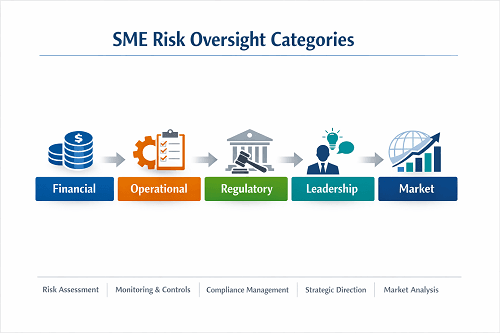
As SMEs grow, risk becomes more complex and less visible. Advisory ensures risks are identified early and managed proactively rather than reactively.
That is why structured risk oversight is central to business advisory.
Unlike day-to-day management, advisory work examines exposure at a strategic level.
Risk oversight typically includes reviewing:
• Financial vulnerability
• Operational fragility
• Regulatory compliance
• Leadership concentration risk
• Market dependency
• Succession exposure
Each category carries different consequences. Together, they determine resilience.
Concentration Risk in Founder-Led SMEs
Founder-led organisations frequently carry concentrated decision risk.
All approvals may sit with one individual. Key client relationships may depend on a single executive. Financial oversight may lack separation.
Advisory oversight examines whether:
• Authority is overly centralised
• Succession planning is realistic
• Institutional knowledge is documented
• Board-level scrutiny is sufficient
When concentration risk is reduced, stability improves.
Situations Where Businesses Benefit from Advisory
Business advisory becomes particularly valuable in the following situations:
- scaling beyond founder-led decision-making
- preparing for board or investor involvement
- leadership transitions
- strategic uncertainty
- increasing operational risk
These are strategic challenges rather than operational ones.
Financial and Performance Oversight for SMEs
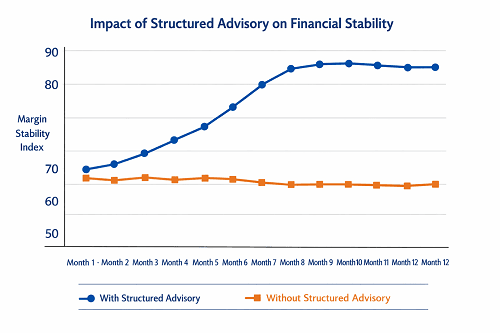
Financial visibility is the foundation of responsible advisory.
Revenue growth alone does not guarantee sustainability. Margins, cash flow and cost discipline determine resilience.
Business advisory strengthens financial oversight without replacing management.
Beyond Revenue Tracking
Many SMEs monitor revenue closely but overlook deeper performance indicators.
Advisory oversight examines:
• Margin consistency
• Cash flow forecasting
• Capital allocation discipline
• Expense growth patterns
• Pricing sustainability
• Debt exposure
When these metrics are reviewed consistently, volatility reduces.
Performance Architecture
Financial oversight also intersects with performance architecture.
Advisors may review:
• KPI alignment
• Reporting cadence
• Forecast accuracy
• Accountability mapping
Rather than creating reports for compliance alone, advisory ensures that reporting drives behaviour.
Businesses seeking long-term strategic clarity often engage a business consultant for SMEs who can support leadership teams as organisations grow and governance structures evolve.
Why Experienced Advisors Matter
Experience improves advisory effectiveness.
An experienced advisor brings:
- pattern recognition
- commercial judgement
- governance awareness
- independent perspective
When should you invest in Business Advisory
Selecting the right advisor requires more than reviewing experience. The effectiveness of advisory depends on alignment, structure and governance awareness.
Key factors to evaluate include:
• Relevant experience at your stage of growth
• Understanding of governance and board dynamics
• Ability to challenge without overstepping
• Structured approach to oversight and accountability
• Clear boundaries between advisory and execution
An effective advisor does not replace leadership.
They strengthen decision quality while maintaining independence.
FAQ
A consultant solves defined problems and implements solutions. A business advisor provides ongoing strategic oversight and governance guidance.
Yes. SMEs benefit from advisory support during growth phases, especially when governance, risk and strategic clarity become more complex.
Most advisory relationships operate monthly or quarterly depending on organisational complexity and growth stage.
Business advisory is highly valuable when structured properly. It improves decision quality, reduces risk exposure and strengthens long-term sustainability.
Work With an Experienced Business Advisor
If your business is growing and decisions are becoming more complex, structured advisory becomes necessary.
Not later. Now.
Business advisory provides:
• strategic clarity
• governance discipline
• improved decision quality
• reduced long-term risk
Explore our private advisory services and access independent, commercially grounded oversight.
This is not discussion.
This is strategic control.