
Mindset plays a critical role in how business leaders make decisions, respond to pressure, and lead organisations as complexity increases. While systems, strategy, and structure are important, the way a leader thinks ultimately shapes outcomes.
Most SME owners initially focus on improving business performance by working with a business consultant in Ireland. However, over time it becomes clear that performance is also influenced by mindset.
Mindset is not theoretical. It directly affects decision-making, communication, and consistency.
This guide explores how mindset influences leadership and when it becomes necessary to address it.
What Is Mindset Transformation?
Mindset transformation refers to the process of consciously changing the mental patterns that influence how individuals interpret challenges, opportunities, and risks.
These patterns often develop over many years through experience, education, and personal beliefs. While some mental habits support growth, others can quietly limit leadership effectiveness.
For example, a leader who believes that mistakes must always be avoided may hesitate to take strategic risks. Another leader who views challenges as learning opportunities may approach the same situation with curiosity rather than fear.
Where structured behavioural change is required, leaders often explore the Business Coaching for SME Owners.
Understanding Limiting Beliefs
Limiting beliefs are assumptions that restrict how individuals perceive their capabilities or opportunities.
These beliefs may appear logical on the surface but can prevent leaders from exploring new possibilities.
Common limiting beliefs in business leadership include:
• believing that delegation reduces control
• assuming failure damages credibility
• avoiding difficult conversations to maintain harmony
• thinking growth must always be linear
Such beliefs can influence behaviour in subtle ways. Over time they shape how leaders respond to uncertainty, conflict, and strategic decisions.
Once identified, these patterns can be challenged and replaced with more constructive perspectives.
The Role of Awareness
Awareness is the first step toward mindset transformation.
Many leadership habits operate automatically because they have been reinforced over time. Without reflection, individuals may not notice how these patterns influence their behaviour.
For example, a founder may believe they are protecting the organisation by personally reviewing every decision. However, this behaviour may unintentionally slow growth and weaken team accountability.
Through structured reflection and discussion, leaders begin to recognise these patterns.
This awareness allows them to experiment with alternative approaches that support organisational development.

Mindset Transformation Coach: What Do They Do?
A mindset transformation coach works with individuals to examine the beliefs and mental habits that influence behaviour.
Some leaders complement mindset work with private advisory support when decisions involve both strategic pressure and personal risk.
Unlike consultants who focus on operational systems, mindset coaches focus on the internal frameworks guiding decision-making.
These conversations often reveal that leadership challenges have deeper psychological components.
Identifying Behavioural Patterns
Mindset coaching typically begins by identifying behavioural patterns.
These patterns often appear in areas such as:
• decision-making speed
• communication during conflict
• risk tolerance
• response to setbacks
Through structured questioning, the coach encourages leaders to reflect on the assumptions behind their behaviour.
Once these assumptions become visible, leaders can evaluate whether they still serve their goals.
Some founders also combine mindset coaching with Personal Development for Business Leaders programmes that strengthen emotional resilience and leadership awareness.

How Mindset Affects Business Growth
Business growth is usually discussed in terms of strategy, funding, market opportunities, or operational efficiency. While these elements are important, the mindset of leadership often determines how effectively those opportunities are used.
Two organisations may operate in the same market, with similar resources and similar products. Yet one may grow steadily while the other struggles to expand. Often the difference lies in how leaders interpret risk, respond to setbacks, and evaluate new possibilities.
When leaders view challenges as opportunities for learning and improvement, they tend to experiment, adapt, and innovate. On the other hand, when leaders operate from fear of failure or excessive caution, organisations may become rigid and slow to respond to changing market conditions.
While mindset shapes decision-making, it often works alongside structured systems and strategy, which are explored in the Business Consulting for Growing SMEs.
Mindset as a Hidden Growth Lever
Business growth is often measured through visible factors such as revenue, team size, and market reach. Yet some of the most important drivers of growth are less visible. Mindset is one of them.
A leader’s mindset influences how quickly they make decisions, how they respond to uncertainty, and how they interpret setbacks. These patterns shape how opportunities are evaluated and whether the organisation moves forward with confidence or hesitation.
Leaders who deliberately strengthen mindset often make better use of the opportunities already available to them.
Decision-Making and Growth
One of the clearest ways mindset influences growth is through decision-making.
Leaders constantly face decisions involving investment, recruitment, partnerships, and market expansion. These decisions rarely come with perfect information. Instead, they require judgement.
Mindset influences how leaders interpret uncertainty.
A leader with a more defensive mindset may interpret the same uncertainty as a signal to delay action. Over time, repeated hesitation can prevent organisations from pursuing opportunities that competitors are willing to explore.
This does not mean that risk should be ignored. Instead, it highlights the importance of balanced thinking when evaluating strategic decisions.
Adaptability and Market Change
Markets rarely remain stable for long. Economic conditions shift, customer preferences evolve, and technology continues to transform industries.
Leaders with adaptable mindsets respond more effectively to these changes.
They are willing to re-evaluate assumptions, reconsider strategies, and learn from new information. This adaptability allows organisations to evolve alongside the markets they serve.
Conversely, leaders who remain attached to outdated assumptions may struggle when conditions change.

Why High Performers Invest in Mindset Work
High-performing leaders often appear confident and decisive from the outside. However, many of these individuals actively work on strengthening their mindset.
They understand that leadership success depends not only on knowledge or experience but also on the quality of their thinking.
Mindset work helps leaders manage pressure, maintain clarity, and remain adaptable in complex environments.
Many leaders also engage in structured business coaching programmes to strengthen thinking patterns, accountability, and performance under pressure.
Managing Pressure and Responsibility
Leadership roles often involve substantial responsibility. Founders and executives must make decisions that influence employees, customers, and investors.
This responsibility can create significant pressure.
Mindset work helps leaders develop strategies for managing that pressure constructively.
Maintaining Perspective During Growth
Periods of rapid growth can be both exciting and demanding.
As organisations expand, leaders must manage larger teams, more complex operations, and increasing expectations from stakeholders.
Mindset work helps leaders maintain perspective during these transitions.
Instead of becoming overwhelmed by complexity, they learn to focus on priorities, delegate effectively, and maintain confidence in their long-term vision.
Many founders strengthen leadership thinking through structured Business Mentoring for SME Owners relationships.
Continuous Improvement
Many high-performing individuals share a common trait: they believe that improvement is always possible.
This belief encourages them to examine their own behaviour, seek feedback, and remain open to new ideas.
Mindset work supports this continuous improvement by helping leaders recognise patterns that influence their decisions.
Over time, these insights lead to better judgement and stronger leadership capability.

High-performing leaders invest in mindset development to improve clarity and decision-making.
Fixed vs Growth Mindset in Leadership
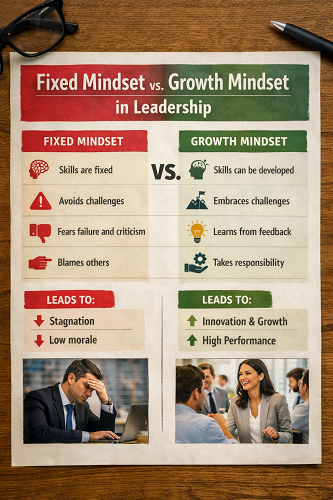
One of the most widely discussed ideas in leadership psychology is the distinction between a fixed mindset and a growth mindset.
The idea of fixed and growth mindsets has been widely explored through research at Stanford University, particularly in relation to learning and performance.
Research across leadership psychology consistently shows that decision-making quality improves when leaders develop greater awareness of cognitive and behavioural patterns.
A fixed mindset assumes that abilities and intelligence are largely permanent. Leaders who operate from this perspective may believe that their current capabilities define their long-term potential.
A growth mindset, in contrast, assumes that abilities can improve through learning, practice, and experience.
For leaders, this difference can have a powerful influence on behaviour. A fixed mindset may lead individuals to avoid difficult challenges in order to protect their reputation. A growth mindset encourages experimentation, learning, and adaptation.
Fixed vs Growth Mindset in SME Leadership
Leaders with a fixed mindset often avoid challenges and difficult situations. They may struggle to admit uncertainty and tend to see mistakes as failures. Because of this, they focus on protecting their authority rather than improving.
These behaviours can slow progress and prevent the organisation from adapting to change.
In contrast, leaders with a growth mindset take a different approach. They are open to feedback and willing to try new ideas. They see mistakes as opportunities to learn, not as weaknesses.
This mindset encourages innovation, collaboration, and open communication within teams.
Many leaders strengthen this approach by working with a business consultant for SMEs, who provides objective feedback and supports better decision-making.
Fear of Delegation
Delegation is one of the most common leadership challenges faced by entrepreneurs and growing organisations.
In early stages of a business, founders often manage many responsibilities personally. This hands-on approach helps ensure quality and control when resources are limited.
However, as the organisation grows, continuing to handle every decision becomes unsustainable.
Delegation therefore becomes essential for scale.
Despite this necessity, many leaders struggle to delegate effectively.
Why Delegation Is Often a Mindset Problem
Delegation is often described as a systems issue, yet for many founders it begins as a mindset issue.
A leader may say they cannot delegate because the team lacks skill, because standards matter, or because the work is too important. Sometimes those concerns are valid. However, in many cases the deeper issue is psychological.
Common internal beliefs include:
• “If I do not stay involved, quality will drop.”
• “No one understands the business like I do.”
• “Delegating means losing control.”
• “If something goes wrong, it will still come back to me.”
These beliefs create hesitation. Over time, hesitation becomes habit.
Mindset work helps leaders challenge these assumptions. It allows them to separate real operational risk from emotional resistance. Once that distinction becomes clearer, delegation becomes easier to design and easier to trust.
This is also where structured Small Business Consulting for SMEs can be useful, because clearer systems and role definitions make delegation safer in practice.
Why Delegation Feels Difficult
Fear of delegation often arises from several psychological factors.
Some leaders worry that tasks will not be completed to the same standard if someone else performs them. Others fear that sharing responsibility may reduce their control over the organisation.
Common concerns associated with delegation include:
• fear of losing control over important decisions
• concern that mistakes may occur
• uncertainty about team capabilities
• personal attachment to operational roles
While these concerns are understandable, they can create bottlenecks within the organisation.
When leaders retain too much control, decision-making slows and employees may feel less empowered to contribute.
Delegation and Leadership Growth
Effective delegation requires trust, clarity, and structured accountability.
Leaders who delegate successfully usually follow a clear process:
• defining responsibilities clearly
• explaining expected outcomes
• providing guidance where necessary
• reviewing results regularly
This approach allows leaders to maintain oversight while enabling team members to develop their capabilities.
Over time, delegation strengthens organisational capacity because responsibility is distributed more effectively.
In many cases, leaders work with an experienced advisor who combines strategic insight with behavioural awareness.

Imposter Syndrome in Founders
Imposter syndrome is a psychological pattern in which individuals doubt their abilities despite clear evidence of competence and achievement.
Many entrepreneurs experience this feeling at different stages of business growth. As organisations expand, the responsibilities associated with leadership often increase faster than personal confidence.
Founders may begin to question whether they are sufficiently experienced or capable to guide the organisation through the next stage of development.
Although these doubts are rarely visible to others, they can influence decision-making in subtle ways.
Why Imposter Syndrome Appears During Growth
Imposter syndrome often emerges during periods of transition.
For example, a founder who successfully manages a small team may suddenly find themselves responsible for a much larger organisation. With this expansion comes new challenges such as governance responsibilities, investor relationships, and strategic planning.
In these moments, leaders may compare themselves with more experienced executives and feel that they lack the necessary expertise.
However, these feelings rarely reflect reality. In many cases, founders have already demonstrated the skills required to guide the organisation through earlier stages of growth.
The key challenge is recognising that leadership development is a continuous process rather than a fixed destination.
Overcoming Imposter Syndrome
Addressing imposter syndrome usually begins with perspective.
Leaders benefit from recognising that uncertainty is a normal part of growth. Every organisation eventually reaches a stage where previous experience no longer provides complete guidance.
Instead of interpreting uncertainty as evidence of inadequacy, leaders can view it as an opportunity to develop new skills.
Practical approaches to overcoming imposter syndrome include:
• seeking feedback from trusted advisors
• reflecting on past achievements
• focusing on learning rather than perfection
• recognising that leadership capability evolves over time

Risk Tolerance and Decision Style
Risk is an unavoidable element of business leadership. Every strategic decision involves some degree of uncertainty, whether related to market conditions, financial investment, or organisational change.
Mindset influences how leaders evaluate and respond to this uncertainty.
Some leaders naturally adopt cautious decision styles, preferring to minimise risk wherever possible. Others demonstrate higher tolerance for uncertainty and are comfortable making decisions with limited information.
Neither approach is inherently correct. Effective leadership requires balancing risk awareness with strategic opportunity.
Understanding Personal Risk Preferences
Each leader develops personal risk preferences based on experience, personality, and past outcomes.
For example, a founder who has experienced financial setbacks may become more cautious in future decisions. Conversely, a leader who has repeatedly succeeded with bold strategies may develop confidence in pursuing ambitious opportunities.
Understanding these personal tendencies helps leaders recognise when their decision style may influence strategic choices.
Reflection can reveal whether caution is protecting the organisation or unintentionally preventing progress.
Balancing Risk and Opportunity
Strong leaders learn to evaluate risk systematically rather than relying solely on instinct.
This often involves:
• analysing potential outcomes carefully
• seeking input from experienced advisors
• considering both short-term and long-term consequences
• ensuring decisions align with strategic priorities
When leaders adopt this balanced approach, they avoid both excessive caution and reckless risk-taking.
Strategic discussions with a business consultant for SMEs can also help leaders evaluate complex decisions more objectively.
Scarcity Thinking in Business
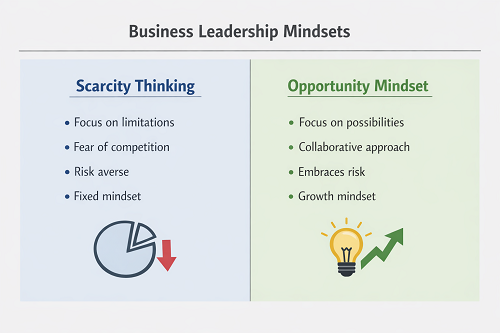
Scarcity thinking occurs when individuals focus primarily on limitations rather than possibilities.
In business contexts, this mindset often develops during periods of financial pressure or uncertainty. Leaders may concentrate heavily on protecting existing resources instead of exploring new opportunities.
While caution can be useful, persistent scarcity thinking may restrict organisational growth.
Moving from Protection to Possibility
Scarcity thinking often begins with a desire to protect what already exists. This can feel sensible, especially after difficult periods. Leaders may focus on conserving time, money, and energy in order to avoid further pressure.
However, when protection becomes the only lens, opportunity becomes harder to see.
Mindset transformation helps leaders move from constant protection to balanced possibility. This does not mean becoming reckless or ignoring constraints. It means learning to ask a wider set of questions:
• What opportunities are we overlooking?
• Are we underinvesting because of fear rather than logic?
• Are we protecting stability at the cost of future growth?
• What would a more balanced decision look like?
These questions help leaders think beyond immediate scarcity. They encourage a more strategic view of resources, possibility, and timing.
Over time, this shift can influence the whole organisation. Teams become more open to ideas, more willing to test improvements, and more confident in navigating uncertainty.
How Scarcity Thinking Limits Growth
When leaders operate from scarcity thinking, they may hesitate to invest in new initiatives even when opportunities appear promising.
Common behaviours associated with scarcity thinking include:
• delaying investment decisions
• avoiding experimentation
• focusing exclusively on short-term stability
• resisting strategic change
Over time, these habits can make organisations less adaptable.
Competitors who adopt more open perspectives may identify opportunities that scarcity-focused organisations overlook.
Developing an Opportunity Mindset
An opportunity mindset does not ignore risk. Instead, it encourages leaders to evaluate both constraints and possibilities simultaneously.
Leaders who cultivate this mindset typically:
• explore multiple strategic options
• remain curious about emerging opportunities
• balance resource management with innovation
• encourage constructive discussion within leadership teams
Reframing Failure
Failure is an inevitable aspect of entrepreneurship. Not every product succeeds, every strategy works, or every investment delivers expected results.
Mindset determines how leaders interpret these outcomes.
Where mindset shifts need to translate into operational change, structured business consulting services can help leaders build systems that support new behaviour.
Some individuals view failure as evidence that an idea should never have been attempted. Others see it as an opportunity to refine their understanding of the market.
Leaders who adopt the second perspective often develop stronger long-term performance.
Learning from Experience
Reframing failure involves examining outcomes carefully rather than reacting emotionally.
Instead of focusing on disappointment, leaders analyse what the experience reveals about their assumptions or strategy.
Key questions may include:
• What factors contributed to this outcome?
• What signals did we miss earlier?
• What adjustments could improve future decisions?
By exploring these questions, leaders convert setbacks into valuable insight.
Creating a Learning Culture
Leadership mindset also shapes organisational culture.
Leadership research published by Harvard Business Review often shows that learning from setbacks is strongly linked to long-term performance and adaptability.
When leaders respond to mistakes with curiosity rather than blame, employees feel more comfortable sharing ideas and taking responsible risks.
This environment encourages innovation and continuous improvement.
Over time, organisations that treat setbacks as learning opportunities often become more resilient and adaptable.
In many cases, this work is reinforced by a trusted business advisor in Ireland who can challenge assumptions and provide perspective during key growth decisions.

Why Experienced Advisors Matter for Leadership Mindset
Mindset work is most effective when guided by experienced advisors.
Without external perspective, leaders often reinforce existing thinking patterns.
Experienced advisors provide:
• objective challenge without internal bias
• pattern recognition across multiple businesses
• structured reflection during high-pressure decisions
• accountability for behavioural change
This independent perspective strengthens both judgement and consistency.
Leadership mindset development becomes increasingly important as organisations scale and decision complexity increases.
When Should You Invest in Mindset Development?
Consider structured mindset development when:
• Decision stress increases
• Delegation resistance appears
• Confidence fluctuates
• Risk tolerance feels extreme
• Leadership behaviour feels reactive
Mindset influences every strategic choice.
Entrepreneurs also benefit from business mentoring services when they want practical perspective alongside mindset development.
Situations Where Mindset Development Becomes Critical
Mindset work becomes particularly important in leadership contexts such as:
- Scaling beyond founder-led decision-making
- Increased pressure and complexity in decision-making
- Difficulty delegating despite team capability
- Leadership misalignment or internal conflict
- Preparing for succession, exit, or reduced operational involvement
In these situations, leaders often combine mindset development with:
- structured insight from the Business Advisory for SME Owners
- behavioural development through the Business Coaching for SME Owners
- practical perspective from the Business Mentoring for SME Owners
FAQ
It is the process of improving how leaders think, decide, and respond to pressure, risk, and uncertainty.
No. Business coaching focuses on performance and goals. Mindset work focuses on the thinking patterns behind decisions.
Yes. Decision quality, risk tolerance, and adaptability are all influenced by mindset.
Usually during growth, delegation challenges, or high-pressure decision periods.
Yes. In many cases, the more complex the business becomes, the more important mindset discipline becomes.
Work on Your Leadership Mindset
If your business is growing but decision pressure is increasing, the constraint is not strategy alone. It is how you think under pressure.
Mindset shapes how you:
- evaluate risk
- make decisions
- respond to uncertainty
- lead through complexity
Without deliberate mindset development, even strong strategies can break down in execution.
Explore our private advisory services and strengthen the thinking patterns that support consistent, high-quality decision-making.
This is not motivation.
This is decision discipline.