

What Is Governance Advisory for SMEs?
Governance is one of those business terms many SME owners associate with large corporations rather than growing private businesses.
Initially, that assumption seems reasonable.
Smaller organisations often operate informally.
Decisions happen quickly.
The founder remains closely involved in daily operations.
Communication flows directly across the business.
However, growth gradually changes this environment.
As organisations become more complex, informal leadership structures often stop working effectively.
Decision-making slows down.
Accountability becomes unclear.
Operational pressure increases.
This is usually when founders begin asking: what is governance advisory for SMEs, and why does it suddenly matter so much?
Because governance is not about unnecessary bureaucracy.
Strong governance advisory helps businesses create the structure, accountability and leadership clarity required to sustain growth successfully.
For a broader overview of strategic advisory support, see Business Advisory for SME Owners.
Governance Is About Decision-Making Clarity
Many people mistakenly reduce governance to policies or formal board procedures.
In reality, governance is fundamentally about how organisations make decisions, manage accountability and oversee risk.
Within SMEs, governance usually involves improving:
- leadership clarity
- reporting structures
- accountability systems
- decision-making processes
- operational oversight
Strong governance helps businesses operate more consistently as complexity increases.
Without it, growth often creates confusion rather than momentum.
Why Governance Becomes More Important During Growth
In early-stage businesses, founders often manage most decisions personally.
This centralised approach can work effectively when:
- teams are small
- operations are simple
- communication remains direct
- organisational complexity stays limited
However, growth changes these dynamics significantly.
As organisations expand, founders can no longer oversee every operational detail directly.
This usually creates pressure around:
- delegation
- accountability
- reporting visibility
- leadership coordination
- strategic alignment
Governance advisory becomes valuable because it helps businesses transition from informal leadership structures towards more sustainable organisational systems.
For more insight into growth complexity and leadership transition, see When Should a Founder Seek Strategic Advisory Support?

Governance Helps Clarify Accountability
One of the first organisational problems governance addresses is accountability confusion.
As businesses grow, responsibilities often evolve informally over time.
This may eventually create:
- overlapping responsibilities
- inconsistent decision-making
- duplicated work
- unclear ownership
- communication breakdowns
Governance advisory helps organisations define:
- who is responsible for what
- how decisions are escalated
- how performance is reviewed
- how accountability is maintained
This clarity improves operational consistency significantly.
Governance Is Not About Slowing the Business Down
Many founders initially resist governance because they fear it will reduce agility.
Poor governance can certainly create unnecessary bureaucracy.
However, strong governance works differently.
Effective governance improves:
- clarity
- consistency
- operational visibility
- leadership alignment
- strategic oversight
When implemented properly, governance often allows businesses to move faster because decisions become more organised and less reactive.
Strong governance supports agility rather than restricting it.
Leadership Alignment Is a Governance Issue
As organisations expand, leadership teams often become less aligned naturally.
Different departments may prioritise competing objectives.
For example:
- sales may prioritise growth
- finance may focus on profitability
- operations may prioritise consistency
- founders may pursue innovation
Without governance structures supporting alignment, organisations become strategically fragmented.
Governance advisory helps leadership teams establish:
- clearer decision rights
- reporting discipline
- accountability consistency
- strategic alignment
This strengthens organisational cohesion over time.
For more insight into leadership alignment and strategic clarity, see What Is a Business Strategy Advisor?
Governance Helps Reduce Founder Dependency
Founder dependency remains one of the most common SME risks.
Initially, founders often remain central to:
- operational approvals
- strategic decisions
- communication
- problem-solving
- leadership oversight
While this may feel necessary, it eventually limits scalability.
The organisation becomes overly reliant on one individual.
Governance advisory helps businesses distribute leadership responsibility more effectively through:
- clearer reporting systems
- accountability structures
- delegated authority
- operational visibility
This reduces pressure on founders while strengthening organisational sustainability.
Research from the Institute of Directors has also highlighted how governance maturity supports long-term business resilience and leadership continuity.

Governance Supports Better Risk Oversight
As businesses scale, risk exposure increases significantly.
This may involve:
- financial risk
- operational dependency
- leadership instability
- compliance concerns
- strategic misalignment
Without governance structures, these risks may remain poorly monitored or inconsistently managed.
Governance advisory helps organisations improve:
- risk visibility
- decision-making discipline
- leadership oversight
- escalation procedures
This creates more sustainable organisational management over time.
For more insight into organisational oversight and accountability, see Risk Oversight Frameworks for SMEs.
Governance Often Improves Communication
Many organisational problems are actually communication problems disguised as operational issues.
This often appears through:
- inconsistent reporting
- unclear priorities
- fragmented decision-making
- reactive leadership communication
Governance structures help improve communication by clarifying:
- reporting expectations
- leadership responsibilities
- escalation channels
- accountability systems
As communication improves, operational friction often decreases naturally.
Governance Advisory Frequently Overlaps with Strategic Advisory
Governance rarely operates in isolation.
As organisations grow, governance discussions often overlap with:
- strategy
- leadership development
- organisational structure
- succession planning
- long-term sustainability
This is why governance advisory frequently becomes part of broader strategic advisory relationships.
For more insight into strategic advisory relationships, see Long-Term Strategic Advisory Relationships.
Governance Helps Businesses Scale More Sustainably
Many businesses grow operationally before their leadership structures are ready.
Initially, this imbalance may not appear obvious.
However, over time it often creates:
- leadership fatigue
- accountability gaps
- inconsistent execution
- communication breakdowns
- organisational instability
Governance advisory helps businesses strengthen the organisational foundations required to sustain long-term growth effectively.
This becomes increasingly valuable as complexity increases.
Research from Deloitte Insights has also explored how governance maturity and leadership alignment strongly influence organisational resilience and scalability.
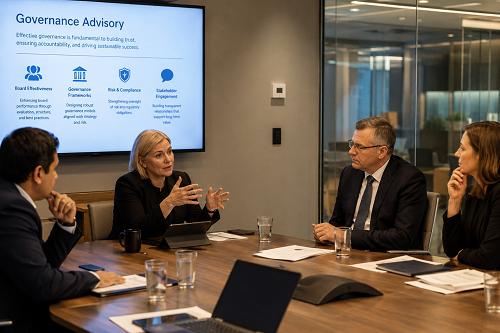
How Governance Advisory Connects with Broader Support
Governance advisory often overlaps with:
- strategic management consulting
- executive coaching
- operational consulting
- organisational development
- leadership advisory
Understanding these overlaps helps SMEs apply the right support at the right stage of growth.
In more advanced situations, organisations may also benefit from broader support through Strategic Management & Governance for SMEs.
Final Thoughts
So, what is governance advisory for SMEs?
At a practical level, it helps businesses improve:
- accountability
- leadership clarity
- operational oversight
- decision-making consistency
- organisational structure
- long-term sustainability
Because ultimately, sustainable growth depends not only on ambition and opportunity, but also on whether the organisation is structured clearly enough to handle increasing complexity responsibly.