

Most SME owners think about risk only when something goes wrong.
A major client leaves.
Cash flow tightens unexpectedly.
Operational problems escalate.
Leadership tension increases.
Growth begins creating instability instead of momentum.
At that point, risk suddenly becomes visible.
However, effective businesses rarely wait for visible problems before evaluating vulnerability.
This is where understanding the role of risk oversight in SME advisory becomes increasingly important.
Because strong advisory support is not only about growth and opportunity.
It is also about helping businesses identify operational, strategic and leadership risks before they begin damaging organisational stability.
For a broader overview of advisory support, see Business Advisory for SME Owners.
Risk in SMEs Often Develops Quietly
Unlike sudden crises, most business risks build gradually over time.
Initially, organisations may appear stable externally while hidden vulnerabilities quietly increase beneath the surface.
This may involve:
- founder dependency
- operational bottlenecks
- governance weakness
- leadership misalignment
- poor reporting visibility
Because SMEs often operate quickly and informally, these issues can remain unnoticed until pressure exposes them.
Strong risk oversight helps businesses identify patterns before they become disruptive.
Risk Oversight Is About Visibility
Many founders associate risk management with excessive corporate bureaucracy.
In reality, effective risk oversight is usually much simpler.
At its core, risk oversight involves improving visibility around:
- decision-making
- accountability
- operational dependencies
- leadership weaknesses
- organisational exposure
The objective is not eliminating all risk.
The objective is ensuring leadership understands where vulnerability exists and whether the organisation is equipped to manage it properly.
For more insight into governance and accountability, see What Is Governance Advisory for SMEs?
Growth Often Increases Organisational Risk
One common misconception is that growth automatically strengthens businesses.
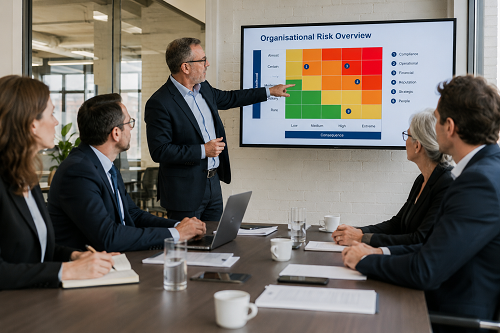
In reality, growth frequently increases risk exposure significantly.
As organisations scale, complexity expands across:
- staffing
- operations
- financial commitments
- leadership coordination
- customer expectations
Without stronger governance and oversight, growth can create instability rather than sustainability.
This is why many SMEs experience operational strain precisely during periods of rapid expansion.
Risk oversight helps leadership evaluate whether organisational structure is evolving alongside business growth.
Founder Dependency Is a Major SME Risk
One of the most common SME vulnerabilities is founder dependency.
Initially, founders often remain central to:
- operational approvals
- strategic decisions
- customer relationships
- financial oversight
- problem-solving
While this may work during early growth stages, it eventually creates significant organisational risk.
If too much knowledge or authority sits with one individual, scalability becomes limited and operational resilience weakens.
Advisory support often helps businesses reduce founder dependency through:
- delegation structures
- accountability systems
- reporting clarity
- leadership development
This improves organisational sustainability over time.
For more insight into founder leadership challenges, see When Should a Founder Seek Strategic Advisory Support?
Leadership Misalignment Creates Strategic Risk
Risk is not always financial or operational.
Leadership misalignment itself can create major organisational instability.
This often appears through:
- conflicting priorities
- inconsistent communication
- unclear accountability
- reactive decision-making
- fragmented strategic direction
Without alignment, organisations often drift strategically even while remaining operationally busy.
Advisory relationships help leadership teams maintain:
- strategic clarity
- communication consistency
- governance discipline
- decision-making alignment
This reduces organisational friction significantly.
Research from the Diligent has also highlighted how governance clarity and leadership accountability reduce organisational vulnerability during periods of growth and complexity.
Operational Risk Often Comes from Weak Visibility
Many operational problems escalate simply because leadership lacks visibility early enough.
For example:
Businesses may not notice:
- accountability gaps
- workflow inefficiencies
- reporting inconsistency
- communication breakdowns
until operational performance starts deteriorating.
Strong risk oversight improves organisational visibility through:
- reporting systems
- governance structures
- accountability clarity
- operational monitoring
This allows businesses to respond earlier and more strategically.
For more insight into operational structure and organisational efficiency, see Efficient Business Consulting: What Does Efficiency Mean?
Risk Oversight Supports Better Decision-Making
Businesses rarely eliminate uncertainty completely.
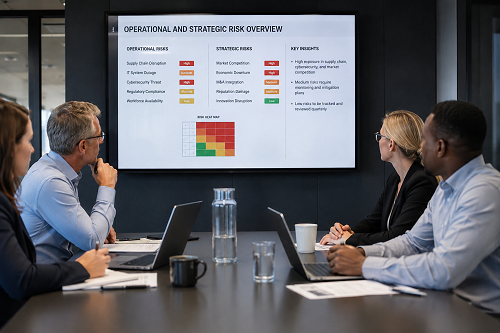
However, strong advisory support improves how leaders evaluate uncertainty itself.
This usually involves helping leaders:
- identify exposure earlier
- evaluate consequences more realistically
- improve strategic discipline
- avoid reactive decision-making
Risk oversight strengthens leadership thinking rather than encouraging fear or excessive caution.
The objective is making more informed and more sustainable decisions.
Governance and Risk Are Closely Connected
As businesses scale, governance and risk oversight become increasingly interconnected.
Weak governance often creates:
- unclear authority
- inconsistent reporting
- poor accountability
- leadership blind spots
These weaknesses frequently increase organisational risk significantly.
Strong governance structures improve:
- oversight
- communication
- escalation clarity
- decision-making consistency
This creates more resilient organisational systems overall.
For more insight into governance development and leadership structure, see Advisory vs Non-Executive Director.
Risk Oversight Helps Businesses Stay Objective
During stressful periods, leadership teams can become highly reactive emotionally.
This may lead to:
- rushed decisions
- excessive optimism
- defensive leadership behaviour
- poor strategic judgement
External advisory support often helps businesses maintain objectivity during uncertain periods.
Advisors provide independent perspective without internal politics or emotional attachment influencing analysis.
This improves leadership judgement significantly during periods of complexity.
Sustainable Businesses Monitor Organisational Health Continuously
Strong businesses do not treat risk oversight as a one-time exercise.
Instead, they continuously evaluate organisational health across areas such as:
- governance
- leadership alignment
- operational visibility
- accountability
- strategic execution
This ongoing oversight helps businesses adapt before problems escalate operationally.
Long-term advisory relationships often strengthen this process because advisors gradually develop deeper organisational understanding over time.
Research from Deloitte Insights has also explored how governance maturity and proactive oversight strengthen organisational resilience and long-term sustainability.

How Risk Oversight Connects with Broader Advisory Support
Risk oversight often overlaps with:
- governance advisory
- strategic planning
- executive coaching
- organisational development
- leadership alignment
Understanding these overlaps helps SMEs strengthen organisational resilience more effectively.
In more advanced situations, organisations may also benefit from broader support through Strategic Management & Governance for SMEs.
Final Thoughts
So, why does risk oversight matter in SME advisory?
Because organisational vulnerability rarely appears suddenly.
It usually develops gradually through:
- weak governance
- poor visibility
- leadership misalignment
- operational dependency
- reactive decision-making
Strong advisory support helps businesses identify these risks earlier, improve organisational oversight and make more disciplined long-term decisions as complexity increases.