

Many business owners initially believe growth depends mainly on strategy, operations or market conditions.
While these factors are important, leadership mindset often influences business performance far more than many founders realise.
The way leaders think affects how they:
- handle pressure
- approach uncertainty
- communicate with teams
- respond to setbacks
- make strategic decisions
This is why many founders eventually begin exploring how mindset affects business growth more seriously.
Because organisations often reflect the mindset patterns of their leadership teams.
Founders operating from fear, emotional reactivity or rigid thinking frequently create environments that limit growth and adaptability.
Meanwhile, leaders with healthier mindset patterns often build businesses that are more resilient, focused and sustainable over time.
As organisations scale, leadership mindset frequently becomes directly connected to:
- organisational culture
- strategic clarity
- leadership consistency
- decision-making quality
For a broader overview of mindset development and leadership psychology, see What Is Mindset Transformation?
Leadership Mindset Influences Decision-Making
Business growth depends heavily on decision quality.
Leaders constantly make decisions involving:
- hiring
- delegation
- investment
- communication
- strategic direction
However, mindset strongly influences how those decisions are approached.
Founders operating from fear or insecurity may become overly cautious, emotionally reactive or resistant to change.
This often weakens organisational adaptability and slows growth.
In contrast, leaders with healthier mindset patterns usually make decisions with greater:
- perspective
- emotional balance
- confidence
- long-term thinking
Over time, these differences significantly affect organisational performance.
Fear-Based Leadership Often Restricts Growth
Many businesses become limited by leadership fear rather than external conditions.
Founders may fear:
- failure
- criticism
- losing control
- delegation
- uncertainty
Without awareness, these fears frequently influence behaviour unconsciously.
This may create leadership patterns involving:
- micromanagement
- inconsistent communication
- poor delegation
- reactive decision-making
These behaviours often weaken organisational trust and operational scalability.
Mindset development helps leaders recognise fear-based patterns earlier and respond more intentionally.

Organisational Culture Reflects Leadership Thinking
Leadership mindset strongly influences organisational culture.
Leaders who operate with emotional stability, adaptability and clarity often create healthier working environments.
Meanwhile, reactive or fear-driven leadership frequently creates:
- tension
- confusion
- low morale
- inconsistent communication
Over time, organisational culture begins reflecting the behavioural habits and emotional patterns of leadership.
This is why mindset development is often far more strategic than many founders initially assume.
Healthy leadership thinking patterns usually strengthen:
- trust
- communication
- collaboration
- organisational resilience
For more insight into communication and behavioural consistency, see Communication Mastery for Leaders.
Growth Requires Adaptability
As businesses evolve, leadership requirements constantly change.
A founder who successfully builds a small business may eventually need entirely different skills to lead a larger organisation.
Without adaptability, leaders often struggle with:
- delegation
- leadership transition
- organisational scaling
- strategic complexity
Rigid thinking patterns frequently create resistance to necessary change.
Mindset growth helps leaders become more psychologically flexible and open to development.
This adaptability often improves organisational scalability significantly.
Emotional Resilience Supports Sustainable Growth
Business growth frequently creates pressure involving:
- financial uncertainty
- staffing challenges
- operational complexity
- strategic risk
Without emotional resilience, leaders often become overwhelmed during difficult periods.
This may lead to:
- emotional decision-making
- inconsistent leadership
- communication problems
- burnout
Mindset development often helps leaders strengthen emotional resilience by improving:
- perspective
- emotional regulation
- confidence under pressure
- recovery after setbacks
This usually supports healthier long-term organisational growth.
Research from IESE Business School has explored how leadership mindset, emotional intelligence and adaptability influence sustainable business growth and executive performance.

Self-Awareness Often Improves Organisational Leadership
Many mindset patterns operate unconsciously.
Leaders may not initially recognise how emotional habits and internal beliefs influence organisational behaviour.
Self-awareness helps founders identify patterns involving:
- control
- perfectionism
- emotional reactivity
- fear-based leadership
This awareness often improves leadership clarity and communication significantly.
Without self-awareness, unhealthy patterns frequently continue automatically and eventually influence organisational culture negatively.
For more insight into leadership awareness and behavioural growth, see Self-Awareness in Leadership.
Growth Often Requires Letting Go of Old Habits
Some founders unintentionally limit business growth because they continue operating with habits that worked only during earlier stages.
For example, leaders may struggle to release operational control or trust senior teams fully.
Over time, this frequently creates:
- decision bottlenecks
- slower execution
- leadership exhaustion
- reduced scalability
Mindset transformation helps leaders recognise when old habits no longer support organisational growth.
This reflective process often strengthens strategic leadership considerably.
Confidence Influences Organisational Momentum
Leadership confidence affects how organisations respond to uncertainty.
Confident leaders often communicate with greater:
- clarity
- calmness
- consistency
- direction
Meanwhile, emotionally unstable leadership frequently creates organisational anxiety and confusion.
Importantly, healthy confidence is not based purely on ego or certainty.
Instead, sustainable confidence often comes from:
- emotional resilience
- perspective
- adaptability
- self-awareness
This type of leadership stability usually improves organisational momentum significantly.
Reflection Helps Leaders Improve Thinking Patterns
Meaningful mindset growth rarely happens automatically.
Strong leaders often create space for reflection around:
- leadership habits
- emotional reactions
- communication patterns
- strategic behaviour
This process helps leaders evaluate whether current thinking patterns are helping or limiting long-term growth.
Research from the National Library of Medicine has also explored how reflective leadership thinking and adaptive mindset improve executive performance and organisational innovation.
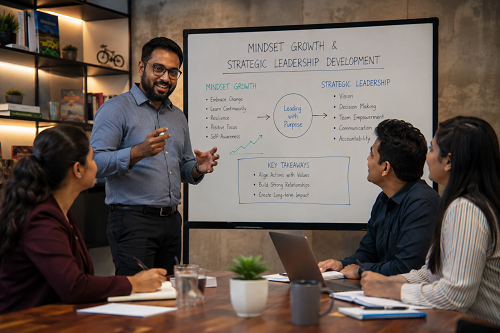
How Mindset Development Connects with Broader Leadership Growth
Mindset development often overlaps with:
- emotional resilience
- leadership communication
- executive coaching
- strategic thinking
- organisational leadership
Understanding these overlaps helps founders build healthier and more sustainable leadership structures as businesses grow.
In more advanced situations, leaders may also benefit from broader support through Mindset for SME Leaders.
Final Thoughts
So, how does mindset affect business growth?
At a practical level, leadership mindset influences behaviour, communication, decision-making and organisational culture.
Without healthy mindset development, businesses often become vulnerable to fear-based leadership, emotional inconsistency and operational stagnation.
Ultimately, founders who strengthen mindset often build healthier, more adaptable and more sustainable organisations as complexity and responsibility continue increasing.