

As businesses grow, leadership challenges often become increasingly psychological rather than purely operational.
Many founders eventually realise that technical skill and business knowledge alone are not enough to sustain long-term organisational growth.
The way leaders think strongly influences how they respond to:
- setbacks
- uncertainty
- criticism
- change
- leadership pressure
This is why understanding fixed vs growth mindset in leadership becomes increasingly important for founders and executives.
A fixed mindset typically assumes abilities, intelligence and leadership capability are largely permanent and unchangeable.
A growth mindset, meanwhile, views learning, adaptation and development as ongoing processes.
These differences may appear subtle initially, but over time they often influence:
- leadership behaviour
- emotional resilience
- organisational culture
- strategic adaptability
As organisations scale, leadership mindset frequently becomes directly connected to long-term business sustainability and growth.
For a broader overview of leadership mindset development, see Why High Performers Invest in Mindset Work.
Fixed Mindset Often Creates Fear-Based Leadership
Leaders operating from a fixed mindset frequently fear appearing weak, wrong or incapable.
Because leadership identity becomes closely connected to competence, mistakes may feel personally threatening rather than educational.
Over time, this often creates behaviours involving:
- defensiveness
- perfectionism
- resistance to feedback
- fear of failure
Founders with rigid mindset patterns may avoid difficult conversations or new challenges because uncertainty feels emotionally uncomfortable.
Unfortunately, this frequently limits organisational adaptability and leadership growth.
Growth Mindset Encourages Adaptability
Leaders with a growth mindset usually approach challenges differently.
Rather than viewing setbacks as evidence of personal inadequacy, they often see them as opportunities for reflection and improvement.
This mindset frequently encourages:
- curiosity
- adaptability
- emotional resilience
- long-term learning
Importantly, growth-oriented leaders do not avoid responsibility or ignore mistakes.
Instead, they generally become more willing to learn from experience and adjust behaviour when necessary.
This adaptability often improves leadership sustainability considerably over time.
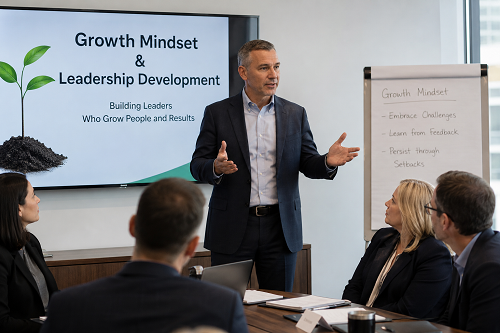
Leadership Communication Is Strongly Influenced by Mindset
Mindset patterns often affect communication quality significantly.
Leaders operating from fear or insecurity may unintentionally communicate through:
- defensiveness
- emotional tension
- control
- frustration
Meanwhile, growth-oriented leaders usually communicate with greater openness and perspective.
This often improves:
- organisational trust
- team morale
- collaboration
- leadership credibility
Over time, healthier communication patterns strengthen organisational culture and leadership effectiveness considerably.
For more insight into communication and leadership behaviour, see Communication Mastery for Leaders.
Fixed Thinking Often Limits Organisational Growth
Businesses frequently struggle when leadership thinking becomes psychologically rigid.
Founders operating from fixed mindset patterns may:
- avoid delegation
- resist organisational change
- fear strategic risk
- reject constructive feedback
This rigidity often weakens scalability because growing businesses require leaders who can adapt continuously.
Without adaptability, organisations frequently become:
- operationally stagnant
- emotionally tense
- strategically limited
Growth mindset patterns help leaders remain more flexible during uncertainty and organisational change.
Emotional Resilience Is Closely Connected to Mindset
Leadership pressure inevitably creates emotional strain.
Founders regularly face uncertainty involving:
- finances
- staffing
- competition
- strategic complexity
Leaders with fixed mindset patterns often interpret setbacks personally, which may weaken emotional resilience over time.
Growth-oriented leaders, however, usually recover more constructively because they maintain broader perspective during challenges.
This often improves:
- confidence
- emotional discipline
- recovery after setbacks
- long-term sustainability
For more insight into resilience and emotional regulation, see Building Emotional Resilience.
Self-Awareness Helps Leaders Recognise Limiting Patterns
Many mindset habits operate automatically.
Founders may not initially recognise how beliefs and assumptions influence leadership behaviour.
Self-awareness helps leaders identify patterns involving:
- fear of criticism
- perfectionism
- emotional reactivity
- resistance to change
This awareness often becomes the starting point for meaningful mindset growth.
Without self-awareness, leaders frequently continue repeating limiting behaviours unconsciously.
Research from the University of California, Berkeley Greater Good Science Center has explored how growth mindset, emotional intelligence and reflective thinking improve leadership resilience and organisational effectiveness.

Growth-Oriented Leaders Often Encourage Healthier Cultures
Leadership mindset strongly influences organisational culture.
Leaders with growth-oriented thinking often create environments where:
- learning is encouraged
- mistakes are discussed constructively
- communication remains open
- adaptability is valued
Meanwhile, fear-based leadership frequently creates cultures involving:
- blame
- emotional tension
- defensiveness
- reduced innovation
Over time, these cultural differences significantly affect organisational performance and employee engagement.
Leadership Growth Requires Reflection
Mindset transformation rarely happens automatically.
Many experienced leaders intentionally reflect on:
- emotional reactions
- communication habits
- behavioural patterns
- leadership assumptions
This reflective process helps founders evaluate whether their thinking patterns are supporting or limiting long-term growth.
Leaders who avoid reflection often become trapped in repetitive behavioural cycles that weaken resilience and organisational effectiveness.
For more insight into reflective leadership development, see Self-Awareness in Leadership.
Growth Mindset Supports Long-Term Leadership Sustainability
Sustainable leadership requires continuous adaptation.
As organisations scale, leaders must evolve psychologically as well as operationally.
Growth mindset patterns help founders become more willing to:
- learn continuously
- seek feedback
- adapt communication
- improve leadership behaviour
This usually strengthens long-term leadership sustainability and organisational resilience considerably.
Importantly, growth-oriented leadership often improves not only business performance, but also personal wellbeing and emotional balance.
Research from Stanford Graduate School of Business has also explored how adaptive leadership thinking and growth-oriented behaviour influence executive development and organisational performance.
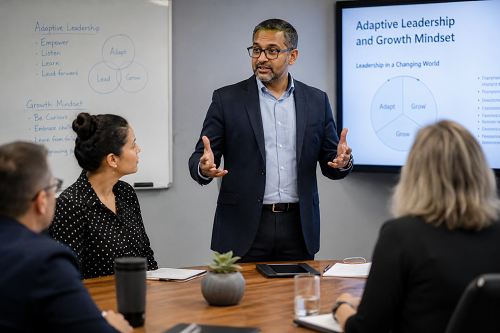
How Growth Mindset Connects with Broader Leadership Development
Growth mindset development often overlaps with:
- emotional resilience
- leadership communication
- executive coaching
- personal development
- strategic adaptability
Understanding these overlaps helps founders build healthier and more sustainable leadership structures as organisational complexity increases.
In more advanced situations, leaders may also benefit from broader support through Mindset for SME Leaders.
Final Thoughts
So, why does fixed vs growth mindset matter in leadership?
Because leadership mindset strongly influences how founders respond to pressure, change and uncertainty.
Without growth-oriented thinking, leaders often become vulnerable to fear-based decision-making, emotional rigidity and organisational stagnation.
Ultimately, leaders who develop healthier mindset patterns often become more adaptable, resilient and effective as business complexity and leadership responsibility continue growing.