

Business growth is often associated with strategy, marketing, finance and operational excellence.
While these factors undoubtedly contribute to success, they are not the only influences on organisational performance. Behind every business decision is a leader whose mindset shapes how opportunities are evaluated, risks are managed and challenges are addressed.
Mindset influences confidence, resilience, adaptability and decision-making. It determines whether leaders view obstacles as reasons to stop or opportunities to learn and improve. For this reason, mindset is frequently one of the most overlooked drivers of business growth.
Understanding the connection between mindset and growth can help SME leaders create stronger foundations for long-term success.
For a broader understanding of leadership thinking and development, see our guide to Mindset for SME Leaders.
Growth Begins with Leadership Thinking
Every organisation reflects the leadership behind it.
Leaders establish priorities, make decisions and shape organisational culture. Their beliefs and assumptions influence how resources are allocated, how opportunities are pursued and how teams respond to challenges.
A leader who believes growth is possible is often more willing to invest in development, innovation and expansion. Conversely, leaders who focus primarily on limitations may become cautious even when opportunities are available.
Mindset does not replace strategy, but it often influences whether effective strategies are pursued and implemented successfully.
Leaders seeking a deeper understanding of mindset development may also find our article What Is Mindset Transformation? helpful.
Mindset Influences Risk-Taking
Growth frequently requires calculated risk.
Expanding into new markets, hiring additional employees, investing in technology or launching new services all involve uncertainty. The way leaders perceive risk often determines whether these opportunities are explored or avoided.
A growth-oriented mindset encourages thoughtful evaluation rather than automatic avoidance. Leaders become more willing to assess opportunities objectively and take informed action when appropriate.
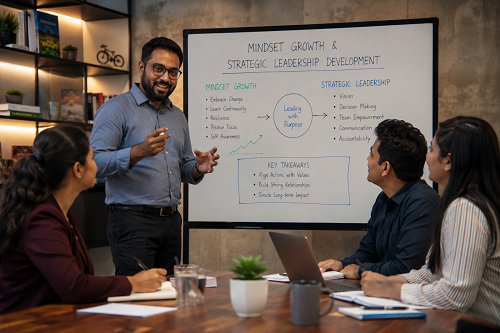
Resilience Supports Sustainable Growth
Setbacks, unexpected challenges and market changes are inevitable. Leaders who lack resilience may struggle to maintain momentum when difficulties arise. Those with stronger mindsets are often better equipped to adapt and continue progressing.
Resilience helps leaders view setbacks as temporary rather than permanent. Instead of focusing exclusively on what went wrong, they examine lessons and identify ways to move forward.
Research from the Stanford Graduate School of Business highlights how mindset influences learning, adaptability and leadership effectiveness.
Mindset Shapes Organisational Culture
Leadership mindset extends beyond individual performance.
The attitudes and behaviours demonstrated by leaders often influence organisational culture. Teams observe how leaders respond to mistakes, opportunities and challenges. Over time, these behaviours shape the beliefs and actions of employees.
Leaders who encourage learning, adaptability and constructive problem-solving often create cultures that support innovation and growth. Those who operate from fear or excessive caution may unintentionally limit initiative and creativity.
As a result, mindset can influence not only leadership effectiveness but also organisational performance.
Leaders interested in strengthening personal growth may also find our article Why High Performers Invest in Mindset Work helpful.

Final Thoughts
Mindset plays a significant role in business growth because it influences leadership decisions, organisational culture and the ability to respond to challenges effectively.
Leaders who develop growth-oriented thinking are often more resilient, adaptable and willing to pursue opportunities that support long-term success. While strategy and execution remain important, mindset frequently determines how effectively those capabilities are applied.
For SME leaders seeking sustainable growth, investing in mindset development can be one of the most valuable decisions they make.
Looking to Unlock Greater Business Growth?
Growth often begins with the way leaders think. The beliefs and assumptions that influence decisions can either create opportunities or limit potential.
An experienced advisor can help you strengthen your mindset, challenge limiting beliefs and develop a leadership approach that supports sustainable business growth.
Learn more about our Private Advisory services and discover how we help SME leaders, founders and business owners strengthen leadership effectiveness and achieve meaningful long-term success.
FREQUENTLY ASKED QUESTIONS
How does mindset affect business growth?
Mindset influences how leaders approach challenges, opportunities and decision-making. A positive and growth-oriented mindset encourages innovation, calculated risk-taking and adaptability, all of which support business growth. Leaders with effective mindsets are often better equipped to navigate uncertainty, inspire teams and maintain focus on long-term objectives, contributing to stronger organisational performance.
Can mindset limit business success?
Yes. Limiting beliefs, fear of failure and negative thinking patterns can significantly restrict business growth. Leaders who doubt their abilities or avoid challenges may miss valuable opportunities for innovation and expansion. Over time, these mindset barriers can affect decision-making, reduce confidence and prevent organisations from reaching their full potential.
What is a growth mindset in business?
A growth mindset is the belief that skills, knowledge and abilities can be developed through effort, learning and experience. In business, leaders with a growth mindset view challenges as opportunities to improve rather than obstacles to avoid. This perspective encourages continuous development, resilience and innovation, helping organisations adapt and grow in changing environments.
Why is resilience important for business growth?
Resilience enables leaders to recover from setbacks, manage uncertainty and maintain progress during difficult periods. Business growth rarely occurs without challenges, and resilient leaders are more likely to persevere when facing obstacles. By learning from setbacks and adapting to change, they can sustain momentum and continue pursuing long-term goals successfully.
Can mindset influence organisational culture?
Yes. Leadership mindset has a direct impact on organisational culture because employees often reflect the attitudes and behaviours demonstrated by leaders. A positive, growth-oriented mindset can encourage collaboration, innovation and accountability. Conversely, negative or limiting attitudes may affect morale and engagement. Over time, leadership mindset helps shape workplace performance and culture.