

Many business owners associate risk management with large corporations, regulatory requirements and complex governance structures.
In reality, risk oversight is equally important for SMEs. In some respects, it can be even more important because smaller organisations often have fewer resources available to absorb the consequences of unexpected events.
Whether the risk relates to finances, people, operations, customers or strategy, business owners benefit from understanding potential vulnerabilities before they develop into serious challenges. This is one of the reasons risk oversight forms an important part of effective business advisory.
Advisory support helps leaders identify risks, evaluate potential impacts and strengthen decision-making so that businesses are better prepared for uncertainty.
For a broader understanding of strategic leadership support, see our guide to Business Advisory for SME Owners.
Risk Is Not Just About Avoiding Problems
Many people view risk solely as something negative.
However, risk is closely connected to opportunity. Every major business decision involves some degree of uncertainty. Expanding into a new market, recruiting senior staff, investing in equipment or launching new services all involve risk alongside potential reward.
Effective risk oversight is not about eliminating uncertainty altogether. It is about understanding the risks involved and ensuring decisions are made with appropriate awareness and preparation.
Advisors help business owners evaluate opportunities more objectively by considering both the potential benefits and potential consequences of important decisions.
Business owners interested in broader leadership support may also find our article What Does a Business Advisor Do? useful.
Growth Often Introduces New Risks
As businesses grow, their risk profile frequently changes.
New employees, larger customer bases, increased financial commitments and more complex operational structures create additional challenges that may not have existed during the early stages of the business.
Many SME owners remain focused on opportunities while unintentionally overlooking emerging vulnerabilities. Advisory support helps leaders maintain a balanced perspective by ensuring risks receive appropriate attention alongside growth objectives.
This often allows organisations to expand more confidently because they have considered potential obstacles before they arise.
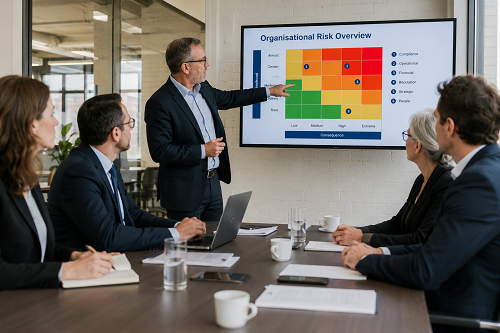
Strategic Risks Often Receive Less Attention
Operational risks are usually easier to identify.
Issues such as staffing shortages, supplier problems or cash flow concerns tend to be visible because they affect day-to-day activities. Strategic risks are often more difficult to recognise.
Examples may include overreliance on a key customer, failure to adapt to market changes, inadequate succession planning or pursuing growth without sufficient organisational capability.
These risks can have significant long-term consequences if left unaddressed. Advisors help business owners examine the wider picture and identify vulnerabilities that may not be immediately obvious.
Research from the Chartered Governance Institute highlights the importance of governance and risk oversight in supporting organisational resilience and long-term sustainability.
Risk Oversight Supports Better Governance
Strong governance and effective risk oversight are closely connected.
Governance structures help ensure risks are identified, discussed and monitored appropriately. This does not require complicated systems or excessive administration. For most SMEs, practical oversight processes are often sufficient.
Advisors frequently help organisations establish routines that encourage better discussion around risk, accountability and decision-making. These processes help leaders respond proactively rather than reactively when challenges emerge.
Business owners exploring governance structures may also find our article What Is Governance Advisory for SMEs? helpful.

Final Thoughts
Risk oversight is not about becoming overly cautious or avoiding every potential challenge. It is about ensuring that business owners understand the risks associated with important decisions and are prepared to manage them appropriately.
As organisations grow, risks often become more diverse and more complex. Financial pressures, operational dependencies, leadership challenges and strategic uncertainties can all influence long-term success. Effective advisory support helps leaders evaluate these issues objectively and maintain a balanced approach to growth and decision-making.
For many SMEs, risk oversight provides an opportunity to strengthen resilience, improve governance and ensure opportunities are pursued with a clear understanding of both potential rewards and potential consequences.
Need an Independent Perspective?
Every business faces uncertainty. The difference often lies in how effectively leaders identify, evaluate and respond to potential risks before they become serious problems.
An experienced advisor can help assess strategic, operational and organisational risks while providing objective perspective on important business decisions. The goal is not to discourage growth but to ensure growth is supported by sound judgement and effective oversight.
Learn more about our Private Advisory services and how they help SME owners strengthen governance, improve decision-making and build more resilient organisations.
FREQUENTLY ASKED QUESTIONS
What is risk oversight in business advisory?
Risk oversight in business advisory involves helping business owners identify, evaluate and monitor potential risks that may impact organisational performance, growth and long-term sustainability. It provides a structured approach to understanding challenges, improving decision-making and ensuring businesses are better prepared to manage uncertainty and achieve their strategic goals effectively.
Why is risk oversight important for SMEs?
Risk oversight is important for SMEs because they often operate with limited resources and may face greater impacts from unexpected challenges. A strong risk oversight approach helps business leaders anticipate possible threats, improve planning, strengthen resilience and make informed decisions that support stability, growth and long-term business success.
What types of risks should SMEs monitor?
SMEs should monitor different types of risks that may affect their operations and future growth. These include financial risks, operational challenges, leadership and management concerns, customer dependency, market changes, succession planning issues and strategic decision-making risks that could influence business performance and sustainability.
How does an advisor help with risk oversight?
An advisor supports risk oversight by providing an independent perspective and helping business owners identify areas of vulnerability. They encourage structured conversations around risk management, governance and strategic decisions while offering guidance that helps leaders develop practical solutions and improve their ability to respond to potential challenges.
Does risk oversight slow business growth?
No, risk oversight does not slow business growth. Instead, it helps businesses grow more confidently by identifying possible challenges and supporting better-informed decisions. Effective risk oversight allows leaders to balance opportunities with potential risks, improve planning and create a stronger foundation for sustainable business development.