

Many SME owners begin exploring external support once business growth starts creating pressures that instinct and experience no longer solve easily.
At first, most founder-led businesses operate through speed, flexibility and direct oversight. Communication remains simple. Decision-making happens quickly. Operational visibility stays relatively clear.
However, growth gradually changes the environment.
Teams expand.
Leadership pressure increases.
Operational complexity becomes harder to manage consistently.
This is usually when the discussion around a small business mentor vs consultant becomes more relevant.
Because although both roles provide guidance and external perspective, they solve very different organisational challenges in practice.
Some businesses require stronger operational structure.
Others need clearer leadership thinking.
Increasingly, many growing SMEs eventually require both.
For a broader overview of consulting support structures, see What Is Small Business Consulting?
Why the Distinction Matters More During Growth
Early-stage businesses often rely heavily on founder involvement.
Initially, this can work extremely well because the organisation remains relatively simple. Founders oversee communication directly, maintain close relationships with teams and make decisions quickly.
Growth complicates this structure.
Over time, founders begin facing:
- competing operational priorities
- communication inconsistency
- delegation difficulties
- accountability pressure
- strategic uncertainty
At this point, many leaders start searching for external support without fully understanding which type of guidance the business actually requires.
This creates confusion because mentoring and consulting are frequently grouped together despite operating very differently.
A mentor usually focuses more heavily on the founder.
A consultant usually focuses more heavily on the organisation itself.
Understanding this distinction helps businesses avoid applying the wrong solution to the wrong problem.
Mentoring Often Focuses on the Founder’s Thinking
Mentoring relationships usually centre around perspective, leadership development and strategic reflection.
Rather than concentrating heavily on operational systems, mentors typically help founders think more clearly about challenges affecting the business and their role within it.
These conversations often explore areas such as:
- leadership confidence
- communication style
- strategic decision-making
- founder pressure
- delegation challenges
- long-term direction
Many SME owners spend most of their time reacting operationally. Mentoring creates space to step back and think more objectively.
For example, a founder may begin recognising patterns such as:
- becoming overly involved operationally
- avoiding difficult decisions
- struggling to trust senior staff
- losing strategic focus during growth
Strong mentoring helps leaders identify these behaviours earlier before they begin affecting organisational performance more seriously.
For more insight into leadership-focused support, see Business Mentor vs Business Coach: What’s the Difference?

Consulting Usually Concentrates More on Organisational Performance
Consulting relationships tend to operate differently.
Rather than focusing primarily on the founder’s mindset or leadership behaviour, consultants usually examine how the business itself functions operationally.
This often includes reviewing:
- workflows
- accountability structures
- reporting visibility
- communication systems
- operational efficiency
- leadership alignment
As SMEs grow, businesses often become more operationally complicated than founders initially expected.
Initially, informal communication and founder oversight may feel efficient.
Over time, however, this structure often creates pressure around:
- decision-making
- delegation
- accountability
- operational consistency
- execution quality
Consultants help businesses strengthen organisational structure before these issues create wider instability.
For example, consulting support may involve improving:
- delegation systems
- management accountability
- reporting structures
- operational clarity
- workflow efficiency
Businesses exploring these areas often review Efficient Business Consulting: What Does Efficiency Mean?
The Biggest Difference Usually Comes Down to Focus
One of the clearest ways to understand the small business mentor vs consultant distinction is this:
Mentors primarily help improve leadership thinking.
Consultants primarily help improve business structure and operational performance.
That does not mean mentors lack commercial awareness.
And it certainly does not mean consultants ignore leadership behaviour entirely.
However, the core emphasis differs.
Mentoring conversations often involve:
- strategic perspective
- founder confidence
- leadership communication
- personal decision-making
- long-term thinking
Consulting conversations usually focus more heavily on:
- organisational structure
- operational execution
- scalability
- accountability
- efficiency
- performance visibility
Both forms of support create value.
The important issue is identifying where the greatest pressure currently exists inside the organisation.
Growth Usually Creates Leadership and Operational Pressure Simultaneously
One reason businesses eventually benefit from both mentoring and consulting is that growth rarely creates isolated problems.
Operational complexity often increases at the same time leadership pressure intensifies.
Founders may begin feeling:
- strategically overwhelmed
- increasingly reactive
- disconnected from long-term priorities
- uncertain around delegation
Meanwhile, the organisation itself may experience:
- workflow bottlenecks
- inconsistent communication
- weak accountability
- operational confusion
This overlap explains why external support often evolves naturally over time.
For more insight into leadership strain during growth, see Leadership Loneliness.
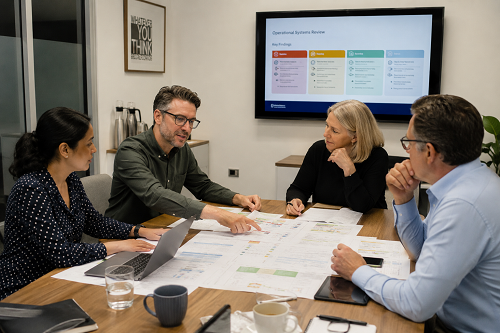
Many Businesses Initially Seek the Wrong Type of Support
One overlooked issue is that founders sometimes misdiagnose the actual problem affecting the organisation.
For example:
A business experiencing operational inefficiency may pursue mentoring when the organisation genuinely requires stronger systems and accountability.
Meanwhile, another founder may seek consulting support when the deeper issue involves confidence, leadership pressure or decision fatigue.
This mismatch can delay improvement significantly.
Strong external support depends on understanding:
- where the pressure exists
- whether the issue is operational or leadership-based
- how complex the organisation has become
- what level of implementation support is required
Without this clarity, businesses often end up solving symptoms rather than the underlying issue itself.
Consulting Often Becomes More Important as Businesses Scale
As SMEs become larger, operational discipline matters more.
Initially, founders can oversee most areas directly.
However, sustained growth eventually requires:
- clearer reporting
- stronger delegation
- improved accountability
- better communication systems
- operational visibility
Without stronger organisational structure, businesses often become operationally heavy over time.
This usually creates:
- leadership fatigue
- execution inconsistency
- slower decision-making
- communication breakdowns
- reduced efficiency
Consulting helps businesses strengthen the foundations supporting long-term scalability.
Research from Deloitte Insights has also explored how governance maturity and operational structure strongly influence long-term organisational scalability and resilience.
Mentoring Often Becomes Valuable During Leadership Transition
Mentoring frequently becomes most valuable when leadership responsibility evolves faster than the founder’s previous experience.
This commonly happens when:
- teams expand rapidly
- operational pressure increases
- leadership complexity grows
- founders begin delegating more responsibility
- strategic decision-making becomes heavier
In these situations, external perspective becomes highly valuable because founders often lack opportunities for honest strategic reflection internally.
Mentoring helps leaders step back from constant operational reaction and reassess wider business priorities more objectively.
This reflective space often improves strategic clarity significantly.
For more insight into founder leadership development, see Fear of Delegation.

Strong SMEs Often Benefit from Both
In practice, many businesses eventually benefit from both mentoring and consulting support together.
Consulting improves organisational structure.
Mentoring strengthens the leadership capability guiding that structure.
Together, these forms of support often create stronger long-term outcomes because leadership quality and operational performance remain closely connected.
As organisations become more sophisticated, external support frequently overlaps with:
- strategic advisory
- governance development
- leadership coaching
- operational planning
- organisational improvement
Understanding these overlaps helps businesses apply the right support at the right stage of growth.
Research from McKinsey & Company has also explored how leadership alignment and operational discipline often need to evolve together as businesses scale sustainably.
Final Thoughts
So, what is the real difference between a small business mentor and consultant?
Usually, it comes down to focus.
Mentors primarily help founders improve strategic thinking, leadership perspective and decision-making confidence.
Consultants primarily help organisations strengthen structure, accountability and operational performance.
Both forms of support can create significant value when applied appropriately.
Because ultimately, sustainable business growth depends not only on operational execution, but also on whether leadership remains clear, aligned and capable as complexity increases.