
How to Measure the Impact of Business Consulting
Many SME owners invest in consulting hoping things will improve.
However, once the engagement begins, a more practical question quickly follows:
How do you actually know whether the consulting is working?
This is where understanding how to measure the impact of business consulting becomes essential.
Because unlike simple project delivery, effective consulting influences multiple interconnected areas of the organisation.
Some improvements are immediately visible.
Others emerge gradually through stronger systems, clearer leadership and more consistent execution over time.
The challenge is knowing what meaningful progress actually looks like.
For a broader overview of consulting support, see What Is Business Consulting?
Why Businesses Often Measure the Wrong Things
One of the most common mistakes SMEs make is measuring consulting purely through short-term financial outcomes.
Revenue growth matters.
Profitability matters.
Operational efficiency matters.
However, consulting often creates value long before those outcomes become fully visible financially.
For example:
Improved accountability may initially appear subtle. Yet over time, stronger accountability often leads to:
- better execution
- faster decision-making
- reduced operational friction
- stronger team alignment
These changes eventually influence performance significantly.
Strong consulting therefore requires broader measurement than immediate financial results alone.
Operational Clarity Is One of the Earliest Indicators
One of the first visible signs of effective consulting is improved operational clarity.
Businesses often begin noticing:
- fewer communication breakdowns
- clearer responsibilities
- stronger reporting structures
- more organised workflows
- reduced operational confusion
This clarity usually creates calmer and more predictable operational environments.
Leaders spend less time reacting to avoidable issues and more time focusing on strategic priorities.
For more insight into operational structure and efficiency, see Efficient Business Consulting: What Does Efficiency Mean?
Decision-Making Quality Often Improves
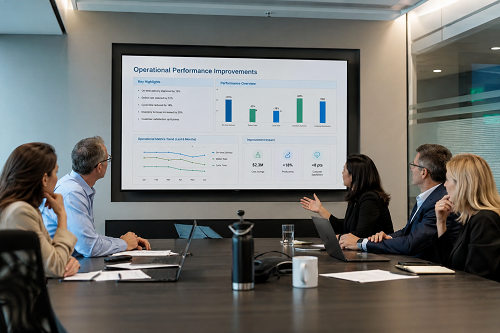
Strong consulting frequently improves decision-making quality across leadership teams.
This usually appears through:
- faster strategic decisions
- clearer prioritisation
- reduced indecision
- stronger accountability
- better communication alignment
When businesses lack structure, decision-making often becomes reactive or inconsistent.
Consulting introduces systems and frameworks that help organisations evaluate issues more objectively.
Over time, leadership teams generally become more deliberate and more aligned strategically.
Accountability Becomes More Consistent
Another major indicator of consulting impact is accountability consistency.
Before consulting, many SMEs struggle with:
- unclear ownership
- inconsistent follow-through
- duplicated work
- reactive communication
- fragmented priorities
As accountability improves, businesses usually experience:
- stronger execution
- fewer operational delays
- clearer responsibility
- improved team coordination
These improvements may appear operational initially, but they often influence overall business performance significantly.
For more insight into leadership accountability and behavioural consistency, see What Does a Business Coach Do?
Organisational Friction Often Decreases
Many SME owners underestimate how much hidden friction exists inside growing businesses.
This friction often includes:
- repeated misunderstandings
- conflicting priorities
- approval delays
- unclear communication
- inconsistent processes
Strong consulting reduces this operational friction gradually.
As clarity improves, businesses often begin noticing:
- smoother communication
- improved collaboration
- faster operational flow
- less leadership frustration
These shifts may not always appear dramatic immediately, but over time they create major organisational improvements.
Why Leadership Confidence Matters
Consulting often improves leadership confidence indirectly.
This does not mean leaders become overconfident.
Rather, stronger systems and clearer visibility usually reduce uncertainty around:
- operational performance
- accountability
- strategic priorities
- decision-making
As businesses become more organised, leadership teams often feel:
- calmer
- clearer
- more aligned
- less reactive
This improvement in leadership confidence frequently influences organisational culture more broadly.
Research from the Center for Creative Leadership has also highlighted the strong relationship between leadership clarity and organisational performance.
Consulting Should Improve Scalability
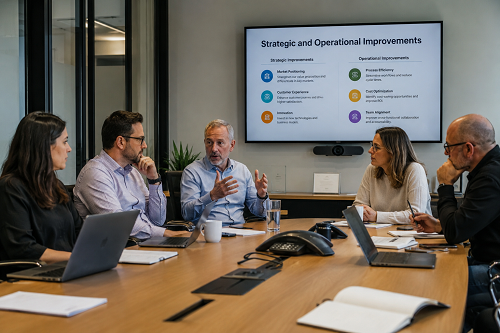
One important way to evaluate consulting effectiveness is scalability.
A business operating efficiently at one size may struggle significantly at another.
Strong consulting helps organisations build systems capable of supporting:
- larger teams
- operational complexity
- increased client demand
- leadership expansion
- long-term growth
If businesses remain overly dependent on founder intervention for daily operations, scalability usually remains limited.
Consulting should gradually reduce this dependency over time.
For more insight into founder dependency and growth challenges, see Business Consultant for Small Businesses: When Is One Needed?
Employee Experience Often Improves Too
Although consulting typically focuses on systems and strategy, employee experience often improves as a result.
This usually happens because:
- communication becomes clearer
- accountability strengthens
- operational confusion decreases
- priorities become more stable
Employees generally perform better when organisations operate with greater clarity and consistency.
This improvement may influence:
- morale
- retention
- collaboration
- execution quality
even if those outcomes were not the original consulting focus directly.
Strategic Alignment Is a Major Indicator
One major sign of effective consulting is stronger strategic alignment across leadership teams.
Without alignment, businesses often experience:
- competing priorities
- fragmented decision-making
- inconsistent communication
- operational confusion
Consulting helps leadership teams align around:
- business priorities
- growth direction
- accountability structures
- operational focus
As alignment improves, businesses usually operate with greater consistency and less internal conflict.
For more insight into strategic alignment and governance, see Strategic Management Consultant: What Do They Actually Do?
Financial Metrics Still Matter
Although consulting should not be measured only financially, commercial performance still matters.
Effective consulting often contributes to improvements such as:
- profitability
- operational efficiency
- cost management
- revenue consistency
- delivery performance
However, these outcomes usually emerge through broader organisational improvements first.
Strong consulting creates sustainable operational conditions that support better financial performance over time.
Why Timeframe Matters
Some businesses expect consulting to produce immediate transformation.
In reality, organisational improvement often happens progressively.
This is because businesses are complex systems involving:
- people
- leadership behaviour
- communication
- operational habits
- accountability structures
Meaningful change requires consistent implementation over time.
Research from McKinsey & Company has also explored how sustainable organisational transformation depends heavily on long-term leadership alignment and operational discipline.
Businesses evaluating consulting too early may overlook important structural improvements already underway.

Consulting Impact Often Extends Beyond Operations
Strong consulting frequently influences broader organisational areas including:
- leadership development
- governance
- strategic thinking
- communication quality
- organisational culture
This is why consulting often overlaps with:
- executive coaching
- strategic advisory
- governance consulting
- leadership mentoring
Understanding these overlaps helps businesses evaluate consulting more holistically.
In more advanced situations, organisations may also benefit from broader support through Strategic Management & Governance for SMEs.
Final Thoughts
So, how should businesses measure the impact of consulting?
Not simply through short-term revenue alone.
Effective consulting usually improves:
- operational clarity
- accountability
- leadership confidence
- strategic alignment
- organisational scalability
- long-term business performance
Because ultimately, the strongest consulting relationships help businesses become more structured, more sustainable and better equipped to navigate complexity over time.