

Many business decisions are influenced not only by strategy or market conditions, but also by mindset.
As organisations grow, founders often discover that internal thinking patterns strongly affect how they respond to pressure, uncertainty and opportunity.
One mindset pattern that frequently influences leadership behaviour is scarcity thinking in business.
Scarcity thinking usually involves operating from a persistent sense of fear, insufficiency or insecurity. Leaders influenced by scarcity often feel there is:
- never enough time
- never enough money
- never enough stability
- never enough certainty
Even when businesses perform well externally, some founders continue operating from a constant expectation of loss or threat.
Over time, this mindset frequently influences:
- decision-making
- communication
- delegation
- organisational culture
- long-term strategic thinking
Without awareness, scarcity thinking often creates leadership patterns that limit sustainable growth and emotional resilience.
For a broader overview of leadership psychology and strategic thinking, see Risk Tolerance and Decision Style.
Scarcity Thinking Often Develops Through Pressure
Many founders do not intentionally choose scarcity thinking.
Instead, these patterns frequently develop through difficult experiences involving:
- financial instability
- business uncertainty
- personal hardship
- operational pressure
Leaders who previously experienced instability may unconsciously remain psychologically focused on survival even after businesses become more stable.
This survival-oriented mindset can become deeply ingrained over time.
As a result, founders may continue making decisions primarily from fear rather than long-term strategic perspective.
Fear-Based Leadership Often Limits Growth
Scarcity thinking frequently creates fear-based leadership patterns.
Founders influenced by fear may become:
- excessively cautious
- emotionally reactive
- resistant to investment
- reluctant to delegate
This often weakens organisational adaptability and slows growth.
For example, some leaders avoid hiring because spending money feels emotionally unsafe. Others refuse delegation because they fear losing control or creating operational risk.
While caution is sometimes appropriate, prolonged fear-based leadership usually limits organisational scalability over time.

Scarcity Thinking Often Affects Communication
Leadership mindset strongly influences communication quality.
Founders operating from scarcity may unintentionally communicate through:
- anxiety
- urgency
- defensiveness
- emotional tension
Over time, this frequently affects organisational culture and employee morale.
Teams often begin sensing fear-based leadership behaviours even when leaders do not express concerns directly.
This may create environments involving:
- uncertainty
- low psychological safety
- reduced confidence
- emotional exhaustion
Meanwhile, leaders operating from healthier perspectives usually communicate with greater calmness and stability.
For more insight into leadership communication and emotional consistency, see Communication Mastery for Leaders.
Scarcity Thinking Can Create Over-Control
Many founders influenced by scarcity struggle with control.
Because uncertainty feels emotionally threatening, leaders may attempt to reduce discomfort by controlling excessive operational detail.
This often creates:
- micromanagement
- delegation problems
- slow decision-making
- reduced team autonomy
Over time, businesses may become overly dependent on founder involvement for routine operations.
Importantly, this pattern usually increases emotional exhaustion rather than reducing it.
Healthy leadership often requires learning how to tolerate uncertainty without becoming excessively controlling.
Emotional Resilience Helps Reduce Scarcity Thinking
Scarcity mindset often intensifies during periods of pressure and uncertainty.
Leaders operating under emotional exhaustion may become increasingly focused on short-term survival rather than long-term strategic thinking.
Emotionally resilient leaders generally maintain perspective more effectively during difficult periods.
This often improves their ability to:
- evaluate risk calmly
- communicate clearly
- tolerate uncertainty
- make balanced decisions
Resilience therefore plays a major role in reducing fear-based leadership behaviour.
For more insight into emotional regulation and sustainable leadership, see Building Emotional Resilience.
Self-Awareness Helps Leaders Recognise Fear Patterns
Many scarcity-driven behaviours operate unconsciously.
Founders may not initially realise how strongly fear influences leadership decisions and organisational behaviour.
Self-awareness helps leaders identify patterns involving:
- excessive caution
- emotional overreaction
- distrust
- survival-focused thinking
This awareness often becomes the starting point for healthier mindset development.
Without reflection, leaders frequently continue reinforcing scarcity patterns automatically.

Organisational Culture Often Reflects Leadership Anxiety
Leadership behaviour strongly shapes organisational culture.
When founders consistently operate from fear or emotional urgency, teams frequently absorb that emotional atmosphere.
This may eventually create cultures involving:
- burnout
- hesitation
- poor collaboration
- reduced innovation
Employees often become reluctant to experiment or take initiative when organisations feel emotionally unstable.
Meanwhile, leaders who communicate with greater perspective and confidence usually create healthier organisational environments.
Over time, emotionally stable leadership often strengthens:
- trust
- adaptability
- morale
- long-term organisational resilience
Scarcity Thinking Can Affect Strategic Planning
Founders operating from scarcity often struggle balancing short-term survival with long-term growth.
Because fear narrows perspective, leaders may focus excessively on immediate problems while neglecting broader organisational strategy.
This frequently affects:
- investment decisions
- talent development
- innovation
- scalability planning
Long-term strategic thinking requires enough emotional stability to tolerate uncertainty without becoming consumed by it.
For more insight into sustainable organisational planning, see Long-Term Growth Planning.
Growth Mindset Encourages Broader Perspective
Growth-oriented leaders usually approach uncertainty differently.
Rather than viewing every challenge as evidence of impending failure, they often maintain a broader perspective around learning, adaptation and long-term development.
This mindset frequently improves:
- confidence
- resilience
- strategic thinking
- communication quality
Importantly, growth mindset does not ignore risk or difficulty.
Instead, it helps leaders respond more constructively and less fearfully during uncertainty.
Research from Columbia Business School has explored how leadership psychology, emotional resilience and adaptive thinking influence executive performance and organisational growth.
Reflection Helps Leaders Rebuild Perspective
Many founders remain trapped in scarcity patterns because they rarely pause to reflect intentionally.
Continuous operational pressure often reinforces survival-oriented thinking automatically.
Reflection helps leaders evaluate:
- emotional habits
- leadership behaviour
- communication patterns
- strategic priorities
more objectively.
Trusted conversations with advisors, mentors or executive coaches frequently help founders regain healthier perspective during difficult periods.
Research from the McKinsey Leadership Center has also explored how reflective leadership and emotional adaptability improve strategic thinking, resilience and organisational effectiveness.
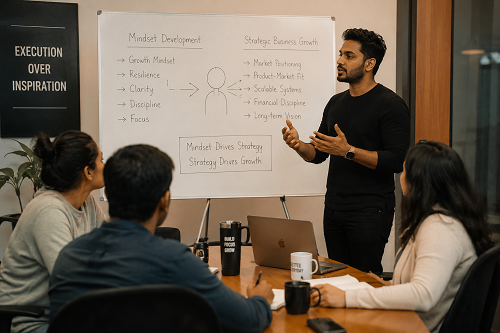
How Scarcity Thinking Connects with Broader Leadership Development
Scarcity thinking often overlaps with:
- emotional resilience
- leadership mindset
- communication habits
- strategic leadership
- executive coaching
Understanding these overlaps helps founders build healthier and more sustainable leadership structures as businesses grow.
In more advanced situations, leaders may also benefit from broader support through Mindset for SME Leaders.
Final Thoughts
So, why does scarcity thinking matter in business?
Because fear-based leadership often influences organisational culture, communication and strategic decision-making more than many founders initially realise.
Without self-awareness and emotional resilience, leaders frequently become trapped in survival-oriented behaviour that limits growth and sustainability.
Ultimately, founders who strengthen mindset and perspective often build calmer, healthier and more adaptable organisations as leadership complexity and responsibility continue increasing.