

Leadership success is influenced by more than knowledge, experience and technical skills.
The way leaders think about their abilities, challenges and opportunities often has a significant impact on their effectiveness. Two concepts that have received considerable attention in personal and professional development are the fixed mindset and the growth mindset.
These terms describe how individuals perceive learning, capability and improvement.
Leaders with a fixed mindset often believe abilities are largely predetermined and difficult to change. Leaders with a growth mindset tend to believe skills and capabilities can be developed through learning, effort and experience.
Understanding the difference between these approaches can help SME leaders strengthen leadership effectiveness and support long-term business success.
For a broader understanding of leadership thinking and development, see our guide to Mindset for SME Leaders.
What Is a Fixed Mindset?
A fixed mindset is characterised by the belief that abilities, intelligence and talents are largely static.
Individuals with this perspective may view challenges as threats because failure could be interpreted as evidence of limited capability. They may avoid situations where success is uncertain or where mistakes are possible.
In leadership, a fixed mindset can sometimes limit innovation, reduce adaptability and discourage learning. Leaders may become overly cautious or resistant to feedback because criticism feels personal rather than constructive.
This does not mean leaders with fixed mindset tendencies cannot succeed. However, these patterns can create barriers to growth if left unexamined.
Leaders seeking to understand the foundations of mindset development may also find our article What Is Mindset Transformation? helpful.
What Is a Growth Mindset?
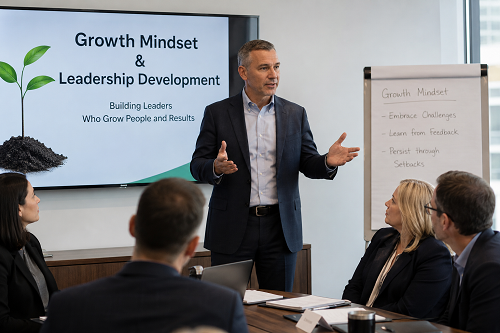
A growth mindset reflects the belief that abilities and performance can improve through learning, practice and experience.
Leaders with this perspective tend to view challenges as opportunities to develop new skills and expand their capabilities. Mistakes are often treated as learning experiences rather than evidence of failure.
This approach encourages curiosity, adaptability and resilience. Growth-minded leaders are generally more willing to seek feedback, experiment with new ideas and invest in personal development.
These qualities can be particularly valuable in changing business environments where flexibility and continuous learning are essential.

Leadership Challenges Reveal Mindset Patterns
Mindset often becomes most visible during difficult situations.
When facing setbacks, leaders with fixed mindset tendencies may focus on protecting their reputation or avoiding failure. Leaders with growth-oriented thinking are more likely to focus on lessons, improvements and future opportunities.
The same challenge can therefore produce very different responses depending on the mindset involved.
Growth-minded leaders often recover more quickly because they view obstacles as part of the learning process rather than permanent limitations.
This ability to adapt is one reason growth mindset is frequently associated with leadership effectiveness.
Research from Stanford University psychologist Carol Dweck has demonstrated the significant influence mindset can have on learning, achievement and personal development.
Growth Mindset Supports Organisational Success
Leadership mindset affects more than individual performance.
Employees often mirror the attitudes and behaviours demonstrated by leaders. When leaders encourage learning, experimentation and continuous improvement, these values frequently become part of organisational culture.
Teams become more willing to share ideas, solve problems and learn from mistakes. This environment supports innovation and long-term growth.
By contrast, cultures influenced by fixed mindset thinking may become overly cautious and resistant to change.
For this reason, leadership mindset can influence the performance of the entire organisation.
Leaders interested in understanding business impact may also find our article How Mindset Affects Business Growth helpful.
Final Thoughts
The difference between fixed and growth mindsets can have a significant impact on leadership effectiveness. While fixed mindset thinking may create barriers to learning and adaptation, a growth mindset encourages development, resilience and continuous improvement.
For SME leaders, adopting a growth-oriented approach often supports stronger decision-making, greater adaptability and improved organisational performance.
Leadership growth begins with recognising that improvement is always possible. The willingness to learn, adapt and develop is often what separates successful leaders from exceptional ones.
Ready to Strengthen Your Leadership Mindset?
Leadership effectiveness is influenced by how leaders interpret challenges, opportunities and feedback. Developing a growth mindset can improve resilience, adaptability and long-term performance.
An experienced advisor can help you identify limiting beliefs, strengthen self-awareness and develop thinking patterns that support meaningful growth and leadership success.
Learn more about our Private Advisory services and discover how we help SME leaders, founders and business owners unlock their potential and achieve sustainable growth.
FREQUENTLY ASKED QUESTIONS
What is a fixed mindset?
A fixed mindset is the belief that intelligence, abilities and talents are largely predetermined and cannot be significantly changed. People with a fixed mindset may avoid challenges, fear failure and view mistakes as evidence of limitations rather than opportunities for growth. This perspective can restrict learning, development and long-term personal or professional progress.
What is a growth mindset?
A growth mindset is the belief that abilities, skills and intelligence can be developed through effort, learning, practice and experience. Individuals with a growth mindset tend to embrace challenges, learn from mistakes and remain open to feedback. This approach encourages continuous improvement and helps people achieve higher levels of personal and professional success.
Why is a growth mindset important for leaders?
A growth mindset helps leaders remain adaptable in changing environments while encouraging continuous learning and improvement. Leaders with this mindset are more likely to embrace feedback, overcome setbacks and support innovation within their organisations. By viewing challenges as opportunities for development, they strengthen resilience, decision-making and overall leadership effectiveness over time.
Can leaders develop a growth mindset?
Yes. A growth mindset can be developed through intentional practice, self-awareness and a commitment to learning. Leaders can strengthen growth-oriented thinking by seeking feedback, reflecting on experiences, embracing challenges and viewing setbacks as learning opportunities. Over time, these habits help create greater adaptability, confidence and leadership effectiveness in complex situations.
How does mindset affect organisational culture?
Leadership mindset has a significant influence on organisational culture because employees often mirror the attitudes and behaviours demonstrated by leaders. A growth-oriented mindset encourages learning, innovation and collaboration, while a fixed mindset may discourage risk-taking and development. The way leaders approach challenges often shapes how teams respond to change and opportunities.