

As businesses grow, leadership responsibilities become increasingly complex.
Decisions that were once made by a founder alone often require broader input, stronger oversight and clearer accountability. Expansion brings new opportunities, but it also introduces risks that can place greater demands on leadership and governance structures.
An effective board provides oversight, strategic guidance and accountability while helping ensure the organisation remains focused on its long-term objectives. However, board structures should evolve alongside the business. What works for a small founder-led company may not be appropriate for a growing organisation with multiple leaders, increasing staff numbers and expanding operations.
For a broader understanding of governance and strategic leadership, see our guide to Strategic Management & Governance for SMEs.
Governance Needs Change as Businesses Grow
In the early stages of a business, governance is often informal.
Founders make most decisions, reporting structures are relatively simple and communication tends to occur naturally. While this flexibility can support agility, it may become less effective as the organisation expands.
Growth often introduces additional layers of management, more complex operations and greater stakeholder expectations. Without appropriate governance structures, decision-making can become inconsistent and accountability may weaken.
Board structures help organisations adapt to these changes by creating clearer oversight and more disciplined decision-making processes.
Business owners interested in governance development may also find our article Governance Advisory for SMEs Explained helpful.
Not Every Growing Business Needs a Formal Board Immediately
One common misconception is that every growing business must establish a formal board of directors.
In reality, governance structures can evolve gradually. Some organisations begin with advisory boards or informal governance arrangements before transitioning to more formal structures as complexity increases.
The appropriate structure depends on factors such as organisational size, ownership arrangements, growth ambitions and leadership capability.
The objective is not to introduce governance for its own sake but to ensure the business has sufficient oversight and strategic support to manage growth effectively.
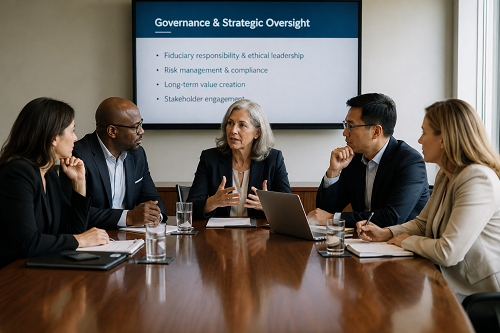
Effective Boards Provide More Than Oversight
Many people associate boards solely with monitoring performance and ensuring compliance.
While oversight is important, effective boards also contribute strategic value. They help leadership teams evaluate opportunities, challenge assumptions and consider long-term implications of important decisions.
Boards often bring diverse perspectives and experience that complement the expertise of management teams. This broader perspective can improve decision-making quality and reduce the risk of strategic blind spots.
Research from the Institute of Directors highlights the role effective boards play in governance, strategic oversight and organisational performance.
Board Composition Matters
The effectiveness of a board depends significantly on who participates.
Strong boards typically include individuals with diverse experience, complementary skills and the ability to contribute constructively to discussions. Independence is also important because objective perspectives help strengthen governance and reduce the likelihood of groupthink.
Businesses should avoid creating boards composed solely of individuals who share similar backgrounds or viewpoints. Diverse perspectives often lead to more robust discussions and better decision-making.
As organisations grow, reviewing board composition periodically helps ensure governance structures continue supporting strategic objectives.
Leaders considering board effectiveness may also find our article When Should a Board Seek External Strategy Support? helpful.
Final Thoughts
Board structures play an important role in helping growing businesses manage increasing complexity and maintain strategic focus. Effective governance provides the oversight, accountability and leadership support needed to navigate growth successfully.
The most effective board structures evolve alongside the organisation. Rather than adopting governance frameworks prematurely or waiting until problems emerge, businesses benefit from reviewing governance needs regularly and making adjustments as circumstances change.
For SMEs pursuing sustainable growth, strong board structures often create greater confidence in decision-making while supporting long-term organisational performance.
Need Support Strengthening Governance?
As businesses grow, governance requirements often evolve faster than existing structures. What worked in the early stages may not provide the oversight, accountability or strategic support required for future success.
An experienced governance advisor can help evaluate board effectiveness, review governance arrangements and develop practical structures that support sustainable growth. The goal is to ensure governance strengthens business performance rather than creating unnecessary complexity.
Learn more about our Business Consulting services and discover how we help SME owners, directors and leadership teams strengthen governance, improve decision-making and achieve long-term success.
FREQUENTLY ASKED QUESTIONS
Why are board structures important for growing businesses?
Board structures provide a framework for effective governance, accountability and strategic oversight as organisations expand. They help leaders make informed decisions, manage risks, monitor performance and maintain alignment with long-term objectives. Strong board structures also improve transparency and support sustainable growth by ensuring responsibilities and decision-making authority are clearly defined.
Does every growing business need a formal board?
Not every growing business requires a formal board immediately. Many organisations begin with advisory boards, mentors or informal governance arrangements. As the business becomes more complex, however, formal board structures can provide valuable oversight, accountability and strategic guidance. The appropriate governance model depends on the organisation’s size, goals and growth stage.
What should a board do?
A board’s primary role is to provide governance oversight and support long-term organisational success. This includes reviewing strategy, monitoring performance, overseeing risk management and ensuring accountability. Effective boards challenge assumptions, provide independent perspectives and help leadership teams make decisions that align with the organisation’s vision, objectives and responsibilities.
How important is board composition?
Board composition is extremely important because the quality of governance depends largely on the people involved. A board with diverse skills, experience and perspectives can provide stronger oversight and better decision-making. Effective composition ensures the organisation benefits from expertise in areas such as finance, strategy, operations, governance and leadership development.
When should a business review its board structure?
Businesses should review their board structure regularly to ensure governance arrangements remain fit for purpose. Reviews are particularly important during periods of rapid growth, organisational change, succession planning, acquisitions or increased complexity. Regular evaluation helps identify gaps in expertise, improve effectiveness and ensure governance supports long-term strategic objectives.