
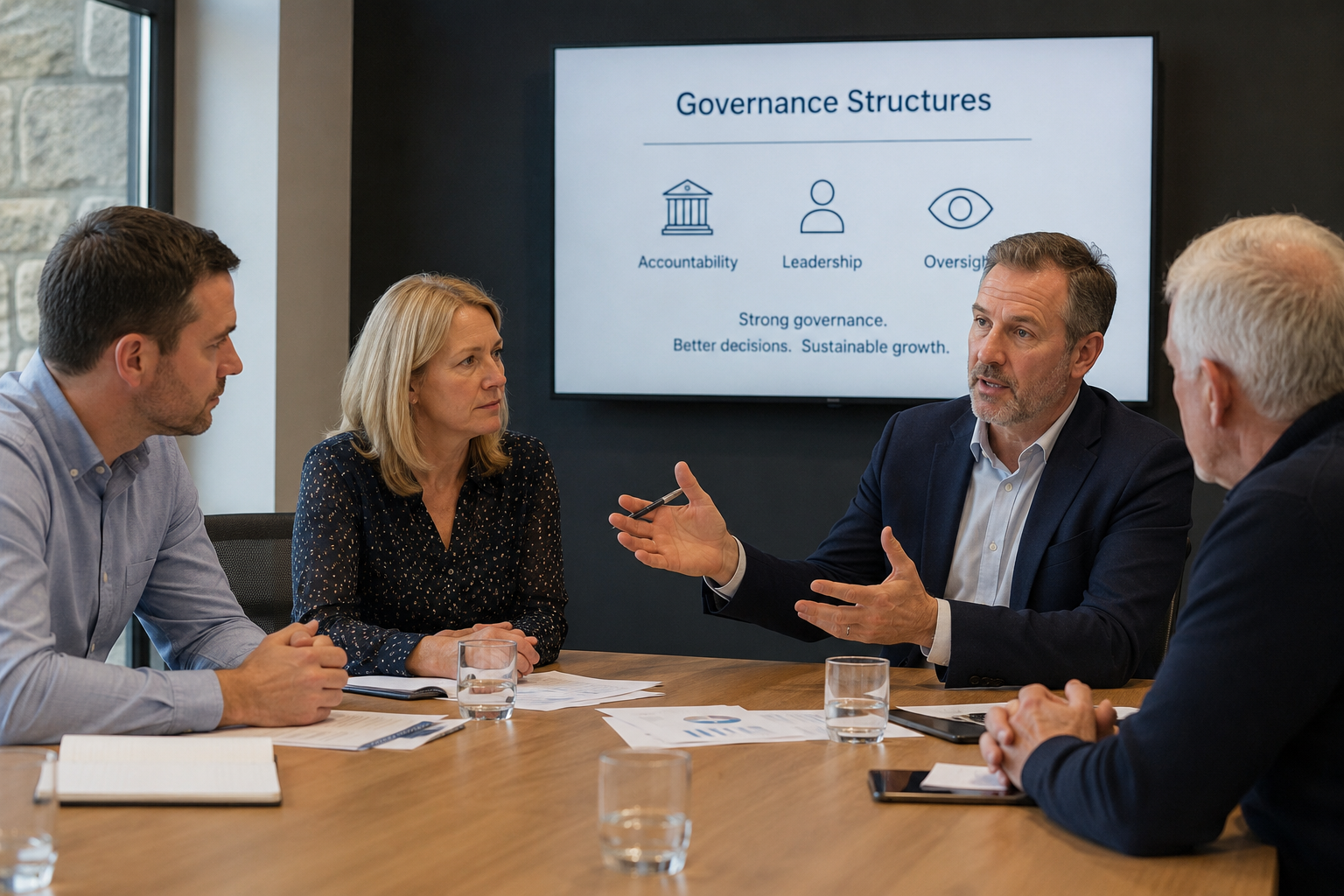
Governance is often misunderstood within small and medium-sized businesses.
Many SME owners associate governance with large corporations, extensive compliance requirements or complex board structures. As a result, governance is sometimes viewed as something that only becomes relevant once a business reaches a certain size.
In reality, governance is important for organisations at every stage of development.
Good governance helps businesses make better decisions, strengthen accountability and create structures that support sustainable growth. Governance advisory helps leadership teams establish these foundations while ensuring governance remains practical and proportionate to the needs of the organisation.
For SMEs navigating growth, increasing complexity or leadership transitions, governance advisory can provide valuable support and perspective.
For a broader understanding of governance and strategic leadership, see our guide to Strategic Management & Governance for SMEs.
Governance Is About More Than Compliance
One of the most common misconceptions about governance is that it exists solely to satisfy legal or regulatory requirements.
While compliance remains important, governance serves a much broader purpose. Effective governance helps organisations establish clear decision-making processes, define accountability and ensure leadership actions remain aligned with strategic objectives.
For SMEs, governance often provides clarity regarding responsibilities, authority and oversight. This helps reduce confusion, improve consistency and strengthen organisational effectiveness.
When governance is viewed only as compliance, businesses may miss the wider benefits it can deliver.
Business owners seeking a broader understanding of governance and strategy may also find our article What Is Strategic Management Consulting? helpful.
Governance Advisory Helps Clarify Accountability
As businesses grow, accountability often becomes more complex.
Responsibilities expand, leadership teams develop and decision-making becomes distributed across a wider group of people. Without clear accountability structures, confusion can emerge and organisational performance may suffer.
Governance advisors help businesses establish clarity regarding roles, responsibilities and reporting relationships. This often involves evaluating leadership structures, decision-making processes and governance arrangements.
Clear accountability supports stronger execution because individuals understand their responsibilities and leaders gain greater visibility into organisational performance.

Better Governance Supports Better Decisions
The quality of governance often influences the quality of decisions.
Businesses operating without clear governance frameworks may rely heavily on informal decision-making or excessive founder involvement. While this approach can work in the early stages, it often becomes less effective as complexity increases.
Governance advisory helps organisations develop structured decision-making processes that support consistency and transparency. Leaders gain clearer information, decision rights become more defined and strategic priorities receive greater attention.
These improvements often lead to stronger organisational performance over time.
Research from the Chartered Governance Institute highlights the relationship between governance effectiveness, organisational resilience and long-term performance.
Governance Evolves as Businesses Grow
Governance is not static.
The structures required for a ten-person business are rarely the same as those required for a fifty-person or one-hundred-person organisation. As businesses expand, governance arrangements often need to evolve to reflect increasing complexity and leadership responsibilities.
Governance advisors help organisations assess whether existing structures remain fit for purpose. They identify gaps, recommend improvements and help ensure governance evolves alongside business growth.
This proactive approach often prevents governance challenges from becoming significant organisational problems.
Business leaders preparing for growth may also find our article Board Structures for Growing Businesses helpful.

Final Thoughts
Governance advisory helps SMEs strengthen the structures that support effective leadership, accountability and decision-making. While governance is sometimes viewed as an administrative requirement, its real value lies in helping organisations operate more effectively and sustainably.
Clear accountability, stronger oversight and improved decision-making all contribute to better organisational performance. As businesses grow, governance becomes increasingly important because complexity often increases faster than existing structures can support.
For SMEs seeking sustainable growth, governance advisory provides an opportunity to establish practical frameworks that support both current performance and future development.
Need an Independent Governance Perspective?
Governance challenges often develop gradually and may not be immediately visible from within the organisation. Issues relating to accountability, decision-making and leadership oversight can affect performance long before they become obvious.
An experienced governance advisor can help assess existing structures, identify opportunities for improvement and develop practical governance frameworks tailored to the needs of your business. The goal is not unnecessary complexity but stronger organisational effectiveness.
Learn more about our Business Consulting services and discover how we help SME owners strengthen governance, improve decision-making and achieve sustainable long-term growth.
FREQUENTLY ASKED QUESTIONS
What is governance advisory for SMEs?
Governance advisory helps small and medium-sized businesses establish effective leadership structures, improve accountability and strengthen decision-making processes. It provides practical guidance on roles, responsibilities, reporting and oversight to support sustainable growth. Strong governance helps business owners manage complexity, reduce risk and create greater organisational stability over time.
Why is governance important for small businesses?
Governance is important because it provides clarity around decision-making, accountability and leadership responsibilities. Effective governance helps business owners avoid confusion, manage risk and improve organisational performance. As businesses grow, governance frameworks support better communication, stronger oversight and more consistent decisions, creating a foundation for long-term success and sustainability.
Is governance only relevant for large organisations?
No. Governance is valuable for businesses of every size, including small and medium-sized enterprises. Even simple governance practices can improve accountability, clarify responsibilities and strengthen leadership effectiveness. As organisations grow, good governance helps maintain structure, support decision-making and reduce operational risks, making it an important consideration regardless of scale.
What does a governance advisor do?
A governance advisor reviews existing leadership structures, decision-making processes and accountability arrangements. They identify opportunities for improvement and recommend practical frameworks that strengthen organisational effectiveness. Their role is to help businesses establish clear governance practices, improve oversight and ensure leadership teams can support sustainable growth and performance.
When should an SME seek governance advisory support?
SMEs should consider governance advisory when experiencing growth, leadership transitions, succession planning, organisational restructuring or increased operational complexity. These situations often require stronger decision-making frameworks and clearer accountability. Governance support helps leaders navigate change effectively, reduce risks and build structures that support long-term organisational success and stability.