

Professionalising a 5–30 Person Business
Many SMEs reach a stage where growth begins creating pressure faster than clarity.
The business may still be performing reasonably well externally.
Revenue continues growing.
New staff are joining.
Customer demand remains steady.
Yet internally, the organisation often starts feeling increasingly difficult to manage.
Communication becomes inconsistent.
Founders feel stretched across too many responsibilities.
Decision-making slows down.
Operational bottlenecks appear more frequently.
This is usually the point where businesses begin thinking seriously about professionalising a 5–30 person business and building stronger organisational structure.
Because the systems and leadership style that work with five people rarely work effectively once the organisation grows towards thirty.
Professionalising the business helps SMEs transition from informal founder-led operations towards more scalable and sustainable organisational management.
For a broader overview of SME consulting and operational growth, see Small Business Consulting for SMEs.
Growth Often Exposes Structural Weaknesses
In smaller businesses, informal communication usually works reasonably well.
Everyone knows what is happening.
The founder remains involved in most decisions.
Problems are solved quickly through direct interaction.
However, as teams grow, informal systems often begin creating operational friction.
Businesses may experience:
- unclear responsibilities
- duplicated work
- communication breakdowns
- inconsistent execution
- delayed decisions
These problems rarely appear because staff lack capability.
More often, they emerge because organisational structure has not evolved alongside growth.
Professionalising the business means introducing greater operational clarity without losing flexibility or agility.
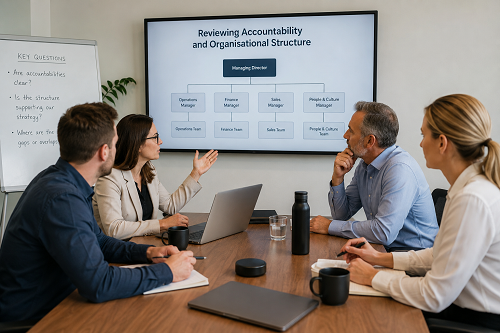
Professionalisation Improves Accountability
One of the biggest changes growing SMEs need is stronger accountability.
In founder-led businesses, accountability often operates informally during early stages.
Over time, this creates confusion around:
- ownership
- reporting lines
- decision-making authority
- operational responsibility
As teams expand, these ambiguities become increasingly expensive operationally.
Professionalising the organisation usually involves improving:
- role clarity
- reporting structures
- accountability systems
- communication processes
This helps businesses operate more consistently and with greater discipline.
For more insight into accountability and organisational visibility, see Financial and Performance Oversight for SMEs.
Founder Dependency Becomes a Major Risk
One of the biggest challenges within 5–30 person businesses is founder dependency.
Initially, founders often remain central to:
- approvals
- communication
- problem-solving
- operational oversight
- customer relationships
While this may feel efficient early on, it eventually creates bottlenecks.
The founder becomes overloaded operationally.
Decision-making slows down because too much responsibility remains concentrated around one individual.
Professionalising the organisation usually requires:
- stronger delegation
- clearer accountability
- distributed leadership responsibility
- improved reporting visibility
This reduces pressure on founders while improving organisational scalability.
For more insight into delegation and leadership structure, see Founder Delegation Systems.
Communication Complexity Increases Rapidly
Many SMEs underestimate how much communication complexity increases during growth.
With five people, communication remains relatively straightforward.
At twenty or thirty people, informal communication often becomes unreliable.
This may create:
- inconsistent information flow
- duplicated conversations
- unclear priorities
- operational confusion
Professionalising the business means creating clearer communication systems around:
- reporting
- accountability
- operational updates
- decision-making
This improves coordination significantly across the organisation.
Professionalisation Is Not About Becoming Corporate
Some founders resist professionalisation because they fear losing agility or entrepreneurial culture.
However, professionalising an SME does not mean becoming unnecessarily corporate or bureaucratic.
Strong professionalisation focuses on improving:
- clarity
- consistency
- accountability
- communication
- operational visibility
without reducing responsiveness or innovation.
The objective is making the business easier to manage as complexity increases.
Not creating unnecessary layers of administration.
For more insight into organisational efficiency and operational structure, see Efficient Business Consulting: What Does Efficiency Mean?
Leadership Structure Must Evolve During Growth
As businesses grow, leadership responsibilities usually become less clear naturally.
Different managers may begin prioritising competing objectives.
For example:
- operations may prioritise delivery consistency
- sales may focus on growth
- finance may focus on cost control
- founders may pursue strategic opportunities
Without stronger leadership structure, businesses often become fragmented operationally.
Professionalising the organisation involves improving:
- leadership alignment
- decision-making clarity
- communication consistency
- accountability discipline
This strengthens organisational cohesion significantly.
Research from the ResearchGate has also highlighted how governance clarity and leadership structure improve organisational resilience during growth.

Professionalisation Improves Operational Consistency
Many growing SMEs struggle with inconsistent execution.
This may appear through:
- varying customer experience
- communication gaps
- inconsistent delivery
- operational inefficiencies
Professionalising the business usually involves strengthening:
- workflows
- reporting systems
- operational processes
- accountability frameworks
This improves consistency across departments and teams.
Operational consistency becomes increasingly important as customer expectations and delivery complexity increase.
Governance Often Becomes Necessary Earlier Than Expected
Many SMEs assume governance only matters for large corporations.
In reality, governance becomes increasingly important much earlier during growth.
Businesses between five and thirty people often begin needing:
- clearer decision rights
- stronger reporting systems
- accountability oversight
- leadership visibility
Without governance clarity, organisational confusion usually increases alongside growth.
Professionalising the business helps establish governance structures gradually before operational instability develops.
For more insight into governance development, see Avoiding Common SME Governance Mistakes.
Professionalisation Helps Businesses Scale Sustainably
Growth without structure often creates operational instability.
Initially, businesses may continue expanding despite internal inefficiencies.
However, over time, weak systems usually lead to:
- leadership fatigue
- communication breakdowns
- accountability confusion
- operational inconsistency
- cultural instability
Professionalising the organisation strengthens the foundations supporting sustainable growth.
This usually improves:
- operational efficiency
- organisational resilience
- leadership clarity
- scalability
- profitability
As businesses become more structured, leadership teams can focus more strategically rather than constantly managing operational friction.
For more insight into scalability and profitability, see How Small Business Consulting Improves Profitability.
Professionalisation Also Supports Team Confidence
Employees generally perform better when organisational expectations are clear.
Without structure, teams often experience:
- uncertainty
- inconsistent communication
- unclear accountability
- operational frustration
Professionalising the business helps create:
- clearer expectations
- stronger accountability
- more reliable communication
- operational consistency
This usually improves morale and team confidence significantly.
People operate more effectively when the organisation itself feels stable and well-managed.
Research from ScienceDirect has also explored how organisational clarity and operational maturity contribute to stronger long-term scalability and leadership effectiveness.

How Professionalisation Connects with Broader Support
Professionalising a growing SME often overlaps with:
- governance advisory
- operational consulting
- executive coaching
- leadership development
- strategic planning
Understanding these overlaps helps businesses strengthen both operational performance and long-term scalability.
In more advanced situations, organisations may also benefit from broader support through Business Consulting for Growing SMEs.
Final Thoughts
So, what does professionalising a 5–30 person business actually involve?
At a practical level, it means improving:
- accountability
- operational structure
- communication clarity
- leadership alignment
- governance visibility
- organisational consistency
Because ultimately, businesses become easier to scale when structure evolves alongside growth rather than falling behind it.