

Clarifying Roles and Responsibilities in SMEs
Many SMEs begin with highly flexible working environments.
Everyone helps wherever needed.
Founders stay closely involved in daily operations.
Communication remains informal and fast-moving.
Initially, this flexibility often works well.
However, as businesses grow, the same informality that once created agility can begin creating operational confusion instead.
Responsibilities overlap.
Decision-making slows down.
Accountability weakens.
Teams become uncertain about ownership and priorities.
This is usually when businesses begin recognising the importance of clarifying roles and responsibilities in SMEs as part of sustainable organisational growth.
Because operational clarity becomes increasingly important as complexity increases.
Without clearly defined responsibilities, even capable teams often struggle to execute consistently.
For a broader overview of operational structure and SME development, see Small Business Consulting for SMEs.
Why Role Clarity Becomes More Important During Growth
In smaller businesses, operational visibility usually remains high.
The founder often knows:
- who is responsible for what
- where bottlenecks exist
- which priorities matter most
- where decisions are being delayed
As teams grow, this visibility naturally becomes harder to maintain.
Without structure, businesses often experience:
- duplicated work
- unclear ownership
- delayed communication
- operational inefficiency
- inconsistent accountability
Clarifying responsibilities helps organisations maintain coordination as operational complexity increases.
Unclear Roles Create Operational Friction
Many SME problems are not caused by lack of talent or effort.
Instead, they develop because responsibilities are poorly defined.
For example:
Teams may become uncertain about:
- who makes final decisions
- who owns customer communication
- who manages operational delivery
- who tracks accountability
This uncertainty frequently creates operational friction behind the scenes.
Tasks fall between departments.
Communication becomes inconsistent.
Execution slows down.
Clarifying roles improves organisational flow significantly.

Accountability Depends on Role Clarity
Accountability becomes difficult when responsibilities remain vague.
If ownership is unclear, businesses often experience:
- inconsistent execution
- missed deadlines
- duplicated work
- communication gaps
People may assume someone else is responsible for important tasks.
Clarifying roles creates stronger accountability because expectations become visible and measurable.
This helps businesses improve:
- reporting consistency
- operational discipline
- communication clarity
- execution reliability
For more insight into accountability systems and oversight, see Financial and Performance Oversight for SMEs.
Founders Often Hold Too Many Responsibilities
One of the most common SME challenges involves founder overload.
Initially, founders often manage:
- operations
- customer relationships
- approvals
- staffing issues
- financial decisions
- strategic planning
As businesses grow, this approach becomes increasingly difficult to sustain.
The founder becomes a bottleneck operationally.
Teams may hesitate to act independently because authority and responsibilities remain concentrated around one individual.
Clarifying organisational roles helps distribute ownership more effectively across the business.
This usually improves both scalability and leadership sustainability.
For more insight into delegation and organisational growth, see Founder Delegation Systems.
Leadership Teams Need Clear Decision Rights
As SMEs expand, leadership teams usually become more layered.
Different managers may oversee:
- operations
- sales
- finance
- customer service
- delivery
Without clear decision rights, businesses often experience:
- leadership conflict
- delayed approvals
- duplicated communication
- inconsistent priorities
Clarifying responsibilities at leadership level helps organisations improve:
- decision-making speed
- operational coordination
- accountability consistency
- communication alignment
This creates stronger organisational cohesion overall.
Role Clarity Improves Team Confidence
Employees usually perform better when expectations are clear.
Without defined responsibilities, teams often feel:
- uncertain
- reactive
- operationally frustrated
- unclear about priorities
This uncertainty can reduce both morale and performance consistency.
Clarifying roles helps teams understand:
- what they own
- what success looks like
- where accountability sits
- how decisions should flow
As clarity improves, teams usually become more confident and proactive operationally.
Research from the Research Online has also highlighted how accountability clarity and governance structure improve organisational performance and leadership effectiveness.

Clarifying Responsibilities Supports Better Communication
Communication problems often develop because responsibilities remain unclear.
For example:
Teams may not know:
- who should provide updates
- who should escalate issues
- who should communicate decisions
- who owns operational follow-through
This confusion usually creates unnecessary operational noise.
Clarifying responsibilities improves communication by creating:
- clearer reporting lines
- more consistent escalation processes
- stronger accountability visibility
As communication improves, organisations usually become more operationally stable.
Organisational Structure Must Evolve Alongside Growth
Many SMEs continue operating with early-stage structures long after the business has become significantly more complex.
Initially, this may remain manageable.
However, over time, weak structure often creates:
- operational bottlenecks
- leadership fatigue
- communication inconsistency
- accountability confusion
Clarifying roles becomes part of broader organisational professionalisation.
Businesses gradually require:
- clearer reporting structures
- leadership hierarchy
- operational accountability
- governance visibility
This evolution helps businesses scale more sustainably.
For more insight into scaling operational structure, see Professionalising a 5–30 Person Business.
Role Clarity Supports Better KPI Systems
Performance management becomes difficult when responsibilities remain vague.
KPIs only work effectively when accountability is clearly attached to ownership.
Without role clarity, businesses often struggle to measure:
- operational performance
- delivery consistency
- leadership accountability
- workflow efficiency
Clarifying responsibilities strengthens KPI systems because ownership becomes more visible across the organisation.
This improves performance management significantly.
For more insight into performance measurement systems, see Implementing KPIs in Small Businesses.
Governance Becomes Easier with Clear Structure
As SMEs grow, governance usually becomes increasingly important.
Strong governance depends heavily on organisational clarity.
Without defined responsibilities, businesses often experience:
- reporting confusion
- accountability overlap
- inconsistent oversight
- weak operational visibility
Clarifying roles strengthens governance by improving:
- accountability clarity
- reporting discipline
- leadership visibility
- decision-making consistency
This usually improves organisational resilience significantly.
Role Clarity Helps Businesses Become Less Reactive
Many SMEs spend excessive time reacting operationally.
This reactive environment often develops because ownership remains unclear.
Clarifying roles helps businesses operate more proactively by improving:
- accountability
- communication
- workflow coordination
- operational consistency
As structure improves, leadership teams usually spend less time firefighting and more time focusing strategically.
Research from Deloitte Insights has also explored how organisational clarity and accountability systems improve scalability and long-term operational performance.
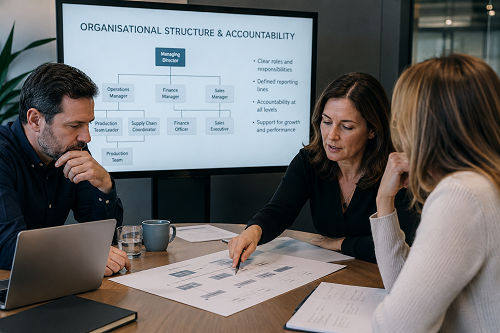
How Role Clarity Connects with Broader Support
Clarifying organisational responsibilities often overlaps with:
- operational consulting
- governance advisory
- leadership development
- strategic planning
- organisational restructuring
Understanding these overlaps helps SMEs strengthen both operational performance and long-term scalability.
In more advanced situations, organisations may also benefit from broader support through Business Consulting for Growing SMEs.
Final Thoughts
So, why does clarifying roles and responsibilities in SMEs matter?
Because sustainable growth depends heavily on organisational clarity.
Strong role definition improves:
- accountability
- communication
- operational consistency
- leadership coordination
- decision-making visibility
Ultimately, businesses become easier to manage when people clearly understand what they own, where accountability sits and how the organisation is expected to operate as it grows.