

Many SMEs initially build sales processes informally.
Founders manage relationships directly.
Sales conversations happen organically.
Commercial decisions remain highly reactive.
During early growth stages, this flexibility often works reasonably well.
However, as businesses scale, informal sales structures frequently begin creating operational strain.
Sales activity becomes inconsistent.
Communication weakens.
Growth targets become difficult to sustain predictably.
This is why many businesses eventually focus on aligning sales structure with growth goals rather than simply increasing sales activity alone.
Because sustainable growth requires more than motivated sales teams.
Strong sales structures help organisations improve:
- commercial consistency
- operational coordination
- profitability
- scalability
- strategic focus
Without alignment between sales structure and growth strategy, expansion often becomes fragmented and difficult to sustain operationally.
For a broader overview of strategic business growth, see What Is Business Development?
Sales Structures Often Become Reactive During Growth
Many SMEs continue using early-stage sales approaches long after organisational complexity increases.
Initially, founder-led selling may work effectively.
However, over time, businesses often experience:
- inconsistent pipelines
- unclear accountability
- communication breakdowns
- unpredictable forecasting
Without structured sales systems, growth frequently becomes dependent on:
- individual relationships
- founder involvement
- reactive opportunities
This limits scalability significantly.
Aligning sales structure with growth goals helps businesses build more sustainable commercial systems.
Growth Goals Should Shape Sales Structure
One common mistake businesses make is separating sales activity from broader organisational strategy.
Sales teams may pursue:
- short-term targets
- unsuitable clients
- aggressive expansion
without considering operational consequences.
Strong sales structures therefore align closely with:
- profitability objectives
- operational capability
- market positioning
- long-term growth strategy
This strategic alignment improves organisational sustainability significantly.
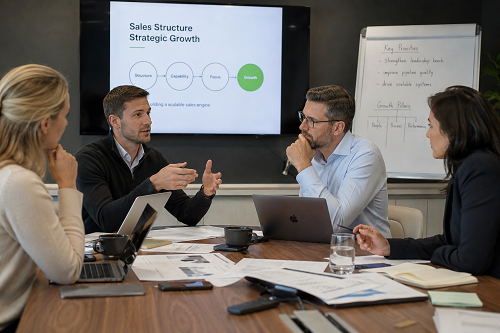
Poor Sales Alignment Often Reduces Profitability
Some businesses increase sales activity while weakening profitability operationally.
This often happens when sales teams pursue:
- low-margin work
- unsuitable clients
- operationally difficult projects
without broader strategic evaluation.
Over time, businesses may experience:
- delivery strain
- resource inefficiency
- reduced margins
- leadership frustration
Strong sales structures help businesses improve:
- commercial discipline
- client selection
- profitability quality
- strategic focus
For more insight into sustainable commercial growth, see How Business Development Drives Profitability.
Operational Coordination Is Critical
Sales success cannot be separated from operational capability.
When sales teams overpromise or expand too aggressively, organisations often experience:
- delivery inconsistency
- staffing pressure
- communication strain
- customer dissatisfaction
Strong sales structures therefore require close coordination between:
- sales
- operations
- finance
- leadership teams
This operational alignment becomes increasingly important as businesses scale.
For more insight into operational scalability and SME structure, see Professionalising a 5–30 Person Business.
Accountability Structures Improve Consistency
Many sales challenges emerge because accountability remains unclear.
Businesses may struggle with:
- inconsistent follow-up
- unclear ownership
- weak forecasting
- fragmented communication
Strong sales structures improve:
- role clarity
- reporting visibility
- pipeline accountability
- communication discipline
This operational consistency usually improves commercial performance significantly over time.
For more insight into accountability and organisational structure, see Clarifying Roles and Responsibilities in SMEs.
Leadership Alignment Influences Sales Performance
Sales structures weaken when leadership priorities become inconsistent.
For example:
- sales teams may prioritise aggressive acquisition
- finance may focus on cost control
- operations may prioritise delivery stability
Without strategic alignment, businesses often create internal tension and fragmented growth.
Strong leadership coordination therefore becomes essential.
Sales structures should support broader organisational objectives rather than operating independently.
Research from McKinsey & Company has also highlighted how organisational alignment and sales discipline strongly influence sustainable growth and profitability outcomes.

Market Positioning Should Guide Sales Activity
Strong sales structures also depend heavily on clear market positioning.
Businesses with weak positioning often struggle with:
- pricing pressure
- inconsistent messaging
- unsuitable opportunities
- reduced conversion quality
Sales systems should reinforce:
- commercial clarity
- differentiation
- strategic focus
- target market alignment
This improves both efficiency and profitability significantly.
For more insight into positioning and commercial strategy, see Business Development Consultant: What Do They Do?
Data Visibility Strengthens Sales Decisions
Many SMEs struggle because sales visibility remains limited.
Businesses may lack reliable insight into:
- conversion quality
- profitability trends
- client retention
- pipeline sustainability
Without accurate data, sales decisions often become reactive or emotionally driven.
Strong sales structures therefore improve:
- reporting systems
- forecasting visibility
- performance tracking
- commercial accountability
This supports stronger strategic decision-making across the organisation.
For more insight into reporting and strategic visibility, see Information Integrity and Reporting at Board Level.
Scalability Requires Delegation and Structure
Founder-dependent sales systems often limit growth scalability.
As businesses expand, founders may struggle managing:
- key relationships
- approvals
- negotiations
- sales coordination
This operational dependency eventually creates bottlenecks.
Strong sales structures therefore frequently require:
- delegation systems
- leadership development
- operational ownership
- process standardisation
This improves scalability significantly.
For more insight into founder scalability and delegation, see Founder Delegation Systems.
Sustainable Growth Requires Commercial Discipline
Ultimately, sustainable sales growth depends heavily on discipline rather than activity alone.
Businesses that scale successfully usually demonstrate:
- strategic focus
- operational coordination
- accountability clarity
- governance maturity
- leadership alignment
These capabilities help organisations sustain growth more consistently over time.
Research from Deloitte Insights has also explored how organisational alignment, operational structure and strategic sales coordination improve long-term business scalability and resilience.

How Sales Structure Connects with Broader Support
Sales structure planning often overlaps with:
- business development
- operational consulting
- governance advisory
- leadership development
- strategic planning
Understanding these overlaps helps SMEs strengthen commercial scalability more sustainably.
In more advanced situations, businesses may also benefit from broader support through Business Advisory for SME Owners.
Final Thoughts
So, why is aligning sales structure with growth goals important?
Because sustainable growth requires more than increasing sales activity alone.
Strong sales structures improve:
- commercial consistency
- profitability
- operational coordination
- accountability
- scalability
- strategic alignment
Ultimately, businesses grow more sustainably when sales systems support broader organisational goals rather than operating reactively or independently from operational reality.