

Strong organisations are rarely built by strong leaders alone.
As businesses grow, organisational success increasingly depends on the effectiveness of the senior leadership team rather than the capabilities of any one individual. Even highly talented executives can struggle to achieve results if priorities are unclear, communication is inconsistent or leadership behaviours are not aligned.
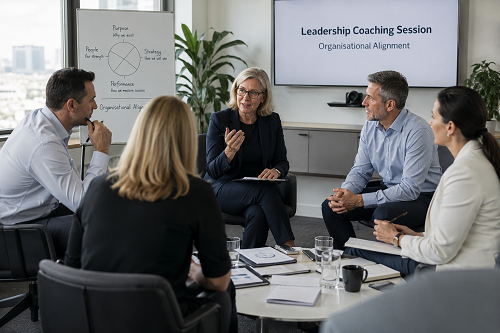
This is one reason coaching senior leadership teams has become increasingly valuable. Team coaching helps leadership groups work together more effectively, strengthen accountability and improve their collective ability to lead the organisation.
Rather than focusing solely on individual performance, leadership team coaching examines how executives interact, communicate and make decisions as a group.
For a broader understanding of leadership development support, see our guide to Executive Coaching for Senior Leaders.
Leadership Alignment Matters
Senior leadership teams often consist of highly capable individuals with different experiences, priorities and perspectives.
While diversity of thought can be valuable, it can also create challenges when leaders are not aligned around common objectives. Conflicting priorities, inconsistent communication and differing interpretations of strategy can reduce organisational effectiveness.
Leadership team coaching helps create greater alignment by encouraging open discussion around goals, expectations and responsibilities. These conversations often help executives develop a shared understanding of what success looks like and how it will be achieved.
When leadership teams operate from a common perspective, organisations are generally better positioned to execute strategy effectively.
Executives interested in leadership effectiveness may also find our article Corporate Executive Coaching: When Is It Needed? helpful.
Communication Influences Organisational Performance
Communication challenges are among the most common issues facing leadership teams.
Important information may not be shared effectively, assumptions can go unchallenged and difficult conversations may be avoided altogether. Over time, these issues can create confusion throughout the organisation and weaken leadership credibility.
Team coaching provides a structured environment where communication patterns can be examined and improved. Leaders are encouraged to engage in more constructive discussions, address challenges openly and strengthen collaboration across the team.
The result is often improved decision-making and greater consistency in how leadership messages are communicated throughout the organisation.
Accountability Strengthens Team Performance
Leadership teams perform more effectively when accountability is clear.
Without accountability, priorities can drift, commitments may not be fulfilled and organisational momentum can suffer. Team coaching helps leaders establish clearer expectations around ownership, responsibility and follow-through.
These discussions often improve trust because executives gain confidence that colleagues will deliver on agreed commitments. Accountability also encourages greater focus on outcomes rather than activity.
As accountability strengthens, leadership teams are often better able to execute strategic initiatives and respond effectively to challenges.
Research from the Center for Creative Leadership highlights the importance of leadership team alignment, trust and accountability in driving organisational performance.
Coaching Helps Teams Navigate Change
Periods of growth, restructuring or strategic transformation place significant demands on leadership teams.
Executives may face increased pressure, competing priorities and difficult decisions that require close collaboration. Coaching provides support during these periods by helping leadership teams evaluate challenges collectively and maintain alignment despite changing circumstances.
Rather than reacting to events individually, leaders learn to approach challenges as a cohesive team. This often improves resilience and helps organisations navigate change more effectively.
Leaders facing organisational transformation may also find our article Executive Business Coach vs Leadership Consultant helpful.

Final Thoughts
Coaching senior leadership teams is about improving how leaders work together rather than focusing exclusively on individual development. Alignment, communication, accountability and collaboration all influence whether a leadership team can successfully guide an organisation through growth and complexity.
The strongest leadership teams are not necessarily those with the most talented individuals. More often, they are the teams that communicate effectively, maintain alignment and work together towards shared objectives. Team coaching helps develop these capabilities while strengthening organisational performance.
For many organisations, investing in leadership team coaching creates benefits that extend far beyond the executive group itself. Improved leadership effectiveness often influences culture, decision-making and strategic execution throughout the business.
Need an Independent Perspective?
Even experienced leadership teams can benefit from objective external perspective. As organisations grow, the challenges facing senior leaders become increasingly complex and require greater levels of collaboration, alignment and accountability.
An experienced coach can help leadership teams strengthen communication, improve decision-making and develop the collective capability needed to lead effectively. The goal is not simply to improve team dynamics but to create stronger organisational outcomes through more effective leadership.
Learn more about our Business Mentoring services and how they help senior leadership teams strengthen alignment, improve performance and navigate complex organisational challenges.
FREQUENTLY ASKED QUESTIONS
What is leadership team coaching?
Leadership team coaching focuses on improving how senior executives work together by strengthening communication, alignment, accountability and decision-making.
How is leadership team coaching different from executive coaching?
Executive coaching focuses on an individual leader, while leadership team coaching focuses on the collective effectiveness of the senior leadership group.
What challenges can leadership team coaching address?
Common challenges include poor communication, conflicting priorities, weak accountability, lack of alignment and difficulties managing organisational change.
Who should participate in leadership team coaching?
Leadership team coaching is typically designed for executive teams, senior management groups and organisational leaders responsible for strategic decision-making.
What benefits can organisations expect from leadership team coaching?
Common outcomes include stronger alignment, improved collaboration, better decision-making, increased accountability and more effective execution of organisational strategy.