

Every business faces risk.
Economic uncertainty, operational disruptions, regulatory changes, cybersecurity threats, market competition and leadership transitions can all affect organisational performance. While risk cannot be eliminated entirely, it can be managed more effectively through structured oversight and informed decision-making.
Many SMEs address risks only when problems arise. Although this reactive approach may seem practical in the short term, it often leaves organisations vulnerable to avoidable challenges and unexpected consequences.
A risk oversight framework provides a structured approach to identifying, evaluating and managing risks before they become significant issues. For growing businesses, this framework is an important component of effective governance and long-term sustainability.
For a broader understanding of governance and strategic leadership, see our guide to Strategic Management & Governance for SMEs.
Risk Oversight Is Different from Risk Avoidance
One of the most common misconceptions about risk management is that it involves avoiding risk altogether.
In reality, growth often requires organisations to take calculated risks. Expanding into new markets, investing in new products, hiring senior staff or implementing new technologies all involve uncertainty. Businesses that avoid every risk may struggle to innovate or grow.
Risk oversight focuses on understanding risks rather than avoiding them. Leaders evaluate potential consequences, assess likelihood and implement appropriate controls to support informed decision-making.
The goal is not to eliminate opportunity but to ensure risks are understood and managed responsibly.
Business owners interested in governance structures may also find our article Governance Advisory for SMEs Explained helpful.
SMEs Need a Structured Approach to Risk
Many small businesses manage risk informally.
Founders and leadership teams often rely on experience, instinct and day-to-day awareness to identify potential problems. While this may be sufficient in the early stages, growing organisations typically require a more structured approach.
A risk oversight framework helps leaders identify key risk categories, assign accountability and monitor emerging issues systematically. Common areas of focus include financial risk, operational risk, compliance risk, strategic risk and reputational risk.
This structure improves visibility and helps leadership teams make better decisions.
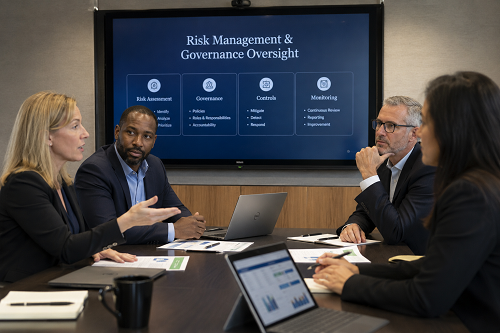
Accountability Is Central to Effective Risk Oversight
Risk management becomes less effective when responsibility is unclear.
If everyone is responsible for risk, accountability can quickly become diluted. Effective frameworks establish clear ownership for different risk categories while ensuring leadership teams maintain oversight.
This clarity encourages proactive management and reduces the likelihood that important issues will be overlooked. Leaders understand their responsibilities and governance structures support consistent monitoring and reporting.
Accountability also strengthens organisational resilience because risks are addressed before they escalate into larger problems.
Research from the ResearchGate highlights the importance of governance, accountability and structured risk oversight in organisational resilience and performance.
Risk Oversight Supports Better Strategic Decisions
Risk oversight should not operate separately from strategy.
The most effective organisations integrate risk considerations into strategic planning and decision-making. Growth opportunities, investments and organisational changes are evaluated through both a strategic and risk lens.
This balanced approach helps leadership teams pursue opportunities confidently while understanding potential consequences. It also reduces the likelihood of decisions being made without adequate consideration of risks.
Businesses focused on strategic governance may also find our article Defining Decision Rights in Leadership Teams helpful.

Final Thoughts
Risk oversight frameworks help SMEs move from reactive problem-solving to proactive governance. Rather than waiting for issues to emerge, organisations develop structured processes that improve visibility, accountability and decision-making.
Effective risk oversight does not prevent businesses from pursuing growth. Instead, it helps leaders understand risks more clearly and make decisions with greater confidence. This balance between opportunity and oversight is essential for sustainable long-term success.
As organisations grow, risk management becomes increasingly important. Businesses that invest in strong oversight frameworks are often better positioned to navigate uncertainty, protect performance and maintain resilience.
Need Support Strengthening Risk Governance?
Risk management challenges often increase as businesses grow and become more complex. Without clear oversight, organisations may struggle to identify emerging threats or respond effectively when challenges arise.
An experienced governance advisor can help evaluate existing risk management practices, strengthen accountability and develop practical risk oversight frameworks tailored to your organisation. The goal is to create stronger governance while supporting strategic growth and business performance.
Learn more about our Business Consulting services and discover how we help SME owners and leadership teams strengthen governance, improve risk oversight and achieve sustainable long-term success.
FREQUENTLY ASKED QUESTIONS
What is a risk oversight framework?
A risk oversight framework is a structured approach that helps organisations identify, assess, monitor and manage potential risks that could affect business objectives. It establishes clear responsibilities, reporting processes and risk management practices, enabling leadership teams and boards to make informed decisions while maintaining effective governance and organisational resilience.
Why is risk oversight important for SMEs?
Risk oversight is important for SMEs because it helps leaders recognise potential threats before they become significant problems. Effective oversight supports better decision-making, improves governance, protects resources and increases organisational resilience. By proactively managing risk, SMEs can reduce uncertainty and create a stronger foundation for sustainable growth.
What risks should SMEs monitor?
SMEs should monitor a range of risks, including financial, operational, strategic, compliance, reputational and cybersecurity risks. Depending on the business, other risks may include supply chain disruptions, talent shortages, market changes and economic uncertainty. Regular monitoring helps leaders respond quickly and minimise potential negative impacts on performance.
Who is responsible for risk oversight?
Responsibility for risk oversight is typically shared between leadership teams, boards and designated risk owners throughout the organisation. While specific responsibilities may vary, accountability should be clearly defined and communicated. Effective risk oversight requires collaboration, regular reporting and ongoing monitoring to ensure risks are appropriately identified and managed.
How does risk oversight support growth?
Risk oversight supports growth by helping businesses evaluate opportunities while understanding potential challenges and uncertainties. Rather than avoiding risk altogether, organisations can make informed decisions that balance opportunity and exposure. This approach improves strategic planning, strengthens confidence and enables sustainable growth while maintaining appropriate governance and accountability.