

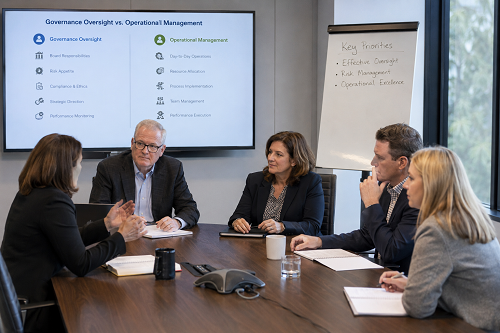
Governance and management are closely related, yet they serve very different purposes within an organisation.
In many SMEs, the distinction between governance and management can become blurred. Founders, directors and senior leaders often perform multiple roles simultaneously, making it difficult to separate strategic oversight from operational responsibility.
While this overlap may be manageable during the early stages of business development, growing organisations benefit from greater clarity. Understanding where governance ends and management begins helps improve accountability, decision-making and organisational effectiveness.
When these roles are clearly defined, businesses are better positioned to execute strategy, manage risk and achieve sustainable growth.
For a broader understanding of governance and leadership effectiveness, see our guide to Strategic Management & Governance for SMEs.
Governance Focuses on Direction and Oversight
Governance is primarily concerned with the long-term interests of the organisation.
Boards, directors and governance structures are responsible for setting strategic direction, monitoring performance, overseeing risk and ensuring accountability. Governance focuses on asking important questions about where the organisation is heading and whether leadership actions align with strategic objectives.
Rather than becoming involved in daily operational activities, governance provides oversight and guidance. It establishes the framework within which management operates.
Effective governance helps organisations remain focused on long-term success while maintaining appropriate accountability and control.
Business owners seeking a deeper understanding of governance structures may also find our article Governance Advisory for SMEs Explained helpful.
Management Focuses on Execution
Management is responsible for implementing strategy and running the organisation on a day-to-day basis.
Managers and leadership teams oversee operations, allocate resources, supervise employees and ensure business activities are performed effectively. While governance determines what should be achieved, management focuses on how those objectives will be accomplished.
This distinction is important because management requires different skills and responsibilities. Operational effectiveness, communication, resource allocation and performance management are all key management functions.
Strong management ensures organisational objectives are translated into practical actions and measurable results.

Blurred Roles Can Create Problems
When governance and management responsibilities become unclear, organisations often experience confusion and inefficiency.
Boards may become involved in operational decisions that should remain within management’s authority. Conversely, management teams may make strategic or governance-related decisions without sufficient oversight.
These situations can create accountability issues, slow decision-making and weaken organisational effectiveness. Leaders may become uncertain regarding responsibilities and important governance activities may receive insufficient attention.
Research from the Chartered Governance Institute highlights the importance of clearly defined governance and management responsibilities in supporting organisational effectiveness and accountability.
Growing Businesses Need Greater Clarity
As businesses expand, the distinction between governance and management becomes increasingly important.
Larger organisations typically involve more people, greater complexity and increased stakeholder expectations. Informal arrangements that worked during the early stages may become less effective as the business grows.
Establishing clear governance and management boundaries helps organisations scale successfully. Boards can focus on oversight and strategic direction, while management teams concentrate on execution and operational performance.
Leaders seeking to strengthen organisational governance may also find our article Board Structures for Growing Businesses helpful.
Final Thoughts
Governance and management are complementary functions, but they are not the same.
Governance provides oversight, accountability and strategic direction. Management focuses on execution, operational performance and achieving organisational objectives. Both are essential, and both contribute to long-term success.
For SMEs, understanding these distinctions becomes increasingly important as the organisation grows. Clear roles help improve accountability, reduce confusion and ensure leaders focus on the responsibilities that matter most.
Businesses that establish strong governance and effective management structures are often better positioned to navigate growth, manage complexity and achieve sustainable performance.
Need Support Strengthening Governance Structures?
Many organisations struggle to define governance and management responsibilities clearly, particularly during periods of growth and organisational change. These challenges can affect decision-making, accountability and overall business performance.
An experienced governance advisor can help evaluate organisational structures, clarify responsibilities and develop governance frameworks that support sustainable growth. The goal is to create stronger leadership alignment while improving organisational effectiveness.
Learn more about our Business Consulting services and discover how we help SME owners, directors and leadership teams strengthen governance, improve accountability and achieve long-term success.
FREQUENTLY ASKED QUESTIONS
What is the difference between governance and management?
Governance and management serve different but complementary functions within an organisation. Governance focuses on setting strategic direction, providing oversight, ensuring accountability and protecting long-term organisational interests. Management is responsible for implementing strategy, overseeing daily operations, managing resources and achieving performance objectives. Effective organisations require both functions working together while maintaining clear boundaries and responsibilities.
Who is responsible for governance?
Governance is typically the responsibility of a board of directors, advisory board, trustees or other governance structures established within an organisation. These individuals provide strategic oversight, monitor organisational performance, manage risk and ensure accountability. Their role is to guide long-term direction and protect stakeholder interests rather than manage day-to-day operational activities directly.
Who is responsible for management?
Management responsibilities are generally carried out by executives, senior leaders, managers and department heads who oversee daily operations. Their role involves implementing strategic plans, managing employees, allocating resources and ensuring organisational objectives are achieved. Management teams are accountable for operational performance and report on progress, results and challenges to governance bodies.
Why is it important to separate governance and management?
Separating governance and management helps organisations operate more effectively by creating clear accountability and decision-making structures. Governance bodies can focus on long-term strategy, oversight and risk management, while management concentrates on execution and operational performance. This distinction reduces confusion, prevents duplication of effort and supports stronger organisational leadership and accountability.
Can governance and management overlap in SMEs?
Yes, governance and management often overlap in small and medium-sized enterprises, particularly when founders and owners perform multiple roles. In the early stages of business growth, individuals may be responsible for both strategic oversight and daily operations. However, as organisations expand, establishing clearer governance and management responsibilities improves accountability, decision-making and sustainable growth.