

Executive Business Coach vs Leadership Consultant
As organisations grow, leadership challenges usually become more complex and interconnected.
Operational pressure increases.
Communication becomes more sensitive.
Decision-making carries greater organisational consequences.
At this stage, many senior leaders begin exploring external support.
However, one common source of confusion involves understanding the difference between an Executive Business Coach vs Leadership Consultant and which type of support is most appropriate.
Because although both roles help leaders improve performance, they usually operate quite differently.
An executive business coach typically focuses on:
- leadership behaviour
- decision-making
- communication
- emotional discipline
- self-awareness
A leadership consultant often focuses more directly on:
- organisational structure
- leadership systems
- strategic alignment
- operational effectiveness
- governance
Understanding this distinction helps organisations apply the right support to the right challenges.
For a broader overview of leadership development and executive support, see Executive Coaching for Senior Leaders.
Executive Coaching Focuses on the Leader Personally
Executive coaching usually centres around the leader as an individual.
The focus often includes improving:
- communication style
- emotional regulation
- leadership awareness
- strategic thinking
- behavioural consistency
Rather than solving operational problems directly, coaches typically help leaders reflect more effectively on how they think, behave and communicate under pressure.
This process often improves leadership clarity and decision-making significantly over time.
Executive coaching becomes especially valuable when leaders feel:
- overloaded
- reactive
- uncertain
- strategically fragmented
The objective is strengthening leadership capability itself.
Leadership Consulting Focuses More on Organisational Structure
Leadership consulting generally operates differently.
Rather than focusing mainly on the individual leader, consultants often evaluate:
- leadership systems
- accountability structures
- organisational alignment
- governance
- operational coordination
Leadership consultants help organisations improve how leadership functions collectively and structurally across the business.
For example:
A consultant may help redesign:
- reporting systems
- leadership accountability
- communication structures
- governance frameworks
The emphasis is usually broader organisational effectiveness.
For more insight into governance and organisational structure, see Strategic Management & Governance for SMEs.

Coaches Usually Help Leaders Reflect More Clearly
Executive coaching often creates structured reflective space for senior leaders.
Many executives operate under constant pressure and rarely pause to evaluate:
- communication patterns
- leadership behaviour
- emotional responses
- strategic thinking
Without reflection, leaders often become increasingly reactive operationally.
Executive coaches help leaders:
- challenge assumptions
- identify blind spots
- improve behavioural awareness
- strengthen decision-making discipline
This reflective process frequently improves leadership effectiveness significantly.
For more insight into executive coaching and leadership reflection, see What Is Executive Coaching?
Consultants Usually Focus More on Systems and Alignment
Leadership consultants often focus more heavily on organisational coordination and operational effectiveness.
This may include improving:
- leadership alignment
- accountability systems
- governance visibility
- operational communication
- strategic execution
Consultants typically analyse how leadership functions across the wider organisation rather than focusing exclusively on one individual leader.
This becomes especially valuable when businesses experience:
- organisational fragmentation
- communication breakdowns
- unclear accountability
- strategic inconsistency
The goal is improving organisational leadership performance structurally.
Coaching Is Often More Behavioural
One major distinction involves behavioural focus.
Executive coaching frequently addresses leadership behaviours such as:
- emotional regulation
- communication discipline
- difficult conversations
- reactive decision-making
- leadership presence
These behavioural patterns often influence organisational culture more than leaders initially realise.
Executive coaching helps leaders improve these areas progressively over time.
For more insight into leadership communication and behaviour, see Executive Presence Development.
Consulting Often Becomes More Strategic Organisationally
Leadership consulting frequently operates at broader organisational level.
This may involve helping businesses improve:
- strategic alignment
- operational structure
- leadership accountability
- governance oversight
- reporting systems
Consultants often work with multiple leaders simultaneously to strengthen organisational cohesion and performance.
This broader structural perspective differentiates consulting from coaching significantly.
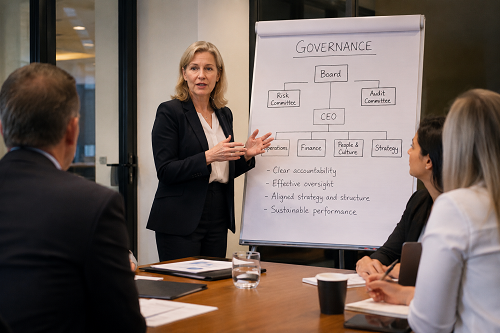
Research from the Institute of Directors has also highlighted how governance clarity and leadership structure improve organisational resilience and strategic effectiveness.
Organisations Often Benefit from Both
In practice, many organisations eventually benefit from both executive coaching and leadership consulting.
This happens because leadership challenges are rarely isolated completely.
For example:
A business may experience:
- communication problems
- accountability confusion
- leadership inconsistency
- operational fragmentation
Some of these issues may relate to leadership behaviour.
Others may relate to organisational structure.
Executive coaching may help leaders improve:
- communication
- emotional discipline
- strategic thinking
Leadership consulting may help strengthen:
- governance
- accountability systems
- organisational alignment
Together, these forms of support can improve both leadership capability and organisational performance simultaneously.
Executive Coaching Often Feels More Personal
Executive coaching relationships are usually highly confidential and personal.
Leaders often discuss:
- uncertainty
- emotional pressure
- strategic concerns
- behavioural challenges
The coaching relationship typically develops through:
- trust
- reflection
- honest discussion
- behavioural insight
This personal focus differentiates coaching significantly from consulting.
For more insight into leadership isolation and reflective support, see Leadership Loneliness.
Leadership Consulting Usually Feels More Operational
Consulting engagements often feel more structured and implementation-focused.
Leadership consultants may work on:
- organisational restructuring
- accountability systems
- reporting frameworks
- governance processes
The engagement usually involves clearer operational deliverables and organisational outcomes.
This project-based structure often differs from the more reflective nature of coaching relationships.
Coaching Helps Leaders Become Less Reactive
One major advantage of executive coaching is improved emotional discipline.
Many leaders spend most of their time responding to:
- organisational pressure
- communication issues
- operational problems
- stakeholder demands
Without reflection, leadership behaviour often becomes reactive.
Executive coaching helps leaders improve:
- composure
- patience
- communication consistency
- strategic clarity
This often strengthens organisational culture and leadership stability significantly.
Leadership Consulting Supports Scalable Growth
As businesses scale, leadership systems usually require greater structure.
Leadership consulting helps organisations strengthen:
- governance
- reporting visibility
- operational coordination
- accountability clarity
- strategic execution
This improves scalability and organisational resilience significantly over time.
For more insight into organisational development and scalable leadership structure, see Professionalising a 5–30 Person Business.
Research from Deloitte Insights has also explored how leadership development and governance maturity improve organisational scalability and long-term operational performance.

How Coaching and Consulting Connect with Broader Support
Executive coaching and leadership consulting often overlap with:
- governance advisory
- strategic planning
- organisational restructuring
- leadership mentoring
- operational consulting
Understanding these overlaps helps organisations apply the right support at the right stage of growth.
In more advanced situations, businesses may also benefit from broader support through Business Advisory for SME Owners.
Final Thoughts
So, what is the difference between an executive business coach and leadership consultant?
Executive coaching usually helps leaders improve:
- behaviour
- communication
- emotional discipline
- strategic awareness
Leadership consulting usually helps organisations improve:
- structure
- governance
- accountability
- leadership alignment
Ultimately, both forms of support become valuable because sustainable organisational growth depends on both effective leadership behaviour and strong organisational systems working together.