

As SMEs grow, leadership decisions often become increasingly complex.
Initially, founders and leadership teams may rely heavily on:
- instinct
- direct observation
- informal communication
- operational familiarity
During early stages, this may work reasonably well.
However, as organisations scale, businesses usually require more structured reporting and stronger governance visibility.
Without reliable information, leadership teams frequently experience:
- poor decision-making
- strategic blind spots
- accountability confusion
- governance weakness
This is why many organisations eventually begin focusing on information integrity and reporting at board level more seriously.
Because strong governance depends heavily on accurate, reliable and timely organisational visibility.
As complexity increases, businesses require stronger systems that improve:
- reporting accuracy
- accountability visibility
- strategic oversight
- governance discipline
- organisational clarity
Reliable information becomes increasingly valuable during periods of growth and operational complexity.
For a broader overview of governance structures and organisational oversight, see Governance vs Management: Clear Distinctions.
Governance Depends on Reliable Information
Boards and leadership teams can only make effective decisions when information remains trustworthy.
Without reliable reporting, businesses often operate reactively.
Leaders may make decisions based on:
- assumptions
- incomplete visibility
- outdated information
- inconsistent reporting standards
Over time, this frequently creates:
- strategic confusion
- operational inefficiency
- accountability gaps
- governance instability
Strong reporting systems therefore improve organisational resilience considerably.
Information Integrity Improves Strategic Oversight
One major purpose of board reporting is improving strategic visibility.
Leadership teams require reliable insight into:
- profitability
- operational performance
- organisational risks
- scalability pressures
- strategic priorities
Without accurate visibility, businesses often struggle evaluating organisational reality objectively.
Strong reporting frameworks therefore strengthen:
- governance quality
- strategic evaluation
- accountability clarity
- organisational alignment
This improves long-term decision-making significantly.
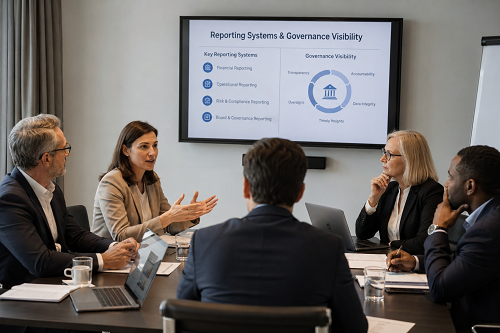
Poor Reporting Weakens Governance
Many SMEs initially operate with fragmented reporting structures.
Different departments may produce:
- inconsistent metrics
- unclear reporting formats
- incomplete visibility
- conflicting information
Without reporting consistency, governance quality usually weakens significantly.
Boards may struggle understanding:
- organisational performance
- operational risks
- strategic priorities
- accountability issues
Improving reporting integrity therefore becomes increasingly important as businesses scale.
Leadership Alignment Depends on Shared Visibility
Leadership coordination often weakens when executives rely on inconsistent information.
For example:
Different leaders may interpret:
- financial performance
- operational priorities
- growth trends
- staffing pressures
differently because reporting lacks consistency.
This frequently creates:
- fragmented decision-making
- strategic tension
- operational confusion
- accountability disputes
Strong reporting systems improve leadership alignment considerably by creating shared organisational visibility.
For more insight into leadership coordination and strategic alignment, see Coaching Senior Leadership Teams.
Governance Visibility Supports Better Decision-Making
Boards require visibility not only into performance, but also into organisational sustainability.
This often includes insight into:
- scalability pressures
- operational weaknesses
- governance risks
- leadership dependency
Without accurate information, businesses often react too late to emerging problems.
Strong reporting frameworks therefore support:
- proactive decision-making
- governance discipline
- organisational resilience
- long-term planning
For more insight into governance oversight and organisational resilience, see Risk Oversight Frameworks for SMEs.
Founder-Led Businesses Often Need Reporting Maturity
Many founder-led businesses initially rely heavily on direct operational oversight rather than structured reporting systems.
Initially, founders may personally observe:
- operational performance
- client relationships
- staffing issues
- financial activity
However, as organisations scale, this approach becomes increasingly difficult to sustain.
Strong reporting systems help businesses reduce excessive dependence on informal visibility and founder oversight.
Research from the Corporate Governance Institute has highlighted how reporting transparency and information integrity significantly improve governance quality and organisational accountability.

Reporting Integrity Supports Accountability
Strong accountability depends heavily on reliable information.
Without accurate reporting, organisations often struggle evaluating:
- leadership performance
- operational efficiency
- strategic execution
- organisational priorities
This may create:
- accountability confusion
- inconsistent evaluations
- operational tension
- governance weakness
Reliable reporting frameworks therefore strengthen organisational discipline significantly.
For more insight into accountability structures and governance clarity, see Defining Decision Rights in Leadership Teams.
Reporting Systems Must Remain Understandable
One common mistake businesses make is creating overly complicated reporting systems.
Boards do not simply require more information.
They require:
- relevant information
- clear visibility
- accurate interpretation
- strategic insight
Overly complex reporting often creates confusion rather than clarity.
Strong reporting frameworks therefore balance:
- simplicity
- visibility
- relevance
- governance value
This improves strategic usefulness considerably.
Information Integrity Builds Organisational Trust
Reliable information also strengthens organisational trust internally.
Leadership teams function more effectively when reporting remains:
- transparent
- consistent
- accurate
- credible
Poor reporting integrity often weakens:
- leadership confidence
- governance credibility
- accountability discipline
- organisational alignment
Strong information integrity therefore supports healthier organisational culture as well as governance.
Reporting Maturity Supports Scalability
As organisations scale, reporting maturity becomes increasingly important operationally and strategically.
Businesses that scale sustainably usually improve:
- reporting visibility
- governance oversight
- accountability clarity
- strategic evaluation
These capabilities help organisations manage increasing complexity more effectively.
Research from KPMG has also explored how governance reporting quality and organisational transparency improve leadership effectiveness and long-term business resilience.

How Reporting Integrity Connects with Broader Governance Support
Information integrity and board reporting often overlap with:
- governance advisory
- strategic management consulting
- leadership development
- organisational restructuring
- operational planning
Understanding these overlaps helps SMEs strengthen governance maturity more sustainably.
In more advanced situations, organisations may also benefit from broader support through Strategic Management & Governance for SMEs.
Final Thoughts
So, why does information integrity and reporting at board level matter?
Because strong governance depends heavily on accurate organisational visibility.
Reliable reporting improves:
- accountability
- governance oversight
- leadership coordination
- strategic clarity
- organisational resilience
- long-term sustainability
Ultimately, businesses make stronger strategic decisions when governance systems rely on accurate, consistent and trustworthy information rather than assumptions or fragmented visibility.