

Many SMEs focus heavily on growth, operations and commercial performance.
Initially, this makes complete sense.
Businesses often prioritise:
- sales growth
- client acquisition
- operational delivery
- profitability improvement
However, as organisations scale, risk exposure also increases significantly.
Operational complexity grows.
Leadership dependency becomes more visible.
Financial pressure may intensify.
Governance challenges emerge more clearly.
This is why many organisations eventually begin exploring risk oversight frameworks for SMEs and how stronger governance improves organisational resilience.
Because risk oversight is not simply about avoiding problems.
Strong frameworks help businesses improve:
- governance discipline
- decision-making quality
- organisational visibility
- strategic resilience
- long-term sustainability
As complexity increases, proactive oversight becomes increasingly important for stable organisational growth.
For a broader overview of governance and organisational oversight, see Governance Advisory for SMEs Explained.
Risk Exists in Every Growing Business
Many SMEs initially approach risk informally.
Founders often rely on:
- instinct
- experience
- reactive decision-making
- operational adaptability
During early growth stages, this may appear sufficient.
However, as businesses expand, risks become increasingly sophisticated and interconnected.
For example:
Businesses may face growing exposure involving:
- operational scalability
- leadership dependency
- financial sustainability
- governance gaps
- communication breakdowns
Without structured oversight, these risks may remain hidden until significant problems emerge.
Risk Oversight Improves Organisational Visibility
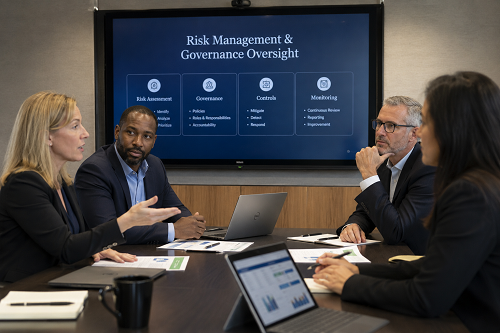
One major purpose of risk oversight is improving visibility.
Businesses require clearer understanding of:
- operational vulnerabilities
- governance weaknesses
- strategic exposure
- financial pressure points
Without strong visibility, leadership teams often make decisions reactively.
Risk oversight frameworks therefore help organisations improve:
- reporting clarity
- governance visibility
- strategic awareness
- organisational discipline
This usually strengthens decision-making quality considerably.
Operational Scalability Creates New Risks
Growth frequently introduces operational pressure faster than businesses expect.
Organisations may suddenly experience:
- staffing strain
- communication complexity
- inconsistent delivery
- leadership overload
Without proper oversight, operational risks often escalate quietly over time.
Risk oversight frameworks help organisations evaluate whether:
- systems
- leadership structures
- workflows
- accountability processes
can realistically support future growth.
For more insight into scalable organisational structure, see Professionalising a 5–30 Person Business.
Founder Dependency Is a Significant Risk Area
Many SMEs remain heavily dependent on founders operationally and strategically.
Initially, this may support agility.
However, over time, excessive founder dependency often creates:
- decision bottlenecks
- leadership exhaustion
- governance imbalance
- scalability limitations
Risk oversight frameworks help organisations strengthen:
- delegation systems
- accountability structures
- leadership development
- governance maturity
This reduces organisational fragility considerably.
For more insight into founder scalability and delegation, see Founder Delegation Systems.
Governance Weaknesses Often Remain Hidden
Governance problems rarely appear dramatically at first.
Instead, businesses may gradually experience:
- unclear accountability
- inconsistent decisions
- fragmented communication
- weak oversight structures
Over time, these weaknesses increase organisational vulnerability significantly.
Strong risk oversight frameworks therefore improve:
- governance clarity
- reporting systems
- decision-making discipline
- accountability visibility
For more insight into governance maturity and organisational oversight, see Board Structures for Growing Businesses.
Leadership Alignment Reduces Organisational Risk
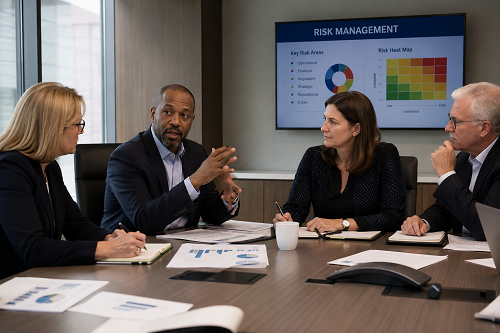
Leadership inconsistency frequently creates strategic and operational risk.
For example:
Different executives may prioritise:
- growth speed
- financial caution
- operational stability
- staffing expansion
without sufficient coordination.
This often creates:
- conflicting decisions
- fragmented priorities
- operational inefficiency
- governance tension
Risk oversight frameworks therefore often strengthen:
- communication clarity
- leadership coordination
- strategic alignment
- accountability discipline
Research from the Institute of Directors has highlighted how governance maturity and structured oversight significantly improve organisational resilience and long-term business sustainability.
Financial Visibility Is Critical
Strong risk oversight depends heavily on reliable financial visibility.
Businesses require accurate insight into:
- profitability
- cash flow sustainability
- operational costs
- investment exposure
Without strong reporting systems, financial risks may escalate unnoticed.
Risk oversight frameworks therefore often improve:
- financial reporting
- information integrity
- accountability visibility
- governance oversight
This improves organisational decision-making considerably.
For more insight into governance reporting and organisational visibility, see Information Integrity and Reporting at Board Level.
Strategic Risk Requires Long-Term Thinking
Many SMEs become heavily focused on immediate operational demands.
However, strong risk oversight requires broader long-term evaluation around:
- scalability
- leadership sustainability
- governance maturity
- market resilience
Without strategic thinking, businesses often become vulnerable to:
- reactive expansion
- poor prioritisation
- operational instability
- strategic drift
Risk oversight frameworks help organisations strengthen long-term resilience significantly.
For more insight into sustainable strategic planning, see Growth Planning Frameworks for SMEs.
Risk Oversight Improves Organisational Stability
Businesses with stronger oversight frameworks usually demonstrate:
- clearer governance
- stronger accountability
- better visibility
- improved strategic discipline
These capabilities help organisations manage uncertainty more effectively.
Importantly, strong risk oversight does not eliminate uncertainty completely.
Instead, it improves organisational readiness and resilience when challenges emerge.
Sustainable Businesses Build Governance Discipline Gradually
Risk oversight maturity rarely develops overnight.
Most SMEs strengthen governance progressively as organisational complexity increases.
This often involves improving:
- reporting systems
- leadership coordination
- accountability structures
- governance visibility
- strategic evaluation processes
Over time, these improvements significantly strengthen organisational sustainability.
Research from PwC has also explored how governance maturity and structured risk oversight improve long-term organisational resilience and strategic decision-making.

How Risk Oversight Connects with Broader Governance Support
Risk oversight frameworks often overlap with:
- governance advisory
- strategic management consulting
- leadership development
- operational planning
- organisational restructuring
Understanding these overlaps helps SMEs strengthen long-term organisational resilience more sustainably.
In more advanced situations, organisations may also benefit from broader support through Strategic Management & Governance for SMEs.
Final Thoughts
So, why do risk oversight frameworks matter for SMEs?
Because growing businesses require more than operational momentum and commercial performance alone.
Strong risk oversight frameworks improve:
- governance visibility
- accountability
- organisational resilience
- strategic discipline
- leadership coordination
- long-term sustainability
Ultimately, businesses become more resilient when governance evolves proactively alongside organisational growth and increasing complexity.